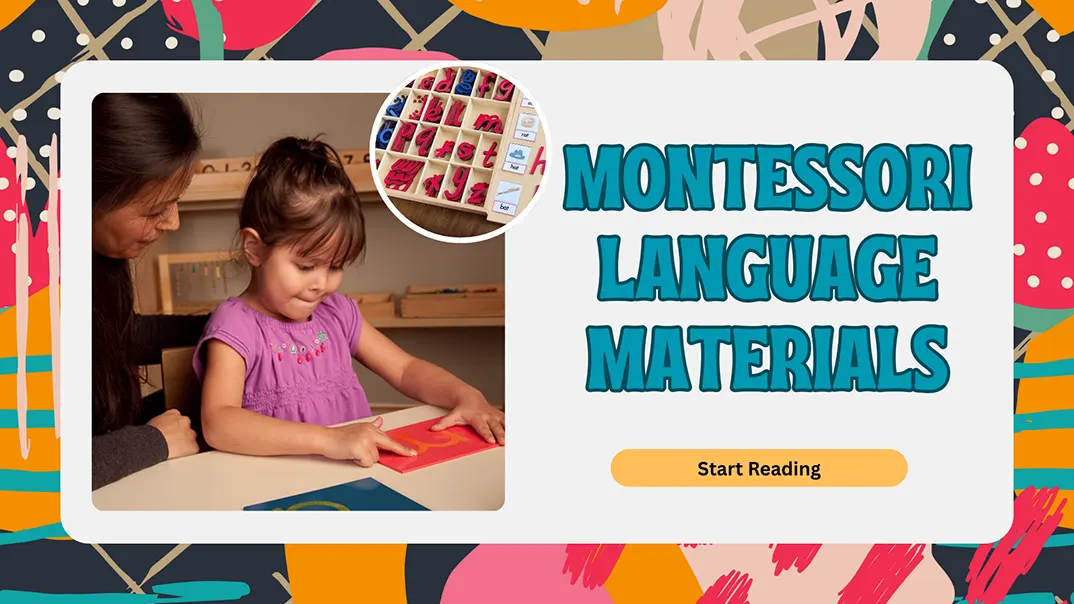
In many traditional classrooms, language learning starts with reading: children are taught to look at letters and memorize them. But the Montessori approach follows a different, more natural path, one that follows the child’s developmental timeline.
Dr. Maria Montessori observed that children are often ready to express words before they are ready to interpret them. This unique sequence is why Montessori Language Materials are designed the way they are. Montessori language starts with the spoken language to build vocabulary. Then, move to sound analysis using tools like the Sandpaper Letters and the Movable Alphabet. These materials allow children to physically ‘build’ their thoughts and words—a process Montessori called ‘writing’—which naturally lays the foundation for fluent reading later on.
For educators and school owners, understanding this specific sequence is key. It’s not just about buying the toys; it’s about creating a Prepared Environment where materials are introduced at the perfect moment. In this guide, we will break down the essential materials you need for each stage and how to display them to support this scientific journey to literacy.
What Are Montessori Language Materials?
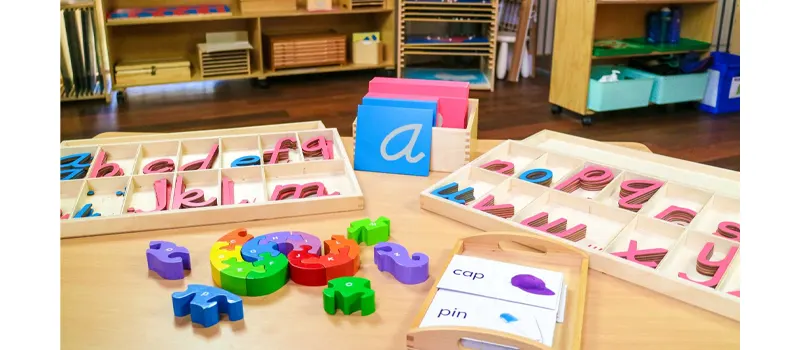
مواد لغة مونتيسوري are a clearly defined group of hands-on learning materials created to support the child’s natural process of language acquisition. Each material is intentionally designed to isolate a specific component of language and present it in a concrete, accessible form that a preschool child can explore independently.
At their core, Montessori Language Materials translate abstract aspects of language into physical experiences. Spoken sounds, written symbols, and word structures are introduced through touch, movement, and visual order rather than verbal explanation alone. This material-based approach allows children to build an internal understanding of language before formal reading and writing are expected.
The Characteristics of Montessori Language Materials
What distinguishes Montessori Language Materials is not how early they introduce reading or how quickly children produce written work, but how carefully they align with the way language actually develops in early childhood. These materials were not designed to deliver information. They were designed to create conditions in which language can take root through the child’s own activity.


1. Concrete Representation of Abstract Language
A defining characteristic of Montessori Language Materials is that abstract elements of language are given physical form. Sounds, symbols, and word structures, which cannot be seen or touched, are represented through concrete materials that children can manipulate directly. This is not done for engagement or novelty. It reflects the understanding that young children construct language through sensory experience before abstract reasoning is fully developed. By working with physical representations, children build internal language understanding through action rather than explanation.
2. Isolation of Difficulty
Montessori Language Materials are intentionally narrow in focus. Each material addresses a single aspect of language development and removes unnecessary complexity. This principle, known as isolation of difficulty, allows the child to concentrate fully on one concept at a time. Because of this, the materials may appear simple or limited at first glance. In reality, their simplicity is the result of careful design. When only one variable is present, the child can recognize patterns, relationships, and errors without confusion or overload.
3. Self-Directed and Self-Correcting
Montessori Language Materials support independent work. The materials are designed so that children can engage with them without continuous adult direction, allowing language learning to unfold at the child’s own pace. This independence does not remove the role of the teacher. Instead, it shifts the teacher’s role from constant correction to careful observation. Through built-in control of error, children are able to notice inconsistencies and make adjustments on their own, strengthening concentration and confidence.
4. Sensory Engagement
Montessori Language Materials are designed to stimulate the senses in a focused and purposeful way. Children trace, manipulate, listen, and speak as they work, strengthening the connection between sound, symbol, and meaning. This sensory integration supports stronger neural pathways and long-term retention during sensitive periods of language development.
5. Materials Follow a Clear Developmental Sequence
Montessori Language Materials are introduced in a deliberate order that reflects how language naturally develops. Spoken language is supported before symbols are introduced. Sound awareness precedes letter recognition. Writing preparation comes before formal reading. This sequence is not arbitrary and should not be reorganized for convenience or speed.
List of Essential Montessori Language Materials
In a Montessori classroom, language materials work together as a structured progression rather than isolated tools. Each essential material supports a specific stage of language development, helping children move from listening and speaking to writing and reading with clarity and confidence.
The Metal Insets
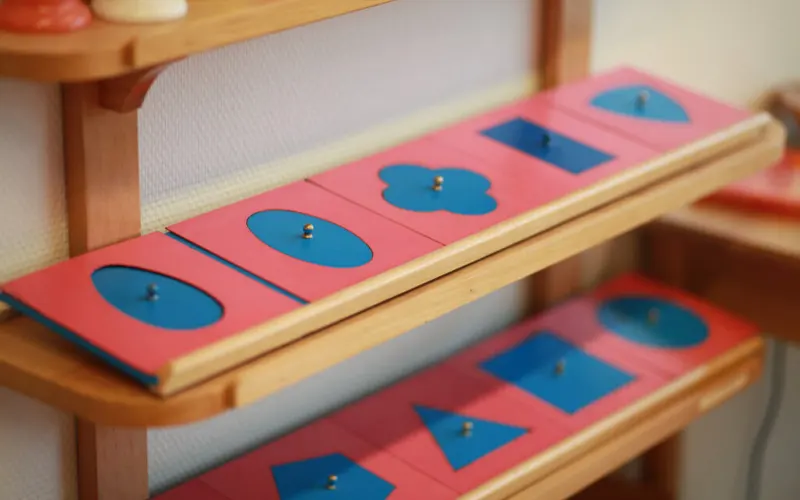
Often mistaken for art stencils, this is actually the primary tool for handwriting preparation. Metal insets are a set of geometric shapes housed in metal frames, designed for tracing with colored pencils. Their purpose is to develop hand control, precision, and muscle memory needed for writing. They prepare the physical skills required for letter formation without introducing letters prematurely.
How to apply: The child places the frame on a piece of paper and traces the interior shape with a colored pencil. Then, they use the inset to trace the exterior. Finally, and most importantly, they fill in the shape with parallel lines or zigzag patterns. This repetitive motion trains the muscles needed for writing letters later on.
The Sandpaper Letters
A set of smooth wooden boards with the letters of the alphabet cut out of fine sandpaper and glued to the center. Following the Montessori color code, consonants are on pink boards, and vowels are on blue boards. This material introduces written symbols through touch and movement. By combining tactile, visual, and auditory input, sandpaper letters help children internalize sound-symbol relationships before formal writing or reading begins.
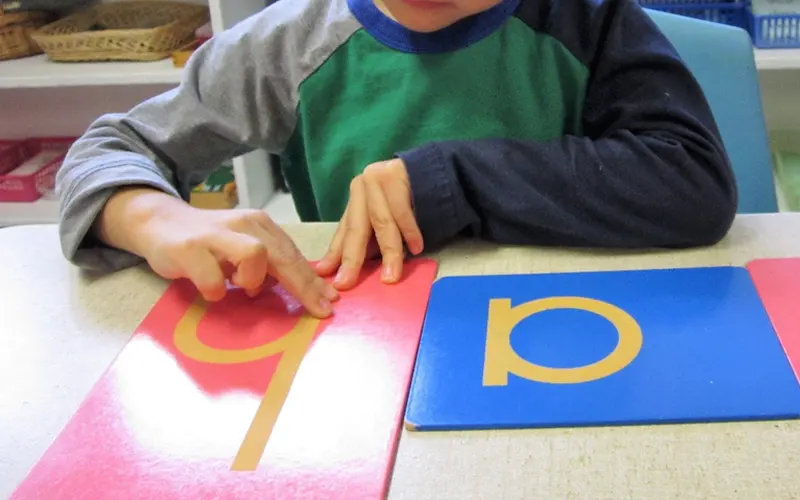
How to apply: The teacher introduces 2-3 letters at a time using the Three-Period Lesson. The child traces the letter with their two index fingers (writing fingers) while making the phonetic sound of the letter (e.g., “mmmmm”, not “em”).
The Large Movable Alphabet (LMA)
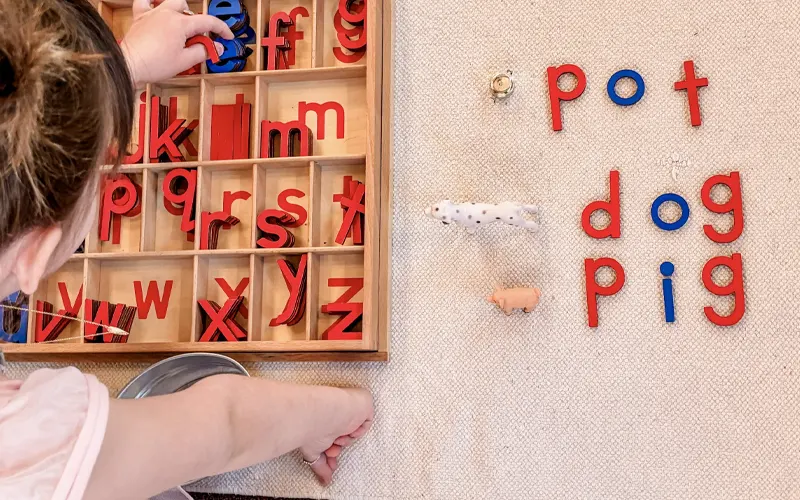
A large partitioned wooden box containing multiple cut-outs of every letter in the alphabet. Like the Sandpaper Letters, vowels are blue, and consonants are pink (or red). To allow the child to “write” (encode) words without the physical struggle of handwriting. Since their hand muscles (trained by Metal Insets) might not be ready yet, the LMA frees their mind to focus solely on the analysis of sounds.
How to apply: The teacher provides an object (e.g., a toy cat). The child says the word slowly (“c-a-t”), isolates the sounds, finds the corresponding letters from the box, and places them in order on the rug. They are building their thoughts visibly.
The Object Boxes (Phonetic Object Boxes)
A box or basket containing a collection of small, realistic miniature objects (e.g., a tiny fan, a cup, a bag, a pig) along with corresponding paper labels. To transition the child from analyzing sounds to reading meanings. It validates that the symbols on the paper correspond to real things in the physical world.
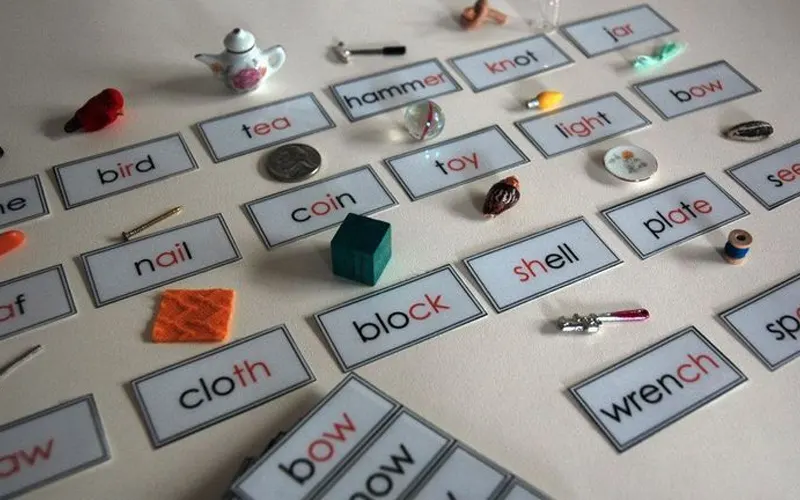
How to apply: The child reads a label (e.g., “bus”), decodes the sounds, and then finds the matching miniature object to place next to it. This physical matching action provides an immediate “check” of understanding.
The Grammar Symbols
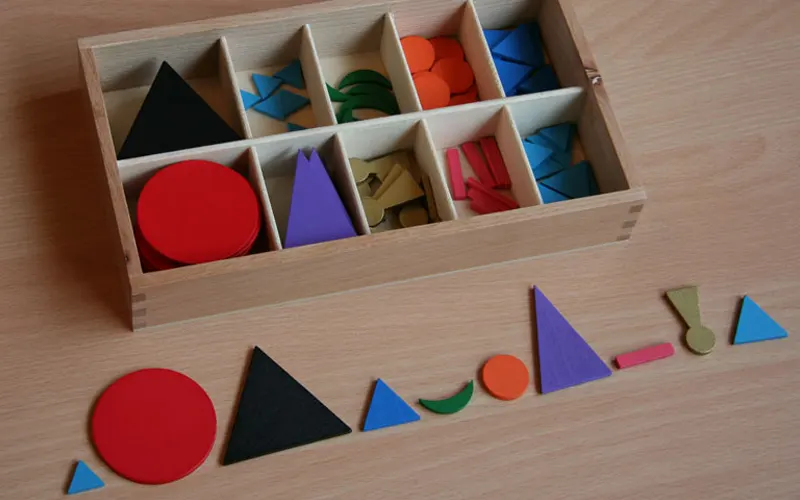
A set of 3D solids or 2D wooden cut-outs representing parts of speech. Each part of speech has a specific shape and color (e.g., The Noun is a black pyramid; the Verb is a red sphere). To make abstract grammatical concepts concrete. A noun is stable and static (Pyramid); a verb is energetic and moves (Sphere/Ball). This gives children a deep, intuitive understanding of sentence structure.
How to apply: Children place these symbols above words in a sentence strip to analyze the function of each word. For example, over the word “Run,” they would place the red circle (Verb).
Nomenclature Cards (Three-Part Cards / Classified Cards)
A set of cards consisting of three parts:
- The control card (Image + Word together).
- The picture card (Image only).
- The label card (Word only).
To enrich the child’s vocabulary and classify the environment (e.g., Parts of a Leaf, Types of Birds, Kitchen Utensils). They move from simple identification to reading practice.
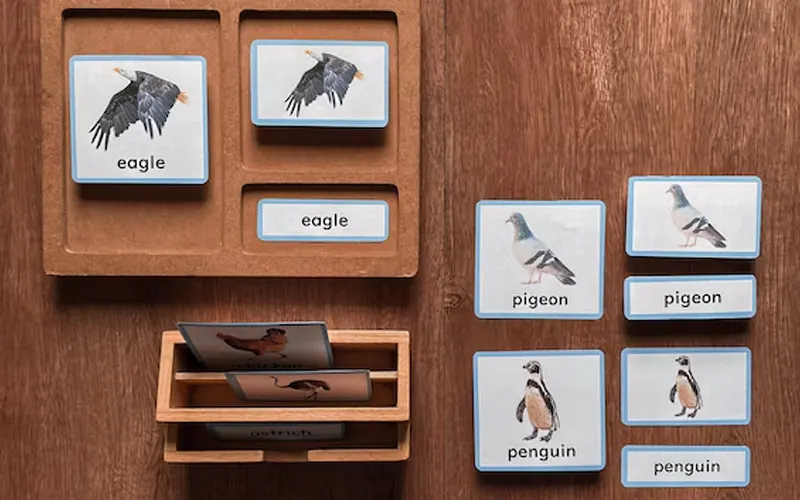
How to apply: Younger children match the picture to the picture. Older children (readers) match the label to the picture, and then use the “Control Card” to check their own work without needing a teacher.
Why Are Language Materials in Montessori Important?
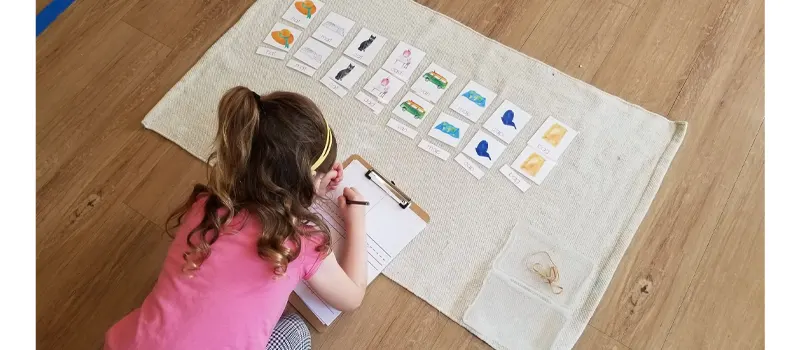
Dr. Maria Montessori discovered that children from birth to age six possess an “Absorbent Mind.” They soak up language from their environment effortlessly, like a sponge soaking up water. However, this absorption isn’t passive. It requires tremendous active effort from the child. The importance of Montessori language materials lies in their role as the “keys” to the world. They are not mere toys to keep a child busy; they are scientifically devised instruments that structure this intense period of absorption.
From Abstract Language to Concrete Experience
Language is inherently abstract, but the young child is a “sensorial learner” who needs physical interaction to truly grasp new concepts. Montessori materials bridge this gap by turning sounds and symbols into tangible experiences. This tactile feedback creates stronger, multi-sensory neural pathways, leading to deeper retention than mere visual memorization ever could.
Self-Correction as the Foundation of Independent Learning
Montessori materials are designed with a built-in “control of error” that allows the child to discover mistakes on their own. This critical feature shifts the focus from seeking external validation to developing internal motivation; when a child can self-correct a matching exercise without adult intervention, they build self-confidence, resilience, and a genuine love for learning.
A Developmental Roadmap That Prevents Frustration
Language acquisition is a complex architectural process, and Montessori language materials provide a precise developmental roadmap to ensure no foundational steps are skipped. By isolating specific skills—such as mastering mechanical hand control with the Metal Insets long before being forced to write with a pencil—the materials prevent the frustration and discouragement often seen in conventional education when children are pushed beyond their current developmental readiness.
How to Choose High-Quality Montessori Language Materials?
In a professional Montessori classroom, material quality is measured by how accurately a material supports the language sequence, how reliably it functions over time, and how well it serves the child without constant adult mediation. The following considerations help distinguish truly high-quality Montessori language materials from superficial imitations.
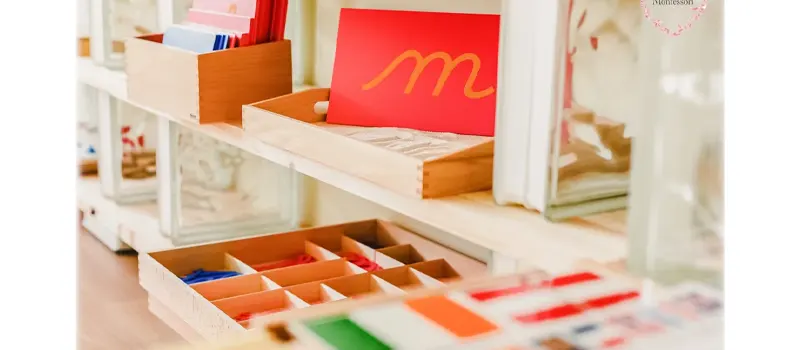
Material Quality and Craftsmanship
High-quality Montessori language materials are built for repeated, long-term classroom use. Precision should remain consistent over time. If a material warps, peels, loses alignment, or becomes unsafe, it fails regardless of its educational intent.
When evaluating materials, pay close attention to construction details. Surfaces should be smooth and child-safe, tactile elements such as sandpaper letters must be firmly attached, and cards should be thick enough to resist bending. Print quality should remain clear after frequent handling. These details directly affect whether a material can function independently and accurately throughout the school year.
Accuracy of Language Content
Language accuracy is non-negotiable. Errors in phonetics, spelling, or visual representation directly interfere with language development and are difficult to correct once internalized.
Before purchasing, verify that phonetic words follow correct sound patterns, spelling rules are consistent across related materials, and images are realistic and unambiguous. Objects, pictures, and labels must correspond precisely. Materials that mix phonetic rules or rely on unclear imagery often create confusion that undermines confidence and progress.
Child-Sized Design and Ease of Handling
A well-designed Montessori language material should feel intuitive in a child’s hands. Components must be sized so children can pick them up, place them accurately, and return them to the shelf without assistance.
If a child needs frequent help simply to manipulate the material, the design is working against concentration and independence. Ease of handling is not a convenience; it is a functional requirement that determines whether language work can remain self-directed.
Built-In Control of Error
High-quality Montessori language materials allow children to recognize and correct mistakes on their own. This control of error should be embedded in the physical design of the material, not dependent on adult confirmation.
When evaluating a product, consider whether the correct outcome is visually or structurally evident and whether the child can check accuracy independently. Materials that rely entirely on adult correction shift learning back into a teacher-led model and lose a core Montessori function.
Work With Manufacturers Who Truly Understand Montessori Education
Beyond the material itself, the understanding of the manufacturer or supplier plays a critical role. Montessori language materials are not generic educational products. Their effectiveness depends on precise proportions, correct sequencing logic, and consistency across the entire language material system. Choosing a supplier who truly understands Montessori education is not just a sourcing decision. It is a safeguard for material integrity and for the effectiveness of the language program as a whole.
الأسئلة الشائعة
How Are Montessori Language Materials Different from Traditional Literacy Materials?
Traditional literacy materials often rely on direct instruction, worksheets, or group lessons. Montessori language materials are designed for independent use, emphasize sensory engagement, and allow children to discover language concepts through interaction rather than explanation.
At what age are Montessori language materials introduced?
Montessori language materials are introduced based on developmental readiness rather than age. Oral language and sound games may begin very early, while materials for reading and writing are introduced gradually as the child demonstrates readiness.
How many Montessori language materials does a classroom really need?
Quality matters more than quantity. A smaller, well-curated set of materials that are accurate, complete, and correctly sequenced is more effective than a large collection of mixed-quality items.
How should Montessori language materials be stored and organized?
Materials should be stored in clearly organized boxes or trays that allow children to access and return them independently. Proper organization supports concentration, order, and repeated use.
What is the first language material introduced in Montessori?
The first language work in Montessori is not a physical material, but oral language activities, often referred to as sound games. These activities focus on listening, speaking, and sound awareness, helping children become conscious of the sounds within words before any symbols or letters are introduced. Only after children develop strong spoken language and auditory discrimination are physical language materials, such as sandpaper letters, introduced. This sequence ensures that written language is built on a solid foundation of sound awareness rather than memorization.
خاتمة
Montessori language materials are not defined by how familiar they look or how widely they are sold, but by how precisely they support the child’s natural construction of language. When viewed as a system rather than a collection, these materials reveal their true purpose: guiding children from spoken language to reading and writing through concrete, orderly, and independent work.
Throughout this article, one theme remains consistent: quality and understanding matter. Materials that lack precision, durability, or linguistic accuracy may resemble Montessori products on the surface, but they often fall short in real classroom use. Thoughtful selection, correct sequencing, and attention to how materials function day after day are what ultimately determine their value.
This philosophy closely aligns with the approach of شيها كيدز. Rather than treating Montessori materials as generic educational products, Xiha Kidz approaches material design and production with a clear respect for Montessori principles, classroom realities, and long-term use. The focus is not only on how materials look, but on how they work together as part of a complete learning environment.


 Arabic
  English
  French
  Italian
  German
  Spanish
  Thai
Thai  Japanese