
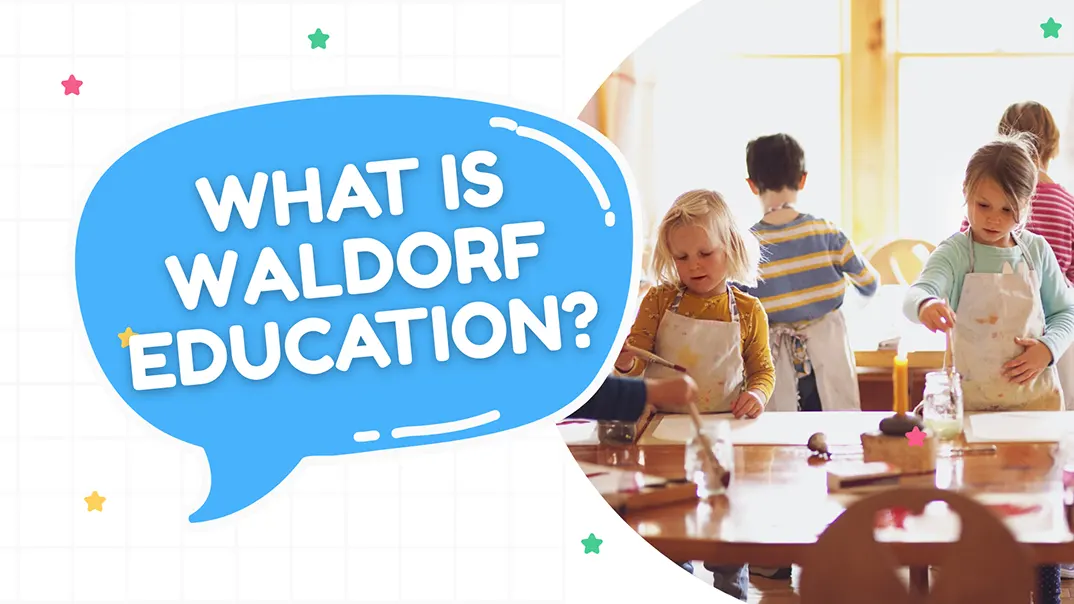
Waldorf Education is a development-focused educational approach that integrates intellectual learning with emotional growth, creativity, and practical life skills. It is based on the belief that children learn best when education respects their natural developmental rhythms.
Rather than separating academics, arts, and movement, Waldorf Education weaves them together into a cohesive learning experience. Storytelling, music, handwork, and imaginative play are not extras but essential tools for learning and self-expression.
As more families look for alternatives to traditional education, Waldorf education often raises questions and curiosity. This article provides a clear explanation of what Waldorf education is, how it works, and how it compares with other educational approaches.
The Origins of Waldorf Education
Waldorf education originated in Germany in the early twentieth century, emerging from the social and cultural changes that followed World War I. The approach was developed by Rudolf Steiner, an Austrian philosopher and educator who believed that education should support the full development of the human being rather than focus solely on academic achievement. His ideas responded to concerns that industrialization and rigid schooling systems were neglecting children’s emotional, creative, and moral growth.

The first Waldorf school was founded in 1919 in Stuttgart for the children of workers at the Waldorf Astoria Cigarette Factory. Steiner was invited to design a school that would offer equal educational opportunities to all children, regardless of social background. This original school became the model for Waldorf education, emphasizing age-appropriate learning, strong teacher-student relationships, and an education rooted in human development rather than standardized outcomes.
From this single school, Waldorf philosophy gradually spread to other parts of Europe and later to North America, Asia, and Australia. Over time, the approach has adapted to different cultural contexts while maintaining its core focus on holistic development, imagination, and meaningful learning experiences. Today, the origins of Waldorf education continue to influence how its schools structure curriculum, teaching methods, and classroom environments around the evolving needs of children.
The Foundations of Waldorf Education
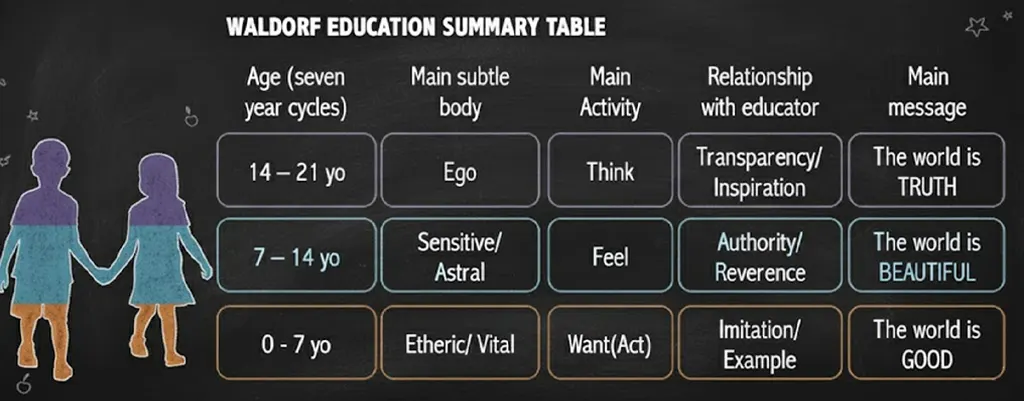
Waldorf education is founded on the view that childhood develops in clearly defined stages, and that education should evolve in response to these stages. Rather than applying the same expectations at every age, Waldorf philosophy aligns learning experiences with how children think, feel, and relate to the world at different points in their development. This developmental perspective shapes curriculum design, teaching methods, and classroom life across all age groups.
Early Childhood (Ages 0–7)
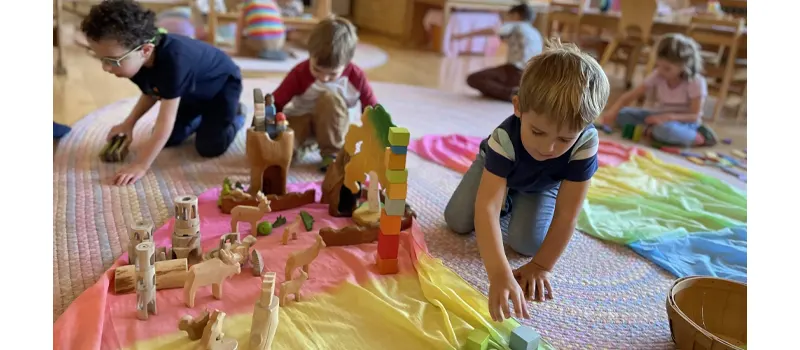
In early childhood, Waldorf education views the young child as an imitator who learns primarily through sensory experience, movement, and the example of trusted adults. For this reason, the kindergarten or preschool classroom is homelike rather than academic. You will find natural materials, simple toys without batteries, plenty of time for free play, and daily participation in real activities such as cooking, cleaning, gardening, and caring for the classroom. These activities are not seen as extras. They are considered the core curriculum for the young child.
Instead of formal reading and writing lessons, Waldorf education in the early years offers rich oral language through songs, verses, and stories told by the teacher. Rhythm is central. Each day follows a clear pattern, and each week and season has its own repeated activities and festivals. This steady rhythm gives young children a sense of security and helps them build healthy habits of attention, social interaction, and self-care.
Creative play is highly valued because it allows children to process their experiences and to build imagination, problem-solving skills, and social awareness. In a Waldorf early childhood setting, you are more likely to see children building a ship from chairs and cloths or acting out a story together than sitting at desks with worksheets. Waldorf education believes that when early childhood is protected and allowed to unfold in this way, academic learning later on becomes deeper, more joyful, and more secure.
Middle Childhood (Ages 7–14)
In middle childhood, roughly the primary school years, Waldorf education shifts toward more structured academic work while still keeping a strong artistic and imaginative element. Children at this age are understood to live strongly in their feeling life. They are hungry for stories about the world and about human beings, and they care deeply about fairness, loyalty, and relationships. Waldorf teachers meet this by teaching subjects through narrative, pictures, and hands-on work that speak to the child’s emotions as well as the intellect.
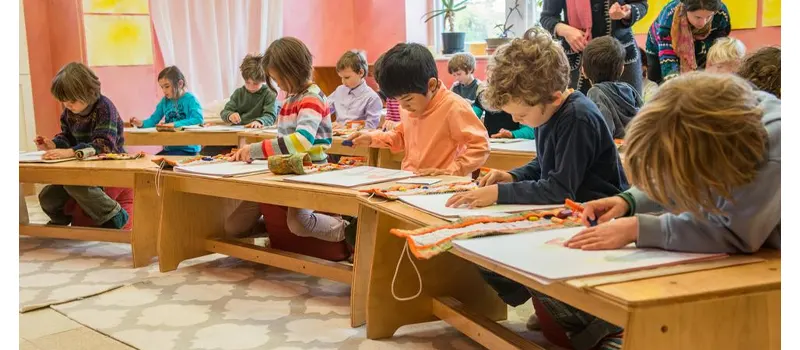
A central practice in Waldorf education during these years is the main lesson block. Each morning begins with a two-hour main lesson focused on one subject, such as mathematics, language arts, history, or science, which is studied intensively for several weeks. Within this time, the teacher weaves together oral teaching, storytelling, movement, music, drawing, and writing. Instead of using standard textbooks, children create their own main lesson books filled with written work and illustrations. This process asks them to digest and recreate what they have learned, which supports deeper understanding.
Social life also becomes more prominent in middle childhood, and Waldorf education pays close attention to class community. The class teacher often stays with the same group of children for several years, building long-term relationships and guiding the group through conflicts and developmental changes. Through group work, class plays, shared projects, and festivals, children learn to cooperate, to take responsibility, and to see themselves as part of a community. These experiences form an important foundation for the more independent thinking that will come in adolescence.
Adolescence (Ages 14–21)
In adolescence, Waldorf education recognises a major shift. Teenagers begin to think more critically and abstractly, and they seek truth, authenticity, and real-world meaning. The task of education at this stage is to support clear, independent thinking while still nourishing the young person’s sense of purpose and social responsibility. Waldorf high schools respond by increasing academic rigour, encouraging discussion and debate, and connecting lessons more directly with contemporary issues and practical work.
Subjects such as mathematics, literature, history, and science are taught in greater depth, and students are invited to question, argue, and explore ideas from multiple angles. Waldorf education places a strong emphasis on phenomenological science, where students first observe and describe natural phenomena before moving to theories and formulas. This approach is meant to strengthen their ability to think for themselves, to notice details, and to form sound judgments rather than simply memorising information.
At the same time, the arts and practical subjects remain central in adolescence. Drama, music, painting, crafts, community service, and internships all play a role in helping students explore their own capacities and interests. Waldorf education sees this as essential preparation for adult life. The aim is that young people leave school not only with academic skills, but also with resilience, creativity, social awareness, and a sense of inner direction.
Core Principles of Waldorf Education
The core principles of Waldorf Education guide how learning environments are designed, how teachers teach, and how children experience school. These principles are not isolated rules but interconnected ideas that shape a coherent and developmentally respectful approach to education.
Child Development Comes First
Waldorf Education is grounded in the principle that teaching should follow the child’s developmental needs rather than external academic standards. Cognitive, emotional, physical, and social growth are seen as equally important and closely linked.
Curriculum planning is therefore aligned with developmental readiness. Skills such as reading, writing, and abstract reasoning are introduced when children are prepared to engage with them meaningfully, supporting deeper understanding and long-term confidence.
Learning Through Rhythm and Repetition
Daily, weekly, and seasonal rhythms are a defining principle of Waldorf Education. Predictable routines create a sense of security that allows children to relax and focus their energy on learning and exploration.
Rhythm is reflected in classroom structure, storytelling patterns, artistic activities, and celebrations tied to the natural year. This regularity supports self-regulation, attention, and emotional balance, especially in early childhood.
Imagination as a Foundation for Learning
Waldorf Education places strong value on imagination as a pathway to understanding the world. Especially in the early years, children learn primarily through images, stories, movement, and creative play.
Rather than abstract explanations, concepts are introduced through experience and narrative. This approach helps children form rich inner images, which later support critical thinking and independent reasoning.
Integration of Arts and Practical Activities
Another key principle of the Waldorf method is the integration of artistic and practical activities across all subjects. Music, drawing, painting, handicrafts, movement, and crafts are not treated as extras but as essential learning tools.
By engaging the body and emotions alongside the intellect, children develop coordination, perseverance, creativity, and a sense of purpose in their work. Learning becomes active and meaningful rather than purely theoretical.
Respect for Childhood and a Gentle Pace
Waldorf Education emphasizes protecting childhood as a distinct and valuable stage of life. Early years focus on play, imitation, and real-world experiences rather than early academic acceleration. This gentle pace allows children to build strong foundations in curiosity, resilience, and social understanding. Academic learning is approached as a natural progression rather than a race.

The Role of the Teacher as Guide and Model
In Waldorf Education, teachers are viewed as role models whose presence, actions, and attitudes influence learning as much as direct instruction. Warmth, consistency, and attentiveness are considered essential teaching qualities. Teachers guide learning through example, storytelling, and carefully prepared environments, helping children develop trust, independence, and intrinsic motivation.
A Human Centered Educational Philosophy
The principles of Waldorf Education were shaped by the educational ideas of Rudolf Steiner, who emphasized educating the whole human being. While modern Waldorf schools adapt to contemporary contexts, these core principles continue to inform how learning is approached in a human-centered and developmentally aware way.
What Are the Four Elements of Waldorf?

In Waldorf Education, the phrase “four elements of Waldorf” is often used to describe a traditional framework of four temperaments that are loosely connected to the classical elements. The four temperaments are choleric, sanguine, melancholic, and phlegmatic, commonly linked with fire, air, earth, and water. In many Waldorf settings, this idea is used as a practical lens for observing children’s tendencies and supporting their needs with balance, rhythm, and appropriate activities.
It is important to understand that in modern Waldorf practice, temperament is not meant to label a child or predict who they will become. Instead, it helps teachers and parents notice patterns, respond with empathy, and provide experiences that strengthen what the child needs most.
Choleric (Fire)
Choleric children are often energetic, decisive, and strong-willed. They may naturally take the lead, move quickly into action, and show intense emotions when something feels unfair or blocked. In a classroom, they often benefit from clear boundaries, purposeful responsibilities, and healthy outlets for physical energy.
Waldorf teachers may support choleric tendencies through meaningful movement, outdoor work, and tasks that require courage and follow-through, such as carrying materials, helping set up activities, or taking on structured leadership roles. The goal is not to reduce their strength, but to guide it into constructive, socially aware action.
Sanguine (Air)
Sanguine children are often cheerful, social, and curious. They may shift attention quickly, enjoy variety, and feel energized by conversation and group activity. In a learning environment, they often benefit from rhythm, gentle repetition, and engaging experiences that help them stay connected without constant novelty.
Waldorf classrooms may support sanguine children through songs, circle time, storytelling, and artistic work that offers lively participation while still building focus. Short, varied activities inside a predictable daily structure can help them feel satisfied and steady at the same time.
Melancholic (Earth)
Melancholic children are often sensitive, thoughtful, and deeply observant. They may care strongly about fairness, details, and meaning, and can become discouraged if they feel misunderstood or if a task feels imperfect. In school, they often benefit from warmth, patience, and learning experiences that honor depth rather than speed.
Teachers may support melancholic children through calm storytelling, careful handwork, nature observation, and tasks that allow attention to detail. A peaceful, consistent environment helps them feel safe, while encouragement focuses on progress and purpose rather than perfect results.
Phlegmatic (Water)
Phlegmatic children are often calm, steady, and comfort-seeking. They may enjoy routine, move at a slower pace, and prefer observing before participating. In a classroom, they often benefit from gentle encouragement, clear structure, and activities that invite engagement without pressure.
Waldorf teachers may support phlegmatic tendencies through consistent rhythms, practical life work, and group activities that naturally draw them in, such as baking, gardening, or cooperative projects. Predictable routines help them feel secure, while gradual invitations to participate strengthen initiative and confidence.
How Waldorf Educators Use This Framework?
In Waldorf Education, the temperament framework is most useful when it leads to balanced support. A teacher might adjust pacing, seating, responsibilities, and activity choices to help each child practice skills they need, such as patience, courage, focus, or flexibility. The intention is always developmental and compassionate.
Many educators also recognize that children rarely fit only one temperament. A child may show different traits at different ages, in different settings, or even at different times of day. That is why in Waldorf Education, observation and relationship come first, and the framework stays secondary.
Benefits of Waldorf Education
Waldorf Education offers a wide range of benefits that extend beyond academic achievement. Its strengths lie in supporting the whole child and fostering long-term qualities that influence how children learn, relate to others, and engage with the world.

1. Whole-Child Development
Waldorf education is designed to nurture every aspect of a child’s being: the head (thinking), the heart (feeling), and the hands (doing). Academic learning is thoughtfully balanced with movement, artistic expression, and practical life skills. This integrated model supports the development of emotional intelligence, physical coordination, and moral awareness alongside intellectual growth.
2. Strong Imagination and Creativity
One of the hallmarks of Waldorf education is its deep commitment to imaginative play and artistic exploration. From early childhood through adolescence, students engage in music, painting, drama, handicrafts, and storytelling. These experiences not only foster creativity but also strengthen problem-solving skills and the ability to think outside the box.
3. Deep Connection with Nature
Outdoor play and seasonal rhythms are essential parts of the Waldorf curriculum. Children are encouraged to observe natural changes, engage with the environment, and develop a sense of wonder about the world. This connection cultivates mindfulness, environmental stewardship, and a grounded, healthy lifestyle.
4. Emotional Security and Confidence
The continuity between teachers and students in Waldorf classrooms helps build trust and strong relationships. A consistent teacher who knows each child well creates a safe space for learning and emotional growth. This support system empowers students to express themselves freely and grow in confidence.
5. Reduced Stress and Pressure
In the early grades, Waldorf education avoids high-stakes testing and academic pressure. Instead, it emphasizes experiential learning and inner motivation. Children are allowed to develop at their own pace without being compared to peers or subjected to rigid benchmarks, reducing stress and promoting a lifelong love of learning.
6. Critical Thinking and Independent Learning
As students progress through the Waldorf system, they are gradually introduced to more abstract and analytical thinking. Lessons are designed to encourage inquiry, discussion, and independent thought. By the time they reach adolescence, Waldorf students are typically confident in forming their own opinions and exploring complex ideas with depth and integrity.
7. Lifelong Passion for Learning
Because Waldorf education engages the whole child and honors the learning journey, it often produces students who are deeply curious and intrinsically motivated. They view learning as a joyful and meaningful process, not just a task to complete, but a way of understanding and connecting with the world.
Challenges and Criticisms of Waldorf Education
While the Waldorf method has gained recognition for its holistic and child-centered approach, it is not without its critics. Like any educational model, it presents certain challenges and may not align with the expectations or needs of every family or student. Understanding these limitations is important for making informed decisions about a child’s education.

1. Limited Exposure to Technology
One of the most commonly cited criticisms of the Waldorf method is its cautious approach to technology, especially in the early grades. Waldorf schools typically discourage the use of screens and digital devices in the classroom and often advise families to do the same at home. While this aligns with the philosophy of promoting hands-on, real-world experiences, some parents worry that delayed exposure may leave children underprepared for a digitally-driven world.
2. Delayed Academic Instruction
Waldorf education places little emphasis on early reading, writing, and mathematics, instead focusing on imaginative play and experiential learning in the early years. This developmental approach has benefits, but it can concern parents who expect strong academic foundations to be laid earlier. Some students may initially fall behind their peers in conventional schools.
3. Teacher Continuity and Subject Depth
In Waldorf elementary education, it is common for the same teacher to guide a class for several years. While this builds strong relationships, some critics question whether one teacher can effectively teach all subjects with equal depth and expertise. This model may also present difficulties if the student-teacher dynamic is not a good fit, potentially affecting the child’s learning experience over multiple years.
4. Anthroposophical Foundations
Waldorf education is rooted in Rudolf Steiner’s philosophy of anthroposophy, a spiritual worldview that is not always explicitly discussed in classrooms but informs the structure and rhythm of the curriculum. Some critics argue that this underlying philosophy lacks transparency or a scientific basis, raising questions about its role in a secular educational context. Others may feel uncomfortable with the spiritual tone woven into certain school traditions and festivals.
5. Limited Standardization and Assessment
Standardized testing and formal grading are generally absent in Waldorf schools, especially in the early years. While this reduces academic pressure and fosters intrinsic motivation, it also means that parents and educators have fewer conventional metrics to evaluate student progress.
How Waldorf Education Differs From Other Educational Approaches?
Waldorf Education is often discussed alongside other alternative education models, but its philosophy, classroom practices, and goals differ in important ways. Understanding these differences helps parents and educators make clearer, more confident decisions based on how children actually learn and develop.
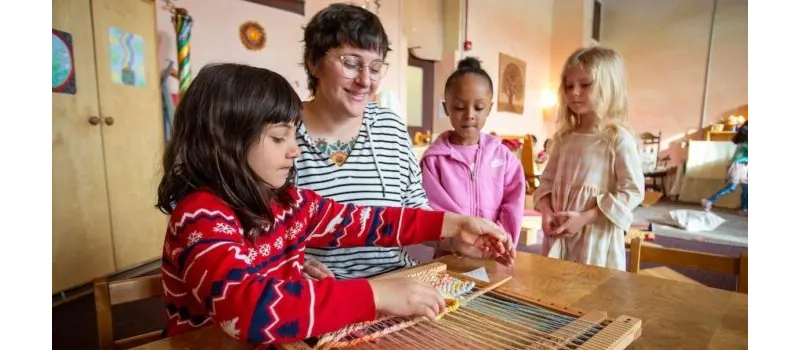
Waldorf Education vs Traditional Education
The most visible difference between the Waldorf method and traditional education lies in pace and priorities. Traditional systems tend to emphasize early academics, measurable outcomes, testing, and standardized benchmarks.
Waldorf Education takes a slower, development-based approach. Academic skills are introduced when children are considered developmentally ready, and learning is evaluated through observation, work samples, and teacher insight rather than frequent testing. The focus is placed on long-term understanding, emotional well-being, and intrinsic motivation rather than short-term performance.
Waldorf Education vs Montessori Education
Both Waldorf and Montessori Education respect child development and value hands-on learning, but they differ significantly in structure and teaching style. Montessori classrooms emphasize individual choice, self-directed work, and carefully designed materiali didattici that guide children toward specific academic concepts.
Waldorf Education places greater emphasis on imagination, storytelling, rhythm, and group experience. Teachers lead lessons more actively, especially in early years, and learning unfolds through shared artistic, social, and practical activities. Where Montessori highlights independence through choice, Waldorf emphasizes connection, imitation, and shared rhythm.
Waldorf Education vs the Reggio Emilia Approach
The Reggio Emilia approach views children as capable researchers and places strong emphasis on project-based learning, documentation, and child-initiated inquiry. Learning topics often emerge from children’s interests and evolve through exploration and collaboration.
Waldorf Education follows a more predictable rhythm and curriculum structure shaped by developmental stages. While creativity and expression are central, teachers guide content intentionally rather than building curriculum primarily from spontaneous projects. The Waldorf approach values continuity, tradition, and rhythm more strongly than open-ended curriculum design.
Domande frequenti
How does Waldorf handle screen time?
Waldorf Education generally limits screen time, especially in early childhood, to protect imagination, attention, and sensory development. Learning focuses on hands-on activities, storytelling, movement, and real-world experiences. Technology is usually introduced later in a developmentally appropriate way.
Is Waldorf Education suitable for all children?
Waldorf Education supports many children, particularly those who benefit from creative learning, steady rhythms, and strong relationships. However, it may not suit children who prefer early academics, highly structured instruction, or frequent testing. Individual learning style and family expectations matter.
How can parents support Waldorf Education at home?
Parents can support Waldorf Education by maintaining daily rhythms, encouraging imaginative play, and limiting screen exposure in early years. Simple activities such as storytelling, outdoor play, and shared practical tasks help reinforce classroom values.
What religion is Waldorf based on?
Waldorf education is not a religious system. It was influenced by the philosophical ideas of its founder, but Waldorf schools themselves are non-denominational and inclusive. The educational approach focuses on human development, creativity, ethics, and respect for others rather than religious instruction, and it welcomes families from diverse cultural and belief backgrounds.
Conclusione
Waldorf Education offers a thoughtful and developmentally respectful approach to learning that places equal value on intellectual growth, emotional well-being, creativity, and practical life skills. By following the natural stages of childhood, it seeks to protect curiosity and build strong foundations for lifelong learning rather than focusing on early academic pressure.
Ultimately, choosing Waldorf education is a personal decision that depends on a child’s learning style, family values, and educational priorities. By thoughtfully considering its foundations, principles, benefits, and challenges, parents and educators can determine whether Waldorf education aligns with their vision for a balanced and meaningful educational journey.




 Italian
  English
  Arabic
  French
  German
  Spanish
  Thai
Thai  Japanese