
Setting up a preschool math center is a process of planning the space, selecting the right tools, and building routines children can follow. Choose a quiet and visible area, use open shelves and defined work spots, and provide rotating hands-on activities that target early math skills. This is the foundation of an effective preschool math center.
The environment matters as much as the materials. When the layout supports choice and cleanup, children can practice math without waiting for an adult. That independence also frees teachers to observe, take notes, and offer targeted support.
This article walks you through a step-by-step setup process, plus practical organization and rotation strategies so your preschool math center stays effective all year.
Goals and Benefits of the Preschool Math Center
A well-designed preschool math center acts as a crucial environment for early cognitive development. The primary goal of this space is to transform abstract mathematical concepts into tangible experiences. Teachers use this area to encourage students to explore numbers, shapes, and measurements through direct physical interaction. When children engage with materials in a designated zone, they can focus their attention and develop a positive attitude toward learning.

1. Supporting Early Math Skill Development
The main goal of a preschool math center is to introduce mathematical thinking through hands-on, concrete activities. By using visual and tactile materials, children begin to understand key concepts such as counting, sorting, comparing, and sequencing. These foundational skills are critical for later academic success and are best acquired through active exploration in early childhood.
2. Encouraging Independent and Differentiated Learning
A well-structured math center allows children to work independently or with peers at their own developmental level. This flexibility supports differentiated instruction, giving children the freedom to choose tasks that are appropriately challenging. As a result, the center promotes self-confidence, persistence, and a sense of ownership over learning.
3. Building a Foundation in Social and Cognitive
Beyond academic skills, math centers promote collaboration, turn-taking, and communication. When children engage in shared tasks like pattern building or measuring, they practice problem-solving and critical thinking in a social context. These experiences not only reinforce math concepts but also support emotional regulation and cooperative behavior.
How to Choose the Right Location for a Math Center?
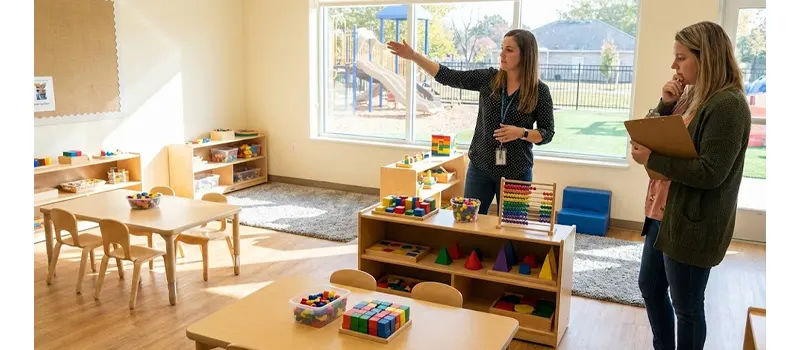
An ideal location balances visibility, accessibility, and flexibility. Children should be able to reach materials easily, work in a calm environment, and engage in both solo and group activities. You need to analyze your current classroom environment to find an area that balances accessibility with the need for concentration.
Prioritize a Quiet Zone
The math center should be placed away from high-traffic or high-noise areas, such as the dramatic play zone or block area. A quieter corner allows children to concentrate on counting, sorting, and problem-solving tasks without being overwhelmed by background noise or movement. By separating the math center from active play zones, you signal to the children that this is a place for thinking and quiet investigation.
Maximize Lighting
Lighting plays a huge role in how inviting a space feels and how well children can engage with detailed tasks. Ideally, you should set up the preschool math center near a window to take advantage of natural light. Natural light reduces eye strain and makes the colorful math manipulatives look more appealing. If window space is not available, ensure that the area has bright and consistent overhead lighting.
Ensure Accessibility and Visibility
The location should be easily accessible to all children, including those with mobility needs. Open pathways and clear signage encourage independent use and promote a sense of ownership. At the same time, the math center should be within the teacher’s line of sight to allow for easy supervision and quick support when needed.
Preschool Math Center Furniture and Layout Planning
Creating a functional layout requires more than just placing a table in a corner. You need a combination of furniture that defines boundaries, offers ample storage, and provides versatile workspaces. A comprehensive setup ensures that every square inch of the area supports learning and autonomy.
Choose a Work Surface That Matches Your Classroom Routine
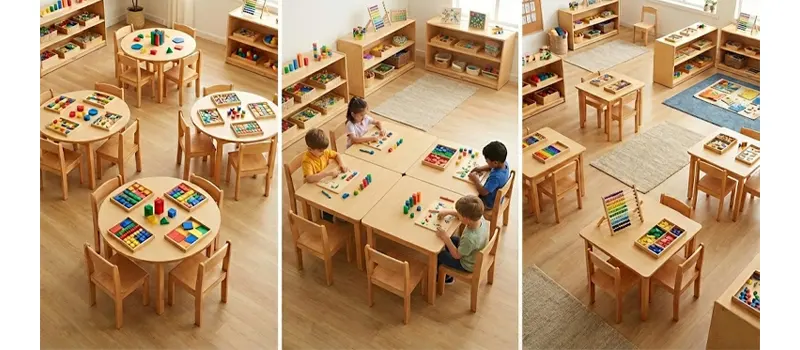
The tables you select should directly support your teaching style and daily schedule. You need to consider whether your students typically work alone or in groups and choose furniture that facilitates those interactions.
- Collaborative Tables: If your routine involves small group projects or teacher-led demonstrations, rectangular or round activity tables are best because they allow multiple children to work together comfortably.
- Individual Workspaces: For classrooms that focus on self-paced learning, such as Montessori environments, individual desks or small square tables allow a child to focus on their task without distraction.
- Adjustable Options: To accommodate different age groups throughout the day, choose tables with adjustable legs. This ensures that whether you are teaching toddlers or preschoolers, the surface is always at the correct ergonomic height.
Defining the Zone with Soft Furnishings
Furniture isn’t just wood and plastic; soft elements are crucial for comfort and for acoustically separating the math center from noisier areas.
- Area Rugs: A distinct rug visually marks the “math zone” on the floor. It provides a comfortable spot for large-scale activities like floor puzzles or giant number lines.
- Floor Cushions: Providing a few cushions creates a cozy nook for children who want to read math-related picture books or work on a tablet quietly.
Accessible Storage Solutions
Storage is the heart of an organization. To foster independence (a key Montessori principle), materials must be displayed openly rather than hidden away in deep bins.
- Low Open Shelving Units: These are essential for defining the perimeter of the math center. Shelves should be waist-high to a child, allowing them to reach materials easily while letting teachers maintain a clear line of sight.
- Mobile Storage Carts: If your classroom space is flexible, a cart on wheels allows you to move math manipulatives to different learning zones or tuck them away when not in use.
- Divided Trays and Baskets: Use shallow trays on shelves to hold specific activities. This helps children carry a “whole task” to their table without dropping pieces.
Managing Traffic Flow and Accessibility
A poor layout causes bottlenecks and frustration. You need to design clear pathways that allow children to retrieve materials and return to their workspace without bumping into peers.
- Wide Pathways: Ensure there is at least three feet of clearance between the shelves and the tables. This prevents congestion when multiple children are browsing for materials at the same time.
- Proximity to Materials: Position the work tables close to the heavy or complex manipulatives. If children have to carry a heavy bin of wooden blocks across the room, it increases the risk of spills and accidents.
- Entry and Exit Points: Design the center with a clear entrance and exit. Avoid creating a “dead end” where children might get trapped if the area becomes popular; a flow-through design often works best for keeping the energy calm.
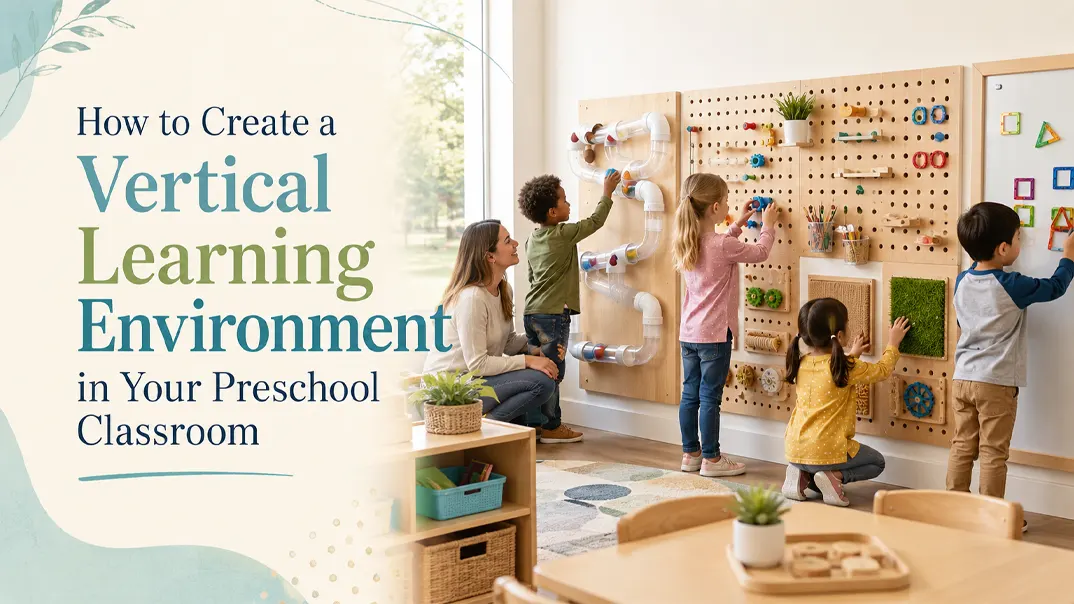
Utilizing Vertical Space
Don’t forget the walls! When floor space is tight, vertical surfaces become valuable teaching real estate.
- Magnetic Whiteboards: Mount these at child height. They are perfect for using magnetic numbers, drawing shapes, or solving simple equations.
- Wall Pockets: Use hanging fabric organizers to store flashcards or lightweight sorting games, keeping the tabletop clear for active work.
- Book Display Shelves: Install a small, front-facing bookshelf to showcase math-themed storybooks, integrating literacy directly into your numeracy center.
Essential Math Materials and Manipulatives
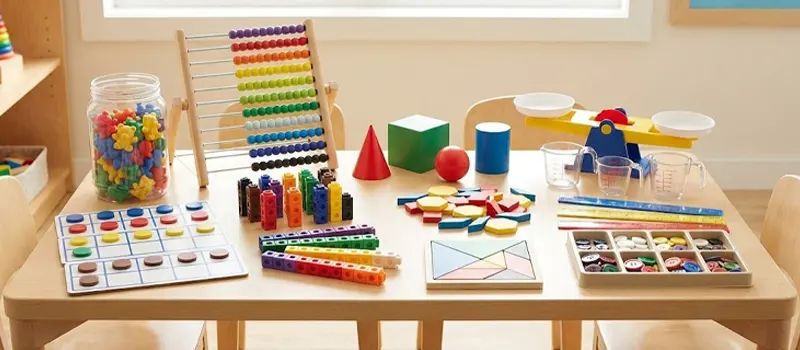
A dynamic preschool math center requires a variety of tools that cater to different learning styles. You should aim to provide materials that are durable and safe for young hands. It is best to categorize these items by the specific skill they develop so you can ensure a balanced curriculum that covers all necessary developmental milestones.
Counting and Number Recognition
Learning to count is often the first step in a child’s mathematical journey. You need materials that allow children to physically associate a number with a quantity. These items help bridge the gap between abstract numerals and real-world value.
- Manipulative Counters: These are small objects like plastic bears, buttons, or stones that children can count one by one.
- Number Lines and Cards: Visual aids that display numbers in order help students understand sequencing.
- Ten Frames: These simple grids teach children to group numbers and visualize how many more they need to make ten.
- Magnetic Numbers: Children can use these on a magnetic board to practice ordering numbers or forming simple equations.
Geometry and Spatial Awareness
Geometry in preschool is about more than just naming shapes. It involves understanding how shapes fit together and how objects occupy space. You should provide materials that encourage construction and visualization.
- Pattern Blocks: These colorful shapes allow children to create designs and explore symmetry.
- 3D Geometric Solids: Wooden or plastic forms like cubes, spheres, and cylinders help children feel the difference between flat and solid shapes.
- Tangrams and Puzzles: These activities challenge students to rotate and manipulate shapes to fit a specific design.
- Bausteine: Standard unit blocks are excellent for teaching spatial relationships and balance.
Measurement and Data
Measurement tools invite children to compare size, weight, and volume. This type of play introduces scientific inquiry into the math center. You should offer real-world tools that look and feel like the ones adults use.
- Balance Scales: A sturdy bucket scale allows children to compare the weight of different toys.
- Rulers and Tape Measures: Flexible tape measures are particularly fun for measuring curved objects or the circumference of a pumpkin.
- Volume Containers: Measuring cups and clear jars are perfect for sensory tables or water play within the math context.
- Timers and Hourglasses: Visual timers help children understand the passage of time and the concept of duration.
Sorting and Logic
Sorting is a critical pre-math skill that helps children organize information. You need materials that have distinct attributes such as color, size, or texture.
- Sorting Trays: These trays with multiple compartments define the workspace and make classification tasks easier.
- Attribute Blocks: These blocks come in various sizes, colors, and thicknesses to challenge children with complex sorting rules.
- Lacing Beads: Threading beads allows children to create and repeat simple color patterns.
If you are interested in incorporating specific pedagogical tools into your setup, we recommend reading our post on Montessori math materials to learn more.
How to Organize the Preschool Math Center Effectively?
An organized preschool math center is not about having more materials. It is about making every activity easy to choose, easy to use, and easy to put back. When the system is clear, children spend more time doing math and less time waiting for help.

Keep It Simple And Focused
Start with a small set of activities that match your goals. Too many choices can overwhelm children and lead to messy shelves. A practical starting point is six to ten activities that cover counting, sorting, patterns, shapes, and measurement.
Group Activities By Skill
Organize trays by what they teach, such as counting, number matching, patterns, shapes, and measuring. This makes planning easier for teachers and helps children recognize different types of math work within the preschool math center.
Store Complete Sets
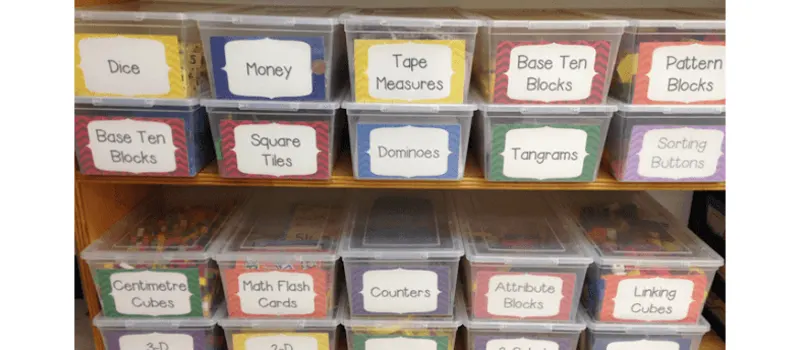
Each activity should be stored as one complete set in a tray or basket, including all pieces needed to finish it. Avoid sharing small parts across multiple activities because items will go missing quickly.
Label For Quick Cleanup
Use labels that show where each tray belongs. A photo plus a short name works well. For activities with several parts, add a simple picture guide of what should be inside the tray so children can self-check during cleanup.
Use Clear Directions
Keep directions short and consistent. A small visual card that shows the setup and one simple sentence is often enough. If needed, demonstrate the activity once, then let children repeat it independently in the preschool math center.
Rotate With A Routine
Keep a few core activities available for several weeks and rotate a smaller set weekly. This keeps the preschool math center familiar while adding enough variety to stay interesting. Rotate one skill area at a time so children do not have to relearn everything at once.
Support Different Levels
Use one activity with an easy option and a challenge option, rather than creating separate trays. For example, children can count objects as the base task, then match numerals or record the answer as an extension. This keeps the preschool math center organized while meeting different ability levels.
Activity Ideas for Preschool Math Center
To keep your preschool math center fresh, engaging, and educational, it’s important to rotate a variety of hands-on activities that target different early math skills. The best math activities are open-ended, self-directed, and adaptable to different developmental levels. Here are some hands-on ideas that cover various mathematical concepts like counting, sorting, geometry, and measurement.

1. Nature Object Sorting
Bring the outdoors inside by collecting leaves, pinecones, or stones. Ask the children to sort these natural items into different trays based on their attributes. They can categorize them by size, texture, or color.
2. Button Jar Estimation
Fill a clear jar with a specific number of large buttons or colorful pom poms. Ask the students to guess how many items are inside the jar and write their predictions on a sticky note. Afterward, count the items together as a group to see who was closest.
3. Measure the Room
Give the children non-standard measuring tools like linking cubes or a piece of yarn. Ask them to measure items around the preschool math center. They can find out how many cubes long the table is or how many hands wide the bookshelf is.
4. Feed the Math Monster
Decorate a tissue box to look like a monster with a large open mouth. Create cards that say “Feed me 5 snacks.” The children must count out the correct number of counters or beads and drop them into the monster’s mouth.
5. Shape Scavenger Hunt
Give the children a clipboard with pictures of shapes like a circle, square, and triangle. Ask them to walk around the classroom and find real-world objects that match those shapes. They can check off the items as they find them.
6. Weighing Station Experiments
Set up a balance scale with a variety of objects that have different weights but similar sizes. Ask the children to predict which object will be heavier before they put them in the buckets. This introduces the concept of making a hypothesis.
7. Graphing Our Favorites
Set up a graph board with categories like favorite fruit, animal, or color. Children place a token or picture under their choice, then count and compare the results, learning about data collection and analysis.
FAQs
What is a preschool math center?
A preschool math center is a designated area in the classroom where children explore math concepts through hands-on materials and guided activities. It supports early numeracy, problem-solving, and independent learning.
How often should I rotate math center activities?
Activities should be rotated every 1–2 weeks to maintain engagement and target different math skills. Seasonal themes or classroom units can also guide rotation.
How do I make the math center inclusive for all learners?
Use multisensory materials, visual cues, and allow for choice. Adapt activities to different skill levels and include support for children with diverse needs.
How do I assess learning in the preschool math center?
Observation is key. Look for signs of understanding, problem-solving, and engagement. You can also use simple checklists or photos to document progress.
How do you introduce the math center to students?
You should introduce the math center gradually to prevent overwhelming the children. Start by presenting one or two materials during circle time and demonstrating how to use them properly. Show the students exactly where the items belong on the shelf. Once they understand the rules for those specific items, you can slowly add more activities to the shelves over the following weeks.
Schlussfolgerung
Setting up a preschool math center is most effective when you treat it as a system, not just a shelf of materials. Choose a calm, visible location, plan child-sized furniture and a clear layout, and stock a focused set of manipulatives that match real early math skills. When activities are organized into complete trays with simple labels and visual directions, children can work independently and teachers can observe and guide with purpose.
If you’re planning or upgrading your math center and need support with furniture, layout design, or durable math materials, feel free to reach out to our team at Xiha Kidz. We’re here to help you create a space that inspires early math learning every day.


 German
  English
  Arabic
  French
  Italian
  Spanish
  Thai
Thai  Japanese