“The training and sharpening of the senses has the obvious advantage of enlarging the field of perception and of offering an ever more solid foundation for intellectual growth.”
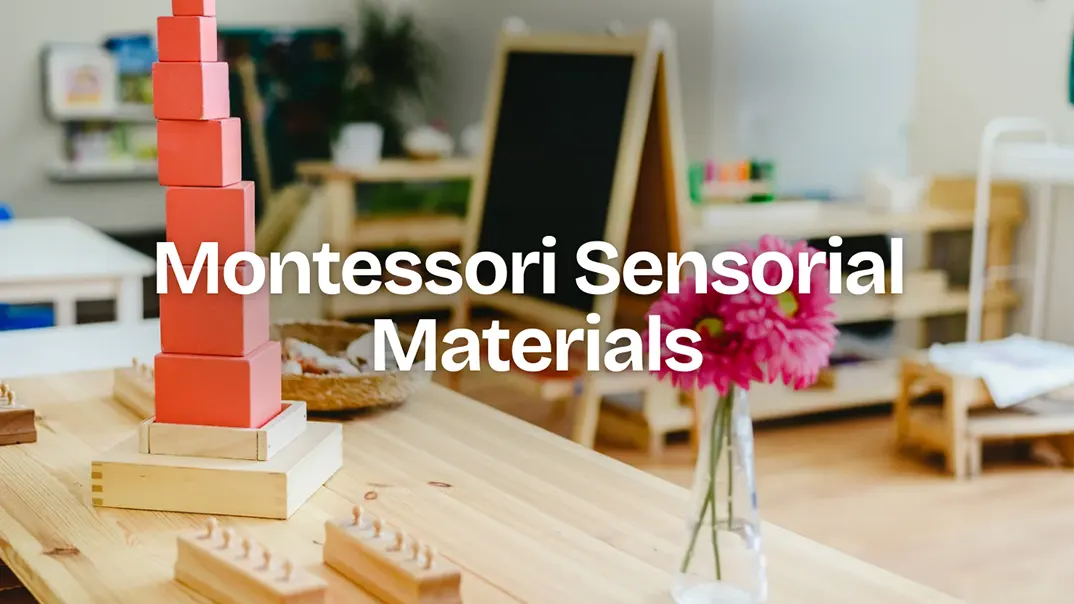
Sensory input is the brain’s first language. Before a child learns to read or write, they must learn to observe, compare, and classify. Montessori sensorial materials transform this critical yet often invisible stage of development into a structured, meaningful process.
In this complete guide, we’ll break down how Montessori sensorial materials work, what makes them unique, and how they support a child’s development in both simple and profound ways.
What Are Montessori Sensorial Materials?
Montessori sensorial materials are a specialized set of learning tools designed to help children refine their senses and build a foundation for abstract thinking. These materials isolate specific qualities such as size, color, texture, sound, weight, temperature, and shape. Each material is intentionally created to highlight only one sensory property at a time, allowing the child to focus on that particular attribute without distraction.

In the Montessori approach, sensorial education is not considered a supplemental area of learning. It is a core component of the curriculum that prepares the child for more advanced academic work. For example, by manipulating the pink tower, the child develops visual discrimination of size, which later supports mathematical concepts such as sequencing, gradation, and unit comparison. Similarly, sound cylinders refine auditory perception, preparing the brain for distinguishing letter sounds in phonics.
Montessori sensorial materials are also aesthetically pleasing, made from natural materials such as wood, metal, or fabric, and presented in an orderly way. Their beauty and clarity invite children to work with them, while their simplicity helps them focus. Through these materials, the child begins to build internal order by recognizing external patterns. This process supports not only cognitive development but also emotional regulation and confidence.
Characteristics of Montessori Sensorial Materials
Montessori sensorial materials have a set of distinct characteristics that make them different from ordinary toys or general classroom resources. Their design is intentional, precise, and rooted in Maria Montessori’s observation of how children learn through the senses. Each characteristic supports the child’s ability to explore one concept at a time and develop accurate sensory discrimination.
Isolation of a Single Sensory Quality
Each material is designed to highlight one specific sensory attribute. Whether it is color, size, shape, temperature, sound, or texture, all other variables are minimized. For example, the pink tower focuses solely on the dimension of size, with all cubes the same color, material, and texture. This isolation allows children to develop precision in perception.
Contrôle des erreurs
Montessori sensorial materials are self-correcting. The child can immediately see, hear, or feel when something is out of place. This control of error promotes independence, critical thinking, and self-assessment. Rather than relying on adult feedback, the child learns through their own observation and reflection.
Aesthetic and Natural Appeal
The materials are often made from natural, high-quality materials such as wood or metal. They are simple yet beautiful, with smooth finishes and harmonious proportions. This aesthetic quality invites children to engage with the materials and fosters respect for their environment.
Purposeful Order and Sequence
Montessori sensorial materials are introduced in a specific progression, moving from simple to complex and from concrete to abstract. This sequence supports the child’s ability to organize information systematically. For example, color tablets are first introduced in pairs, then in graded sets, and eventually in more nuanced color matching and grading.
Mathematical Precision in Design
The measurements, proportions, and weights of Montessori sensorial materials are exact and scientifically determined. This precision gives consistency to the child’s sensory experience. When a cube in the pink tower is exactly one centimeter larger than the next, or when each rod increases in length by a fixed amount, the child encounters measurable reality rather than approximate differences. This accuracy helps children build an internal sense of order.
Categories of Montessori Sensorial Materials
While traditional education often focuses on five senses, the Montessori method adopts a more refined classification. In many Montessori training centers and classrooms, sensorial materials are grouped into eight sensory categories to better reflect the range of human perception. These include not only sight, touch, hearing, smell, and taste, but also the baric sense (weight), thermic sense (temperature), and stereognostic sense (tactile recognition without sight).
Visual (Sight) Sensory Materials
These materials help children develop visual discrimination by focusing on size, color, and form. Each subcategory isolates a specific quality to train the eye and support mental organization. The materials are designed to be simple, attractive, and self-correcting, allowing children to explore independently.


Taille
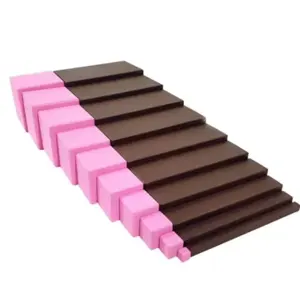
- Tour rose: A set of ten pink wooden cubes ranging from large to small. It teaches children to observe differences in size and volume.
- Escalier marron: Consists of ten wooden prisms that differ in width but not in length or height. It focuses on thickness and comparison.
- Red Rods: Ten red rods of equal thickness but varying lengths. These help children understand length and develop spatial awareness.
- Cylindres à bouton : Wooden cylinder blocks, each containing ten cylinders with knobs. The cylinders vary in height, diameter, or both, depending on the block. These support visual discrimination of size, depth perception, and fine motor control.
- Knobless Cylinders: Four sets of colored cylinders (red, yellow, green, and blue), each set varying in one or two dimensions. Unlike the knobbed version, they have no handles and can be used freely to build and compare.
Couleur
- Color Tablets (First Box): Introduces primary colors using two tablets of red, yellow, and blue.
- Color Tablets (Second Box): Expands to secondary and tertiary colors, with matching pairs for each.
- Color Tablets (Third Box): Focuses on grading shades from light to dark, refining the child’s ability to distinguish tones.
Form/Shape
- Solides géométriques: A set of three-dimensional shapes such as spheres, cubes, cones, and pyramids. These help children explore form and geometry.
- Geometric Cabinet: Includes flat wooden shapes stored in drawers. Children learn to recognize and name various two-dimensional figures.
- Constructive Triangles: A set of triangles that can be combined to form new shapes. This teaches part-to-whole relationships and supports early math thinking.
- Trinomial Cube: A three-dimensional puzzle made up of 27 color-coded wooden blocks. While it appears as a sensorial material, it indirectly introduces algebraic concepts related to the formula (a + b + c)³.
Auditory (Hearing) Sensory Materials
Auditory materials are designed to sharpen a child’s listening skills by helping them distinguish between different sounds. These tools support auditory discrimination, concentration, and memory skills that are essential for both language development and music education. Each material encourages the child to focus carefully and notice subtle differences in sound.
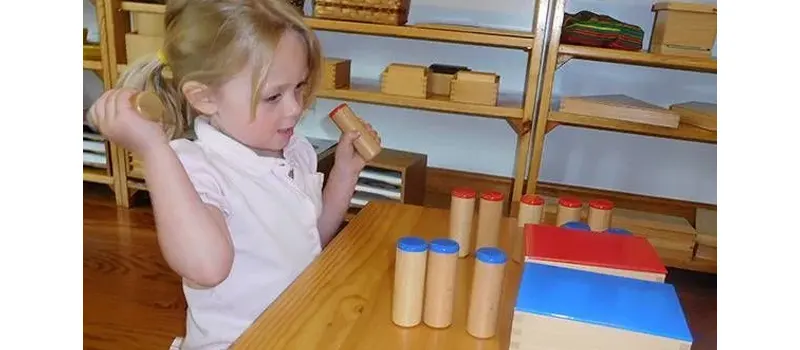
- Sound Cylinders: A set of six red and six blue wooden cylinders, each filled with different materials to produce a distinct sound when shaken. The child matches each red cylinder with its blue pair by listening closely. This activity develops auditory discrimination and memory.
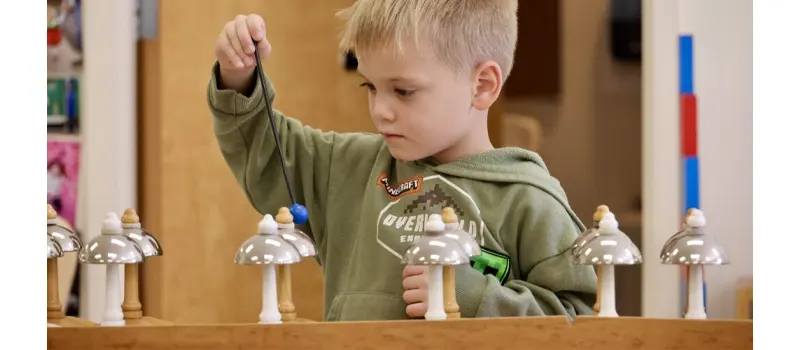
- Cloches Montessori: A series of bells arranged in two identical sets, tuned to the diatonic scale. Children match, grade, and eventually play musical patterns by ear. This material introduces pitch, tone, and musical structure in a hands-on way.
Tactile (Touch) Sensory Materials
Tactile materials help children refine their sense of touch by exploring differences in texture, weight, and temperature. These activities are often done with eyes closed or blindfolded to heighten the tactile experience. The goal is to develop sensitivity in the fingertips and build attention to fine details, which also supports later work in writing and practical life.
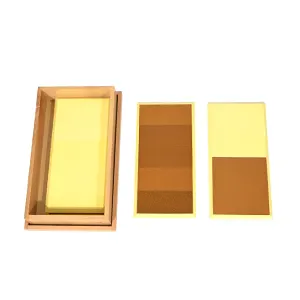
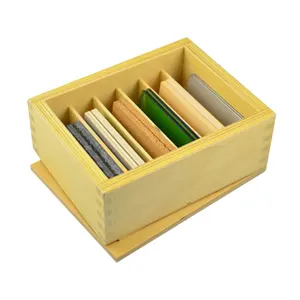
- Touch Boards: Three boards covered with sandpaper in varying degrees of roughness. Children use their fingers to feel and compare the textures, improving tactile discrimination.
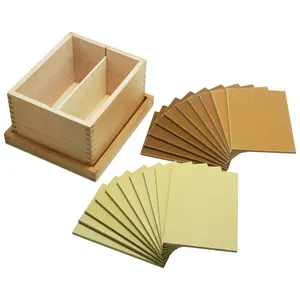
- Touch Tablets: A set of wooden tablets covered with different grades of sandpaper. Unlike the boards, these are used in pairs for matching, allowing children to practice identifying textures by feel alone.
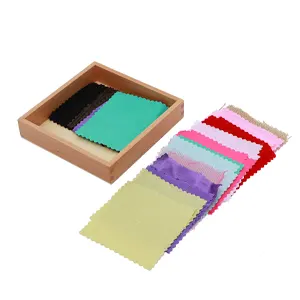
- Fabric Box: Contains pairs of fabric swatches made of different materials. Children match the fabrics by touch, often while blindfolded. This activity strengthens sensory memory and descriptive vocabulary.
Olfactory (Smell) Sensory Materials
Olfactory materials in Montessori education are designed to isolate and refine a child’s sense of smell. These materials allow children to explore scent through pairing and recognition, encouraging sensory awareness and careful observation.
- Bouteilles odorantes : Small opaque bottles containing various scents (e.g., spices, herbs, essential oils); children match identical smells or grade them by strength.
Gustation (Taste) Sensory Materials
Gustation materials help children become more aware of different tastes and develop their ability to distinguish between them. Although taste-based activities are less frequent due to hygiene and safety considerations, they still play an important role in supporting sensory development.
- Tasting Bottles: Containers with basic taste solutions (sweet, sour, salty, bitter); children match or name the tastes during supervised activities
Baric Sensory Materials
Baric materials are designed to refine a child’s baric sense, which is the ability to perceive differences in weight. These materials encourage children to compare objects that look the same but feel different, helping them build focus, coordination, and tactile memory.
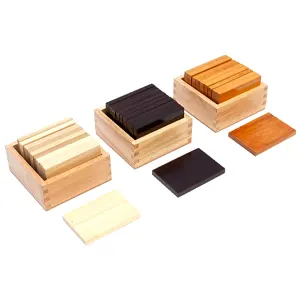
- Comprimés bariques: A set of wooden tablets made from different types of wood, giving them distinct weights while keeping size and appearance nearly identical. Typically grouped into three pairs (light, medium, and heavy) children are encouraged to compare and sort them by weight using only their hands.

Thermic Sensory Materials
Thermic materials are designed to help children refine their thermic sense, which is the ability to detect differences in temperature through touch. These activities help children build awareness of heat and cold, often using natural materials that retain temperature at different rates.
- Comprimés thermiques : Tablets made of various materials (metal, wood, felt) that retain heat differently; used to compare temperature through touch.
- Thermic Bottles: Bottles filled with water at varying temperatures; children match or grade by warmth or coolness.
Stereognostic Sensory Materials
Stereognostic materials help children develop the ability to identify objects using touch alone, without the aid of sight. This sense combines tactile feedback with muscular memory and spatial awareness. In Montessori education, stereognostic activities strengthen fine motor coordination, spatial understanding, and confidence in independent exploration.
- Mystery Bag: A fabric bag containing familiar classroom objects or geometric solids. Children reach into the bag without looking and identify the items by touch. This helps develop detailed tactile perception and memory.
- Solides géométriques: Though also part of visual materials, geometric solids are often used in stereognostic exercises where children feel and name the shapes while blindfolded. This deepens their spatial understanding and solidifies abstract geometric concepts.
The Purpose of Sensorial in Montessori
Sensorial education is not an isolated component of the Montessori method. It is a deliberate and essential part of the curriculum that prepares the child for all future learning. Below are the key purposes that guide the use of Montessori sensorial materials in early childhood education.

1. Refine and Classify Sensory Impressions
Children are constantly absorbing information from the world through their senses, but these impressions are often vague and unorganized. Montessori sensorial materials help children isolate one quality at a time, so they can compare, contrast, and classify their sensory experiences with clarity and focus.
2. Build a Foundation for Abstract Thinking
Before a child can grasp abstract concepts in math, language, or science, they must understand concrete differences. Sensorial work gives children the tools to notice patterns, sequences, gradation, and relationships, which later supports logical reasoning, measurement, and symbolic thinking.
3. Foster Order and Internal Structure
The Montessori environment is built on the principle of order. Montessori sensorial materials are presented with precision and used in a specific sequence. As children engage with these materials, they begin to organize their internal thinking, mirroring the external order of their environment. This sense of order supports concentration and independent learning.
4. Support Language Development
As children work with sensory qualities, they learn to describe what they see, hear, touch, and feel. This vocabulary building happens naturally as they explore materials. For example, words like “rough,” “smooth,” “longer,” “shorter,” “darker,” and “lighter” become meaningful through hands-on experience.
5.Encourage Independence and Self-Correction
Montessori sensorial materials are designed with built-in control of error. This means children can recognize mistakes on their own and correct them without adult intervention. This promotes self-confidence, decision-making skills, and the habit of careful observation.
6. Prepare the Senses for Everyday Life
Beyond academic readiness, sensorial education helps children become more aware of their surroundings. A child who can notice subtle differences in sound, shape, or color is better prepared to engage with the world in a thoughtful, intentional way.
How to Present Montessori Sensorial Materials?
In the Montessori method, how a material is introduced is just as important as the material itself. A well-prepared presentation ensures that the child connects with the material meaningfully, develops concentration, and works with increasing independence. Below are key principles and steps for effectively presenting Montessori sensorial materials to children.
Preparation of the Environment
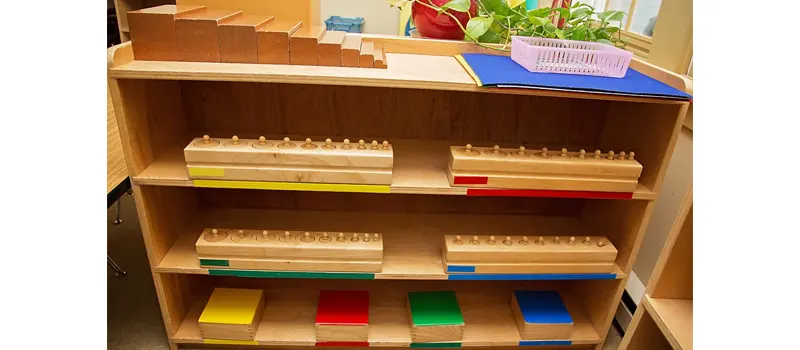
The environment should be clean, orderly, and free of distractions. Montessori sensorial materials are placed on low, accessible shelves and organized by category. Each material should be complete, aesthetically appealing, and presented in isolation to invite focused work. If space allows, you may also create a small sensorial area to offer children a calm and dedicated place for exploration.
Observation Before Presentation
The adult should observe the child to assess readiness. Signs of readiness include interest in similar activities, a growing attention span, and hand-eye coordination. Presentations should not be forced but offered at the right moment of curiosity or developmental need.
The Three-Period Lesson
Many Montessori sensorial materials are introduced using the three-period lesson, which helps build both understanding and vocabulary:
- Naming (First Period): The adult names the concept while showing the material.
- Recognition (Second Period): The child is asked to identify the concept.
- Recall (Third Period): The child is asked to name the concept.
This structure supports both sensory discrimination and language development.
Use of Precise, Minimal Language
During the presentation, the adult should speak clearly and only as needed. The child’s attention should remain on the movement and the material, not on adult explanation. Use simple, consistent vocabulary (e.g., “shorter,” “heavier,” “darker”) and avoid unnecessary commentary.
Slow and Deliberate Movement
All demonstrations should be slow, exact, and purposeful. This helps the child internalize the correct use of the material. The adult uses their dominant hand first, breaking down the movement into logical, repeatable steps.
Invite, Then Step Back
After the demonstration, the adult invites the child to try. At this point, the adult steps back and observes quietly, allowing the child time and space to explore. Assistance is only offered if the child requests it or misuses the material in a way that risks damage or disruption.
Encourage Repetition, Not Results
The goal is not “getting it right,” but engaging with the material repeatedly. Children refine their senses through repeated use. The adult’s role is to support the process, not correct the outcome.
Respect for the Child’s Autonomy
Children are free to choose Montessori sensorial materials after the initial presentation. Repetition, variation, or spontaneous discovery are all encouraged. This freedom within structure is essential to Montessori philosophy.
Montessori Sensory Activities for Preschoolers
Montessori sensory activities give children a structured way to explore the world through their senses. The goal is not only to enhance sensory perception but also to build concentration, order, coordination, and confidence.

- Texture Hunt: Children explore the classroom to find objects that are rough, smooth, bumpy, or soft, then group them by texture.
- Sound Walk: A silent walk indoors or outdoors where children focus on identifying and naming the sounds they hear (e.g. birds, footsteps, doors closing).
- Temperature Sorting: Children touch various objects (wood, metal, fabric) and sort them into warm, cool, or neutral groups using their sense of touch.
- Scent Matching Game: Children smell sets of scent bottles and try to find the matching pairs using only their sense of smell.
- Weight Comparison Challenge: Using tablets or small objects that look the same but have different weights, children guess which is heavier or lighter by holding and comparing.
- Mystery Object Bag: Children reach into a cloth bag without looking, feel an object, and try to identify it based on shape, texture, and size.
- Color Walk: Children walk around the classroom or playground collecting objects that match a specific color, then sort and arrange them into gradients.
- Pitch Pairing: Using instruments or everyday objects (e.g., glasses with water), children listen and match sounds of the same or similar pitch.
Conclusion
Montessori sensorial materials hold a central place in early childhood development because they offer children a precise and purposeful way to explore the qualities of the world. Through these carefully designed materials, children learn to notice differences in size, shape, color, sound, texture, scent, and weight. By isolating one sensory property at a time, the materials allow children to focus deeply, compare confidently, and form accurate mental impressions through direct experience.
Through consistent use, these materials lay the groundwork for more abstract academic concepts and help children approach learning with confidence, curiosity, and independence. They empower children to explore the world with all their senses and make sense of it on their own terms.
À Xiha Kidz, we are passionate about supporting early childhood education through authentic, high-quality Montessori materials. Our collection of sensorial tools is thoughtfully designed to align with Montessori principles and meet the developmental needs of children during their most formative years. Xiha Kidz is committed to helping you create rich, hands-on learning experiences rooted in Montessori excellence.




 French
  English
  Arabic
  Italian
  German
  Spanish
  Thai
Thai  Japanese