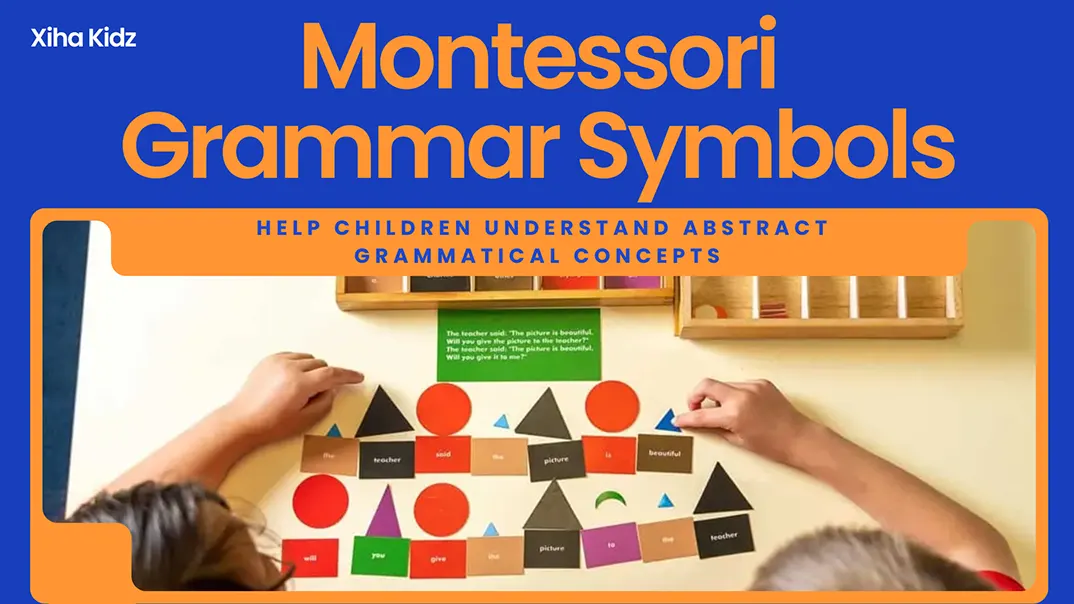
Montessori grammar symbols are a set of nine specific geometric shapes and colors used to represent the different parts of speech in a sentence. Dr. Maria Montessori designed these distinct visual aids to help children understand abstract grammatical concepts by associating them with tangible qualities.
Learning the rules of language can often feel like a tedious task filled with memorization and abstract definitions. The Montessori method transforms this experience by turning grammar into a sensory exploration. By using these physical symbols, children are able to hold a part of speech in their hands and physically manipulate the structure of a sentence. This hands-on approach builds a deep and intuitive understanding of how language functions.
In this article, you will learn the purpose of Montessori grammar symbols, what each symbol represents, and how to use them to support clearer writing, stronger reading comprehension, and more confident communication.
Key Benefits of Montessori Grammar Symbols
Montessori grammar symbols help children understand how language works by making sentence structure visible. Instead of learning grammar as a set of definitions, children work with real words in meaningful sentences and use symbols to see the job each word is doing. Over time, this builds a strong foundation for reading comprehension, clear writing, and confident communication.
1. Concrete Understanding of Abstract Concepts
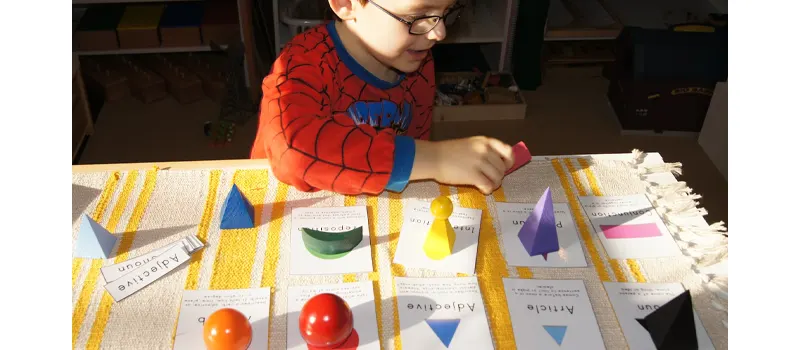
Grammar can be difficult for young learners because it deals with abstract rules. Montessori grammar symbols give children something tangible to work with. For example, instead of just hearing that a noun is a person, place, or thing, children associate it with a large black triangle. This visual anchor helps reinforce the concept and make it more memorable.
2. Supports Visual and Kinesthetic Learners
Many children learn best when they can see and touch what they’re learning. Montessori grammar symbols cater to both visual and kinesthetic learning styles. Children place the symbols above or below words in a sentence, creating a physical interaction that strengthens cognitive connections.
3. Encourages Independent Exploration
Montessori grammar symbols are designed to let children analyze language independently. Once introduced, children can use the symbols to decode sentences on their own, which builds confidence and encourages a sense of discovery. This autonomy aligns with the broader Montessori philosophy of self-directed learning.
4. Reinforces Sentence Structure and Syntax
By consistently applying symbols to each word in a sentence, children begin to see how sentences are built. They notice patterns, such as how an adjective often comes before a noun or how verbs show action. Over time, these patterns become internalized, leading to stronger language and writing skills.
5. Makes Grammar Engaging and Enjoyable
Traditional grammar lessons can feel dry or confusing, especially at a young age. Montessori grammar symbols introduce a playful, artistic element that makes language learning more enjoyable. Children often treat grammar analysis as a game or creative activity rather than a task, which fosters a lifelong interest in language.
Basic Montessori Grammar Symbols
The 9 Montessori Grammar Symbols Explained
The Montessori grammar symbols are not random shapes assigned to words. Dr. Montessori intentionally designed each one to reflect the nature of the part of speech it represents. The visual characteristics of the shape, such as its stability, color, or energy, give the child a clue about its grammatical function.
The Noun Family
These symbols typically appear together because they function as a unit to name and describe objects. They are all triangular, showing their relationship to one another.
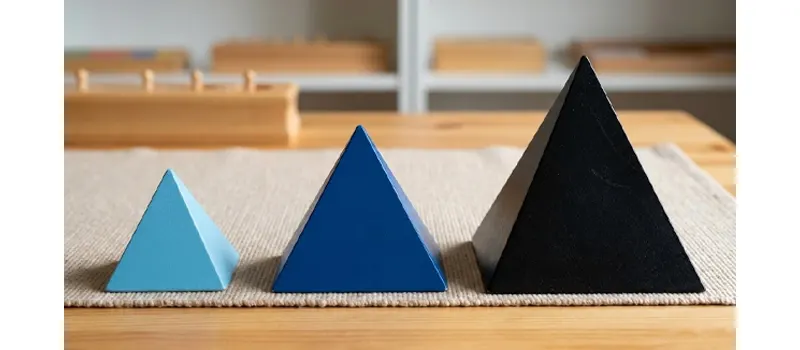
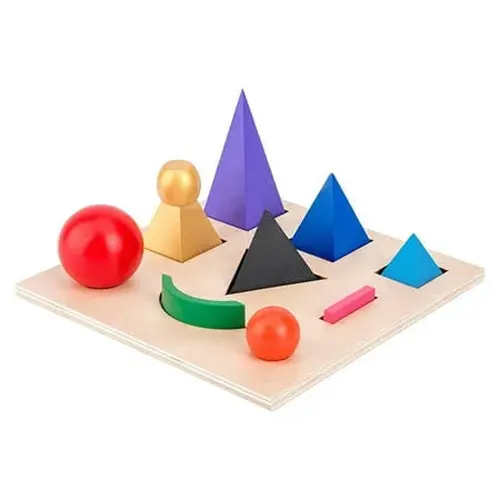
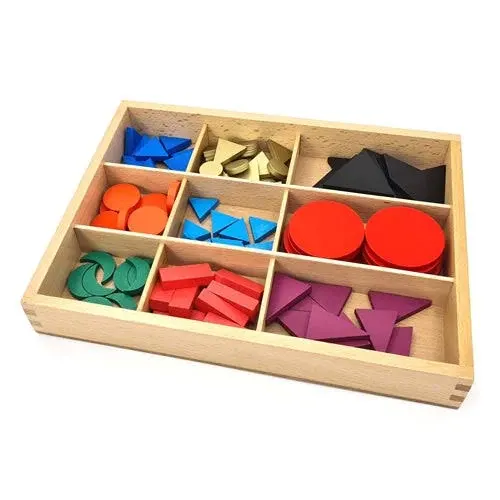
- The Noun (Black Pyramid): The noun is represented by a large black triangle. This shape mimics a pyramid, which is one of the most stable and ancient structures in human history. The color black represents coal, signifying carbon, the basis of organic matter. This teaches the child that nouns are naming words for things that are solid, tangible, and fundamental.
- The Article (Light Blue Triangle): The article is a small light blue triangle. It is the smallest member of the noun family. Its size indicates that it is a tiny word used to introduce a noun. The light blue color connects it to the other blue triangle in the family (the adjective) but distinguishes its specific role as a marker for the noun.
- The Adjective (Dark Blue Triangle): The adjective is a medium dark blue triangle. It is smaller than the noun because it is less important than the object itself, but it is larger than the article. The blue color is often associated with the sky or water, which can change in appearance, just as an adjective changes or “colors” the meaning of a noun.
The Verb Family
These symbols relate to action and energy. They are circular to represent movement.

- The Verb (Red Sphere): The verb is a large red circle. Dr. Montessori chose the color red to symbolize fire, blood, and the sun, all of which represent life and energy. The sphere shape suggests movement, as a ball can roll and bounce. This signifies that verbs are action words that drive the sentence forward.
- The Adverb (Orange Circle): The adverb is a smaller orange circle. It is often placed near the verb because it modifies or adds detail to the action. The color orange is related to red but is less intense, showing that the adverb depends on the verb for its existence, much like a planet orbiting a sun.
Connecting and Emotional Words
These symbols serve to link parts of a sentence or express strong feelings.
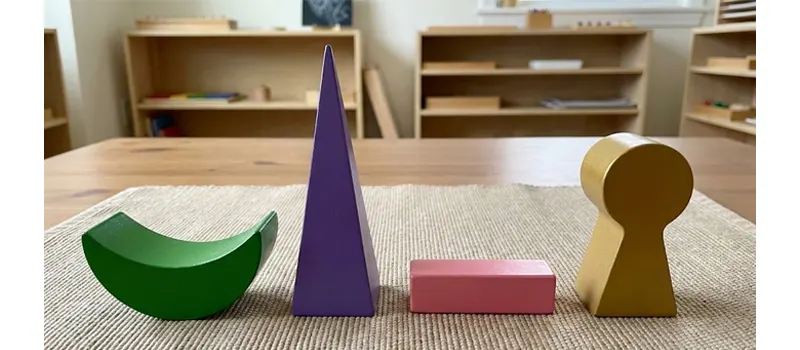
- The Preposition (Green Crescent): The preposition is a green crescent shape. It looks like a bridge or a link. This visual perfectly describes its function, which is to connect nouns to other parts of the sentence or to show the relationship between objects. The green color represents growth and connection, like vines connecting branches.
- The Pronoun (Purple Pyramid): The pronoun is a tall, purple isosceles triangle. It is triangular like the noun, because it takes the place of a noun. However, it is tall and slender, which gives it a distinct appearance. The color purple is historically associated with royalty, suggesting that the pronoun stands in for the noun with dignity and importance.
- The Conjunction (Pink Bar): The conjunction is a small pink rectangle. This shape looks like a small link in a chain or a piece of tape. It symbolizes the act of joining two words or phrases together mechanically. The pink color is soft and distinct from the primary colors of the main parts of speech.
- The Interjection (Gold Keyhole): The interjection is a gold shape that resembles a keyhole or an inverted exclamation point combined with a triangle. The gold color signifies something precious or sparkling, like a burst of emotion. The shape is often described as a keyhole because interjections unlock the emotional tone of a sentence.
When to Introduce Grammar Symbols?
Determining the right moment to introduce Montessori grammar symbols relies more on the developmental readiness of the child than on a specific calendar age. You should introduce Montessori grammar symbols when a child can read short sentences with understanding and is ready to think about how words work. In most Montessori settings, this often happens in the early elementary years.
The Reading Prerequisite
The most critical requirement is that the child must be reading comfortably. Since the symbols are used to analyze written language, the student needs to be able to decode words without significant struggle. If a child is still focusing entirely on sounding out letters, introducing grammar analysis can be overwhelming. The focus should remain on reading fluency first. Once reading becomes automatic, the child is mentally free to look at the function of the words rather than just their sounds.
The Shift to the Reasoning Mind
Maria Montessori observed a distinct shift in psychology around age six. Children move from the Absorbent Mind stage to the Reasoning Mind stage. They stop asking “what” and start asking “how” and “why.” The Montessori grammar symbols cater perfectly to this new intellectual hunger. At a certain stage, children will want to know how sentences are constructed and why words change meaning in different contexts. Introducing symbols at this stage can satisfy their natural curiosity about language structure.
Tips: Every child develops at their own pace. Some may be ready to start grammar symbol work at four and a half, while others may benefit from waiting until age six. What matters most is that the child feels confident and curious, not rushed or confused.
How to Use the Montessori Grammar Symbols?
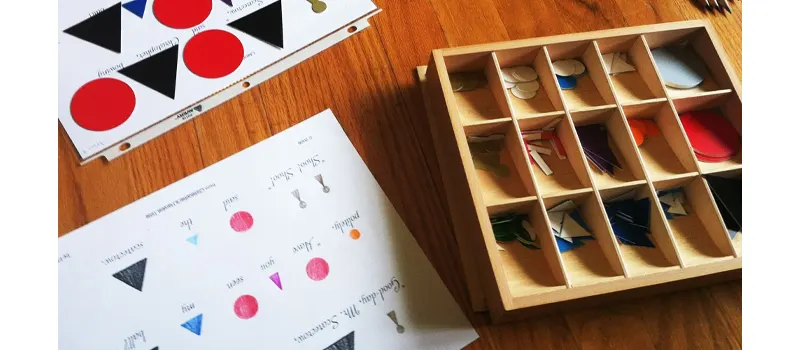
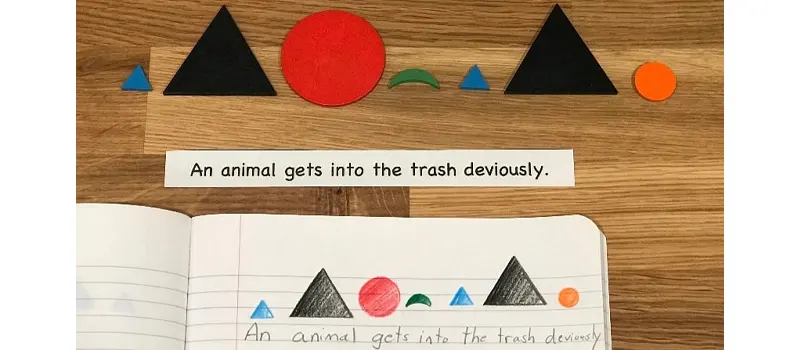
Montessori grammar symbols are used as hands-on tools to help children visually analyze and understand the parts of speech in a sentence. Each word is paired with a specific symbol based on its grammatical role, and students place these symbols above or below the words as they explore sentence structure. This process transforms grammar from a set of rules into a dynamic, interactive activity.
Introduction of Individual Symbols
The journey begins by introducing the symbols one at a time. Educators typically start with the noun and the verb. They present the black pyramid to represent the noun and explain its stable nature. Next, they introduce the red sphere to represent the verb and highlight its energetic qualities. Storytelling is often used here to make the characteristics of each shape memorable.
Matching Montessori Grammar Symbols to Words
Once the child identifies the shapes, they practice matching them to single-word cards. The teacher might lay out a card with the word “cat” and ask the student to place the correct symbol above it. This simple activity reinforces the link between the written word and its grammatical category.
Sentence Analysis
After the child is comfortable with individual words, they move on to analyzing phrases and full sentences. The student writes a sentence on a strip of paper or uses pre-printed sentence strips. They then place the corresponding wooden or paper symbol directly above each word in the sequence. This visual map allows the child to check their own work. If a sentence is supposed to describe an action but lacks a red circle, the student can instantly see that the verb is missing.
Expanding to Complex Grammar
As the learner masters nouns and verbs, the guide gradually introduces the remaining shapes. Articles, adjectives, and prepositions are added to the mix. The child learns to visualize how an adjective helps a noun or how a preposition links words together. This method allows students to deconstruct long and complicated sentences with ease.
A Practical Lesson Plan: Teaching with Montessori Grammar Symbols
While understanding the theory is important, the real magic happens during the lesson. This section provides a structured, five-step guide to introducing these symbols in a classroom or home setting. This process moves from simple identification to complex sentence analysis.
Step 1: Preparation of Materials
Before beginning the lesson, ensure you have a “Grammar Box” or a sorted tray containing the paper or plastic versions of the symbols. You will also need blank slips of paper, a black pen, and a red pen. In many Montessori environments, we write the verb in red to emphasize its energy, while the rest of the words remain in black.
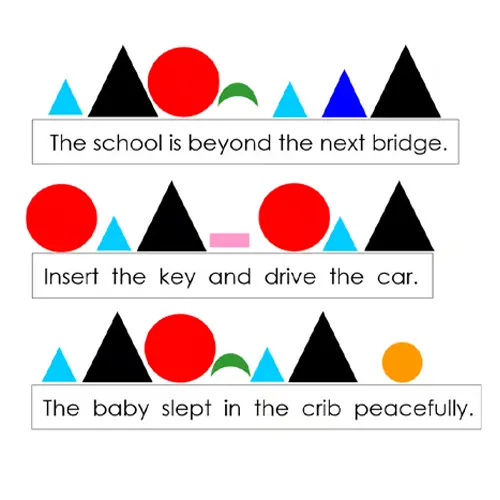
Step 2: Spoken Language Review and Introduction
Start with a brief conversation about naming words to ground the concept in reality. Ask the child to name objects in the room. Then, ask a question like “Can you describe the chair?” to bring in adjectives naturally.
Once the concept is clear, introduce the symbols physically.
- Show the black triangle and explain that it stands for a noun.
- Follow with the small light blue triangle for the article.
- Introduce the dark blue triangle for the adjective.
- Allow the child to hold and feel each symbol to establish a sensory connection.
Step 3: Select Meaningful Content
Children understand grammar faster when the words carry actual meaning. Avoid random word lists. Instead, choose phrases or sentences that match the child’s world, such as classroom routines, animals, nature, or stories they enjoy. Keep early exercises:
- Short (3 to 6 words)
- Concrete and easy to imagine
- Grammatically correct
Step 4: Present a Simple Phrase
Begin with a simple phrase card, such as “The red apple.” Read it together with the child and then identify the role of each word aloud:
- “Apple” is the name of the thing. It is the noun, so we use the black triangle.
- “Red” describes the apple. It is the adjective, so we use the dark blue triangle.
- “The” introduces the noun. It is the article, so we use the light blue triangle.
Step 5: Symbol Placement and Practice
Have the child place each grammar symbol directly above the corresponding word. Encourage them to explain their choices as they go. Once they understand the concept, repeat the activity with two or three more short phrases or sentences. Encourage independence with each round and offer help only when absolutely needed.
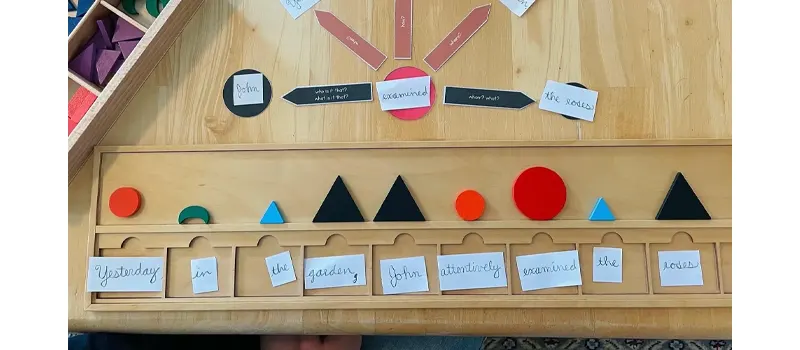
Step 6: Expand to More Parts of Speech
Once nouns, articles, adjectives, and verbs feel easy for the student, you can add more symbols to the lessons. A practical expansion path includes:
- Prepositions: To show relationships like in, on, under, or near.
- Conjunctions: To connect ideas like et, but, or because.
- Pronouns: To replace nouns like he, she, or they.
- Adverbs: To describe how, when, or where an action happens.
Remember to keep each new symbol grounded in meaning. For example, when introducing prepositions, use an object and physically demonstrate “under the box” or “beside the book” before analyzing the sentence text.
Step 7: Connect Montessori Grammar Symbols to Writing
A simple way to make the work practical is to use symbols as a writing tool, not just an analysis tool. Try these extension activities:
- Sentence Expansion: Start with a simple base like “The dog runs.” Ask the child to add one adjective, then a prepositional phrase, and finally an adverb. Have them label each version with symbols.
- Revision Support: When a child writes a story, ask them to label their own sentences. This helps them check if they have included a clear noun and verb.
- Style Choices: Compare two sentences and discuss how adding an adjective or changing a verb changes the tone. The symbols make these changes visually obvious.
Real-Life Classroom Example
One of our long-term clients, A Montessori school in New South Wales, Australia, integrated Montessori grammar symbols into their lower elementary classrooms as part of their early literacy curriculum. Their team had initially been unsure how to move beyond noun-verb identification and expand into richer grammar work.
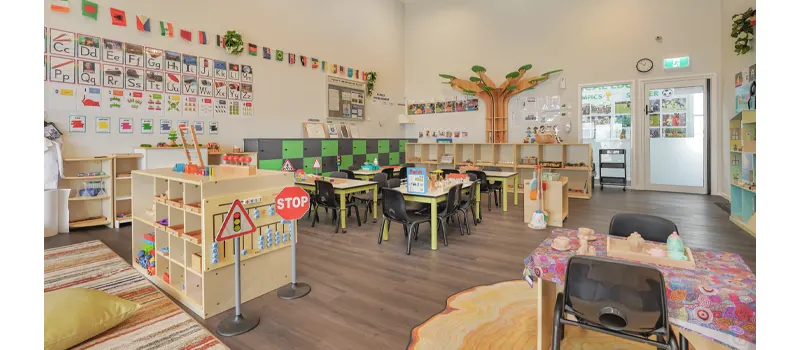
With support from our team, they organized a dedicated language area with trays of grammar symbols, printed sentence cards, and grammar booklets created by their staff. During morning work cycles, children would independently choose a sentence card, read it aloud, and use the symbols to analyze it.
Over time, the teachers noticed that students were transferring their grammar knowledge into writing tasks. Sentences became more descriptive, and children were more confident using adjectives, prepositions, and conjunctions in context. Teachers also reported a notable increase in students self-editing their writing using the symbol work as a reference point.
Montessori Grammar Symbols vs Traditional Grammar Teaching
The difference between using Montessori grammar symbols and relying on traditional instruction lies in how the information is presented to the child. Traditional methods often depend on rote memorization and abstract definitions from the very beginning. Teachers typically introduce a rule, such as telling students that a verb is an action word, and then ask them to underline verbs on a worksheet. This approach can feel disconnected from the real world and often leads to disengagement.
In contrast, the Montessori approach starts with concrete experiences before moving to abstract concepts. Instead of asking a child to memorize a definition, the teacher hands them a red sphere. The child feels the shape and sees the color. They associate the energy of the red ball with the energy of an action word. This sensory connection anchors the concept in their mind much more effectively than verbal repetition alone. Below is a comparison of key differences between the two approaches:
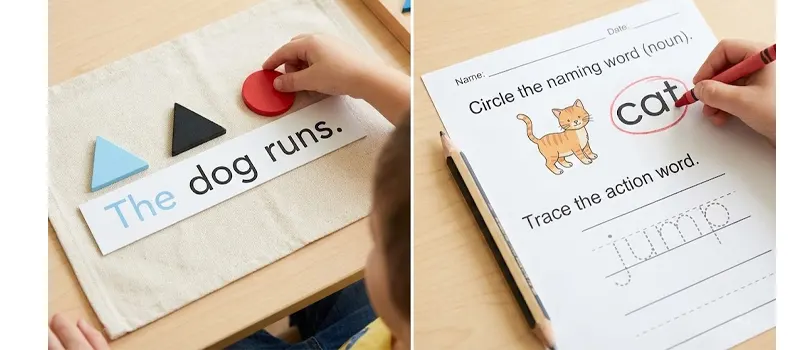
Learning Approach
- Montessori: Emphasizes discovery and hands-on learning. Children use symbols to analyze sentences physically, which helps them internalize grammatical relationships through direct experience.
- Traditional: Focuses on instruction and explanation. Teachers present grammar rules, and students are expected to apply them through written exercises.
Rôle de l'enseignant
- Montessori: Acts as a guide, introducing one concept at a time and allowing the child to explore and make connections independently.
- Traditional: Functions as the main source of information, delivering grammar lessons to the entire class with limited personalization.
Matériaux utilisés
- Montessori: Uses tactile materials like sentence strips and colored symbols to represent parts of speech. These materials are visually appealing and interactive.
- Traditional: Primarily uses textbooks, grammar charts, and blackboard explanations, which can feel detached from real-life language use.
Child Engagement
- Montessori: Children often enjoy grammar analysis because it feels like a puzzle or game. The process is engaging and open-ended.
- Traditional: Students may find grammar boring or difficult, especially when taught in isolation from reading and writing.
Long-Term Understanding
- Montessori: Encourages deep, intuitive understanding through repetition and real-world application. Children are able to generalize grammatical knowledge into their writing.
- Traditional: Can lead to surface-level understanding, where rules are memorized for a test but not retained over time.
How to Assess Progress with Montessori Grammar Symbols?
Assessing a child’s progress with Montessori grammar symbols is less about testing and more about observing how naturally they use and understand the symbols in context. Progress in Montessori education is measured through development, independence, and the depth of a child’s engagement with materials, rather than through standardized tests or grades.
Observing Speed and Confidence
The most immediate indicator of progress is the speed and certainty with which a child selects a symbol. A student who truly understands the concept will reach for the red sphere immediately upon identifying a verb. If a child frequently hesitates or hovers over multiple shapes before choosing one, it indicates they may still be confused about the function of that word. Teachers monitor this body language to decide if a lesson needs to be repeated.
Self-Correction Capabilities
Matériel Montessori are designed to include control of error. This means the activity itself often reveals mistakes to the learner. Progress is evident when a child can identify and correct their own errors without adult intervention. For example, if a student reads a sentence and realizes they have placed a noun symbol where a verb symbol belongs, they demonstrate a deep level of comprehension. This ability to self-audit is a major milestone in the learning process.
Verbal Explanation of Choices
Progress is also evident when a child can explain why they chose a particular symbol. For example, if asked, “Why did you place a red circle above this word?” the child might respond, “Because it shows what the cat is doing, so it’s a verb.” The ability to verbalize reasoning demonstrates both comprehension and metacognitive development.
Complexity of Sentence Structure
As students gain proficiency, their sentences should become more complex. Early progress involves labeling simple noun and verb combinations. Advanced progress is shown when a student can successfully analyze sentences containing prepositions, adverbs, and conjunctions. A teacher assesses progress by noting if the child can handle these more intricate sentence structures without feeling overwhelmed.
Transition to Abstraction
The ultimate measure of success is when the child no longer needs the physical objects. The Montessori grammar symbols are a bridge to abstract understanding. When a student can identify parts of speech in their head or on paper without needing to manipulate the wooden shapes, they have achieved the final stage of the curriculum. At this point, the symbols have served their purpose and the concept is fully mastered.
FAQ
What are Montessori grammar symbols used for?
They are used to represent parts of speech with specific colors and shapes so children can see how a sentence is built. This helps grammar feel concrete and easier to understand.
Are Montessori grammar symbols only for Montessori schools?
No. While they were created for Montessori classrooms, grammar symbols can be used effectively in any educational setting, including homeschool and traditional classrooms, to support language development.
Do children need to memorize grammar terms before using the symbols?
Not at all. In the Montessori approach, children learn grammar concepts through experience. They work with the symbols first and gradually learn the terminology in context as their understanding deepens.
What is the difference between Montessori grammar solids and grammar symbols?
The primary difference is the dimension and the stage of learning. Grammar solids are three-dimensional wooden objects used for the initial introduction to parts of speech. Their weight and shape provide a sensory experience for young children. The Montessori grammar symbols are flat, two-dimensional shapes made of paper or plastic. Students use these flat symbols for abstract work, such as analyzing sentences on paper, once they have understood the basic concepts.
Conclusion
Montessori grammar symbols are more than just colorful shapes; they are a key that unlocks the logic of language for young minds. By converting abstract grammatical rules into tangible, sensory experiences, this method allows children to see the structure of their thoughts.
Rather than memorizing rules, children discover grammar through play, observation, and hands-on exploration. This approach not only builds confidence but also lays the foundation for stronger reading and writing in the years to come. For educators and parents seeking a meaningful way to support early language development, Montessori grammar symbols are a thoughtful and proven resource.

 French
  English
  Arabic
  Italian
  German
  Spanish
  Thai
Thai  Japanese