Preschool assessments help you decide what a child is ready to learn next and what support will help. This guide explains what to observe, how to record meaningful evidence during everyday play, and how to turn your findings into teaching decisions and useful conversations with families.
What Are Preschool Assessments?
Preschool assessments are systematic ways to gather and interpret information about children’s learning and development. You collect evidence, relate it to appropriate learning goals, and use it to decide what to do next. The purpose is to understand each child, rather than create a classroom ranking.
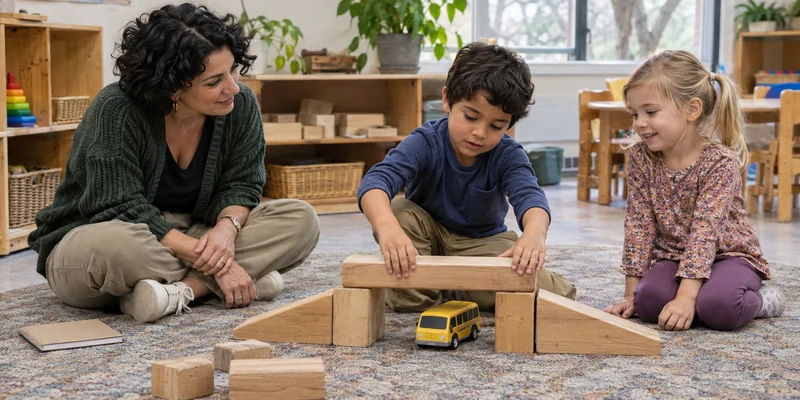
Preschool assessment includes more than testing. Watching a child negotiate a role in pretend play, reviewing drawings made over several weeks, and asking a family about storytelling at home can all contribute evidence. A test is a particular set of tasks or questions; it may be one part of an assessment, but it does not represent the whole process.
Consider a child who recites numbers but gives a toy animal two crackers when asked for four. Knowing the number sequence and connecting numbers to quantities are different skills. That observation gives you a more useful teaching starting point than a general comment such as “good at math.”
What Are the Main Types of Preschool Assessments?
For teaching, the main distinction is formative versus summative assessment. Preschool programs also encounter developmental screening and comprehensive evaluation, which answer different questions. These purposes are separate from methods such as observation or portfolios.
Valutazione formativa
Formative assessment informs teaching while learning is happening. You notice what a child understands, offer support or a new challenge, and check how the child responds.
For example, a child sorts buttons by color but has not yet tried another grouping. You might offer large, age-appropriate sorting pieces with clear differences in shape and ask, “Is there another way these could go together?” The response helps you decide whether to model a new sorting rule or extend the challenge.
Valutazione sommativa
Summative assessment summarizes learning at the end of a defined period, such as a term or curriculum unit. In preschool, this can be a teacher’s synthesis of observations, work samples, and an established assessment tool’s ratings. It need not be a sit-down examination.
A useful summary describes what the child now does, the evidence supporting that judgment, and any conditions that still matter. “Retells a familiar story using picture prompts” is more informative than “language skills improved.”
Developmental Screening
Developmental screening helps identify whether a child may need further evaluation in areas such as language, physical development, cognitive skills, or social-emotional development. It uses validated screening tools, such as caregiver questionnaires or structured activities, administered and interpreted by someone trained to use them. A concerning result does not mean a child has a developmental disorder. It simply indicates that further evaluation may be needed.
A teacher-created skills checklist is not automatically a screening tool. Milestone checklists can support developmental monitoring, but they cannot replace validated screening instruments. Preschools should use developmental screening alongside ongoing classroom observations to gain a clearer understanding of each child’s development.
Comprehensive Evaluation
When developmental concerns require further investigation, qualified professionals may conduct a comprehensive evaluation to gain a deeper understanding of a child’s strengths and needs. Depending on the evaluation and professionals involved, the findings may help identify support needs, determine eligibility for services, or inform a diagnosis.
Classroom records can provide valuable information during this process, including teachers’ observations, learning progress, and examples of a child’s everyday behavior. However, these records do not authorize teachers to diagnose developmental conditions or independently determine eligibility for special education services. A comprehensive evaluation should draw on multiple sources of evidence and use appropriate assessment tools administered and interpreted by qualified professionals.
What Developmental Areas Should You Assess?
Your records should show more than letter recognition and counting. Use your program’s early learning standards to identify relevant goals across development, then translate those goals into behaviors you can actually observe.
Sviluppo cognitivo
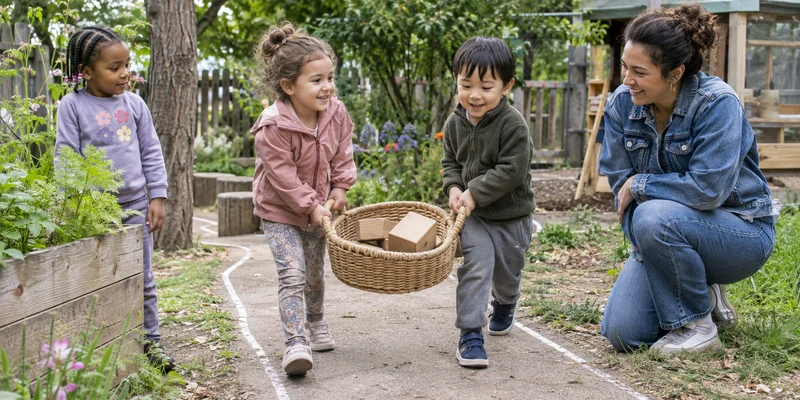
Look at how children solve problems, remember information, compare quantities, recognize patterns, and investigate cause and effect. Record their strategies as well as their answers. When a block bridge collapses, does the child repeat the same arrangement, widen the supports, or ask for another piece? Each response gives you different information about their thinking.
Language and Literacy
Observe understanding, conversation, storytelling, awareness of sounds and print, and early mark-making. A child can demonstrate story comprehension by arranging picture cards or acting out events before independently reading or writing. Record the language used and whether an adult supplied vocabulary or prompts.
Sviluppo socio-emotivo
Evidence of social and emotional development includes how children enter play, express needs, seek comfort, respond to peers, and recover after difficulty. Record the situation and adult support. Taking a turn after a teacher models a request is different from negotiating a turn independently; both are useful information.
Physical Development and Motor Skills
Notice movement, balance, coordination, manipulation of tools, and participation in daily routines. Watch a child pour water, turn book pages, carry materials, or use drawing tools. Identify any access barriers: an unstable seat or a container that is difficult to open may affect performance without telling you much about the skill you intended to observe.
Approaches to Learning
This area concerns how children engage with learning: curiosity, initiative, attention, flexibility, persistence, and creativity. Observe whether a child tries a new strategy or returns to a self-chosen project. Do not equate quiet sitting or immediate obedience with strong learning habits.
What Methods Are Used to Assess Preschool Children?
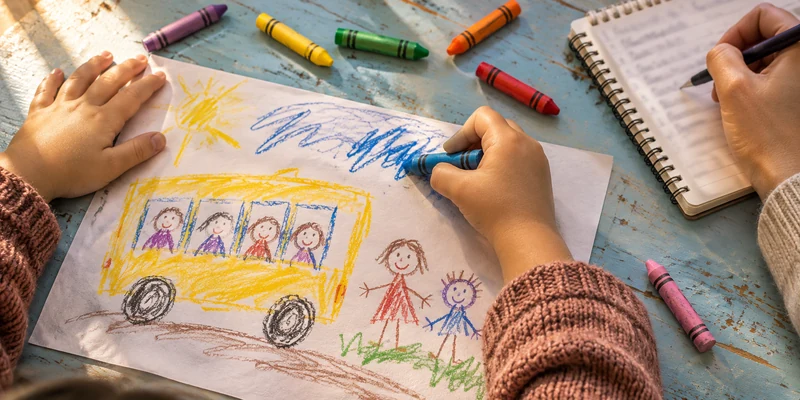
Choose a method that lets the relevant skill become visible. A finished picture can show mark-making, but it cannot reliably tell you how the child planned it, described it, or handled frustration while making it.
Osservazione
Observe during familiar routines and activities, with a question in mind. To understand peer entry, watch what happens when a child approaches an occupied play area. To understand counting, watch the child distribute materials at snack time. Let the activity continue naturally instead of turning every interaction into a question-and-answer session.
Anecdotal Records and Checklists
An anecdotal record is a short account of a particular event. Write what you saw and heard before adding an interpretation. Objective observation notes distinguish observable behavior from assumptions about a child’s intentions or feelings.
For instance, replace “Avery cannot share” with “When Sam reached for the truck, Avery held it against their chest and said, ‘I’m using it.’ After the teacher offered a timer, Avery passed the truck when it rang.” You can now identify both the difficulty and the support that helped.
A checklist helps you notice gaps in coverage. For your own classroom notes, distinguish observed independently, observed with support, and not yet observed, and attach a date and example. These are recording categories, not standardized scores. When using a published tool, follow its actual rating definitions.
Esempi di lavori e portfolio
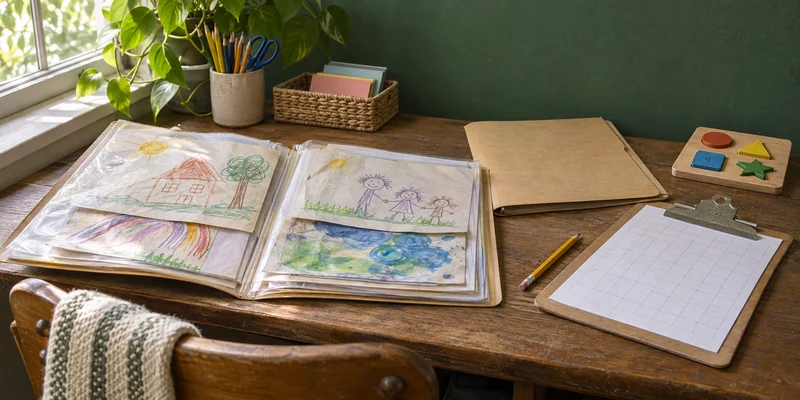
Select samples that show something meaningful: an early attempt, a later attempt, or a change in strategy. Add the date, activity, child’s explanation where relevant, and any adult assistance. Three carefully annotated samples can be more useful for a conversation than a folder full of undated artwork.
A photograph of a completed construction does not show who built it. Note whether the work was individual or shared and which contribution you observed.
Play-Based Assessment
Play provides a setting in which several skills can emerge together. A pretend grocery store might reveal counting, communication, role negotiation, and planning. Choose one or two observation goals so you can document them accurately without interrupting the play.
Play-based assessment is not necessarily informal: some structured instruments also use playful tasks. If you use one, follow its administration rules instead of changing prompts and treating the resulting score as comparable.
Family Input and Conversations
Ask for specific examples: “How does your child explain a game to a cousin?” will usually tell you more than “Is your child good at talking?” Families may describe skills that have not appeared in the classroom, especially in a home language.
For multilingual children, gather information about both English and the child’s home language, with qualified language support when needed. Assessment guidance for dual language learners explains why language background and family information matter. Limited English output alone should not be treated as evidence of a developmental delay.
How to Conduct Preschool Assessments in Your Classroom?
Build a manageable cycle: define a question, choose a suitable way to investigate it, collect evidence, interpret it, and plan a response. The following steps show how to run that cycle without creating a separate testing day for every child.
Step 1: Identify Your Assessment Goals
Start with a learning question precise enough to guide observation. “Understand math development” is broad. “Does the child match one object to each person when distributing materials?” is observable.
Keep your program’s full range of learning goals in mind, but focus on a limited number of skills during each observation. Before starting, consider what behavior would demonstrate the skill and what evidence would help you answer your question. Allow for different ways children may demonstrate the same ability rather than expecting every child to respond in exactly the same way.
Step 2: Choose Appropriate Assessment Methods
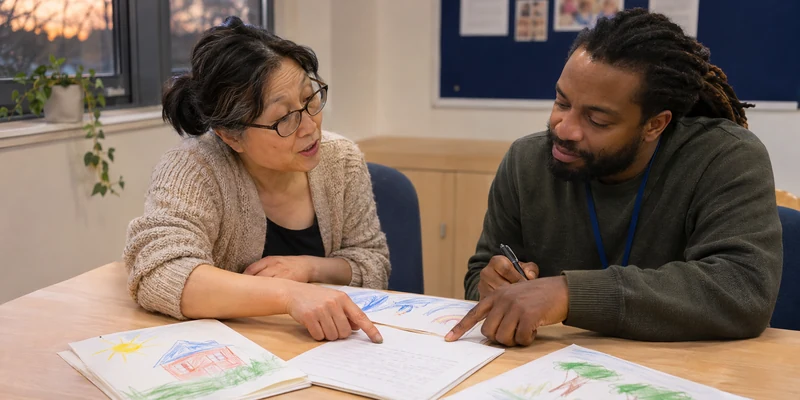
Choose a method that matches your assessment goal, the child’s age, communication abilities, and access needs. For example, real objects may reveal more about a child’s understanding of one-to-one counting than a worksheet. To review drawing development, dated work samples can help teachers compare changes over time.
Before adopting an assessment tool, check:
- Purpose and coverage: Does the tool support classroom planning, developmental screening, or another specific decision? Does it cover the developmental areas you need to assess?
- Validity and reliability: For published assessment instruments, is there evidence that the tool is suitable for the intended purpose, age group, and population?
- Practical fit: Can your staff follow the required instructions, training, administration, and documentation procedures?
- Accessibilità: Does the tool allow appropriate accommodations for children’s communication, language, and physical access needs? Could any adjustments affect how the results should be interpreted?
Teacher-created observation sheets and checklists can help organize classroom records, but they should not be treated as validated screening instruments. When using a standardized assessment, follow its administration and scoring instructions, including any restrictions on accommodations.
Do not choose a tool simply because it produces attractive reports. Its results are useful only when the evidence is appropriate for your children and the decisions you need to make.
Step 3: Observe and Document Progress
Use a consistent record format. Here is a fictional classroom example, not a developmental benchmark or screening result:
| Record Field | Example Entry |
|---|---|
| Child, Date, and Context | Child A; October 6; pretend café; two peers present |
| Learning Question | Does the child match one cup to each place setting? |
| Evidence | With five plates on the table, placed cups beside three plates, then put two cups beside the same plate. |
| Adult Support | After “Check whether every plate has a cup,” moved one cup to an empty place. One plate remained without a cup. |
| Interpretation to Explore | May need support keeping track of which places have a cup; one event is insufficient to establish a pattern. |
| Next Opportunity | Offer a smaller number of place settings, then observe another distribution task during a familiar routine. |
For a class of 20, teachers might organize focused observations by rotating four children each day across a five-day week. This is one way to manage documentation, not a recommended assessment frequency or a substitute for observing all children. Continue noticing children’s behavior during everyday activities, follow up when children are absent, and make sure documentation never interferes with active supervision.
Step 4: Review and Interpret the Evidence
Review records from different activities and occasions before drawing conclusions. Separate what the child did independently from what happened after an adult prompt. Consider whether the child demonstrates the same skill in different classroom situations, such as structured activities, free play, and daily routines.
In the café example, you still do not know whether the child was tracking quantities, distracted by a peer, or unfamiliar with the activity. A later observation during another snack-time or distribution task may provide more information. Missing evidence means you need another opportunity to observe; it does not automatically mean the child lacks the skill.
Look for both consistent patterns and differences between observations. If possible, review selected records with a colleague. If you interpret the same event differently, return to the original evidence and the assessment tool’s guidance before deciding on the next step. Avoid drawing conclusions from a single observation or assigning ratings that the available evidence cannot support.
Step 5: Plan a Response and a Review
Finish with a small, explicit plan: the goal, what you will change, who will provide the support, and when you will look again. For the café example, you could begin with fewer place settings and model checking each place, then look for independent use of that strategy in another routine.
Your review asks whether the support changed participation or understanding. It should not become repeated practice of an assessment item just to obtain a higher rating. If you identify a developmental concern, follow the referral process promptly rather than waiting for the next routine review.
How to Use Preschool Assessment Results to Improve Learning?
Preschool assessment results are useful only when they lead to better teaching decisions. Teachers can use what they observe to adjust group activities, provide individual support, communicate with families, and improve the classroom environment. The goal is to respond to children’s actual learning needs rather than simply record their performance.
Plan Activities Around Shared Needs
If several children can name shapes but have difficulty explaining how shapes fit together, plan a small-group construction challenge. Offer pieces to combine and questions about what changed. Children already exploring those relationships can try a more complex design.
Group children around a current learning need, then reconsider the grouping as new evidence appears. Avoid permanent “high” and “low” groups based on an early snapshot.
Provide Individualized Support
Not every child who struggles with an activity needs the same kind of support. Teachers should first identify what is making the task difficult, then choose an appropriate response.
For example, a child may understand a matching activity but have difficulty grasping small pieces. Providing larger, easier-to-handle materials may allow the child to demonstrate their understanding. However, if the difficulty comes from not understanding the matching rule, changing the materials alone will not solve the problem. The teacher may need to demonstrate the task or provide clearer instructions.
For children with an Individualized Education Program (IEP), coordinate classroom support with their families and relevant professionals. If new developmental concerns arise, share specific observations with families and help them understand how to access further evaluation. In the United States, children aged three and older may be evaluated through their local public school system, while state early intervention programs generally serve children under three. Eligibility and procedures vary by state.
Communicate Progress With Families
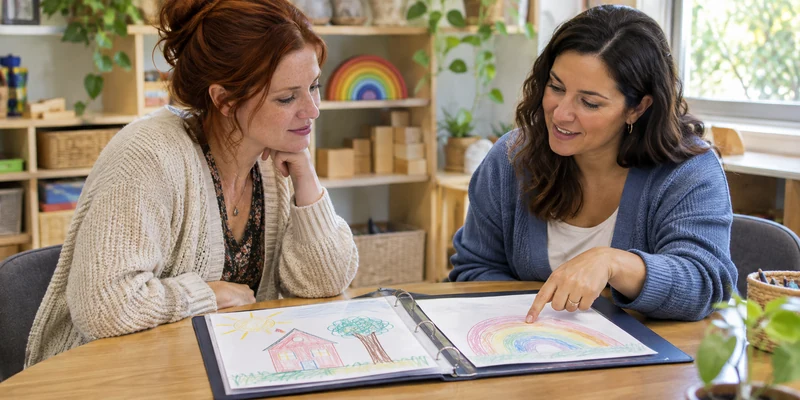
Bring a small selection of evidence and explain what changed. A useful conversation might begin: “In September, Jordan told the story by naming the pictures. This week, Jordan connected two events using ‘because.’ We are giving more time to explain characters’ choices. What kinds of stories do you hear at home?”
This fictional example shows a sequence you can reuse: evidence of progress, the current learning focus, and a question inviting the family’s perspective. Discuss concerns clearly and sensitively; do not hide them behind vague praise. Agree on the next contact or action before the conversation ends.
Review Teaching and the Learning Environment
When several children struggle with the same task, the issue may not be their individual abilities. Teachers should also examine whether the activity, instructions, materials, or classroom arrangement provide suitable opportunities for children to demonstrate their skills.
For example, if teachers want to assess whether children can independently select learning materials, but the materials are placed on shelves beyond their reach, the classroom arrangement prevents children from showing that ability. Moving appropriate materials within children’s reach, while maintaining safe supervision, gives them a better opportunity to make independent choices.
Assessment results can also help preschool directors identify where educators need additional support. This may include clearer assessment criteria, shared planning time, or guidance on interpreting children’s development. Collecting more records will not improve teaching if educators do not know how to use the information.
After making adjustments, observe children again to see whether the changes are helping. This ongoing process allows teachers to refine activities, individual support, and classroom arrangements based on children’s changing needs.
Common Mistakes to Avoid When Assessing Preschool Children
- Treating one event as a stable ability. Check whether the result appears again under appropriate conditions before making a broad classroom judgment.
- Confusing missing evidence with inability. “Not yet observed” calls for a suitable opportunity, not an automatic low rating.
- Ranking children instead of identifying next steps. Consider individual progress and relevant developmental expectations. When a qualified evaluator uses a norm-referenced instrument, its scores require the instrument’s prescribed interpretation.
- Measuring access or English proficiency by accident. Check whether language, motor demands, unfamiliar materials, or the setting changed what the task actually measured.
- Collecting records without acting on them. Every review should identify a teaching decision, a follow-up question, or a referral action where appropriate.
- Sharing identifiable records too widely. Use approved storage and communication systems, limit access, and follow applicable consent and confidentiality requirements for observations, photos, and recordings.
FAQs About Preschool Assessments
How Often Should Preschool Assessments Be Conducted?
Gather evidence during normal activities throughout the year. Review it often enough to adjust teaching, and complete formal checkpoints according to your program and tool. A start-of-year baseline with later summaries can be useful, but no single schedule fits every program. Address concerns when they arise.
What Is the Difference Between Assessment and Developmental Screening?
Classroom assessment helps you plan teaching and monitor learning. Developmental screening identifies possible concerns that may need further evaluation. A completed screening does not replace ongoing classroom assessment, and a classroom portfolio does not replace a required screening.
Are Preschool Assessments Standardized Tests?
Not necessarily. Assessment may include observations, family information, work samples, and structured tasks. “Standardized” means procedures and scoring are specified; it does not necessarily mean a paper-and-pencil test. Use standardized tools according to their instructions and intended purpose.
How Can You Assess Children Who Cannot Read or Write Yet?
Use actions, conversation, gesture, play, drawing, and manipulation of real objects. To investigate story understanding, for example, invite children to act out an event or order pictures. Choose a response format that lets the target skill appear without requiring an unrelated skill.
How Should Teachers Share Results With Parents?
Meet privately, explain ratings in plain language, and show a few dated examples. Invite the family’s observations, provide language support where needed, and agree on one useful next step. Avoid presenting a score without explaining what it means for the child’s daily learning.
At What Age Should Children Start Preschool Assessments?
Developmental monitoring can begin during infancy and continue throughout the preschool years. The appropriate assessment tools depend on the child’s age and developmental stage. For example, an assessment designed for a three-year-old may not be suitable for a child who is just beginning to walk and talk. Always check the age range specified by the assessment tool.
How Should Preschool Assessments Be Conducted for Bilingual Children?
Bilingual children may demonstrate different language abilities depending on which language they use and how much experience they have with each one. Teachers should consider the child’s language exposure and communication skills across both languages rather than judging development only through English proficiency. When concerns arise, a qualified professional familiar with bilingual development can help determine whether further evaluation is appropriate.
Conclusione
Effective preschool assessments lead to a clear next step. Start with a meaningful question, collect evidence in appropriate contexts, and use what you learn to adjust teaching. A manageable process that changes children’s learning experiences is more useful than a large collection of unused records.


 Italian
 English
 Arabic
 French
 German
 Spanish
 Thai
 Japanese