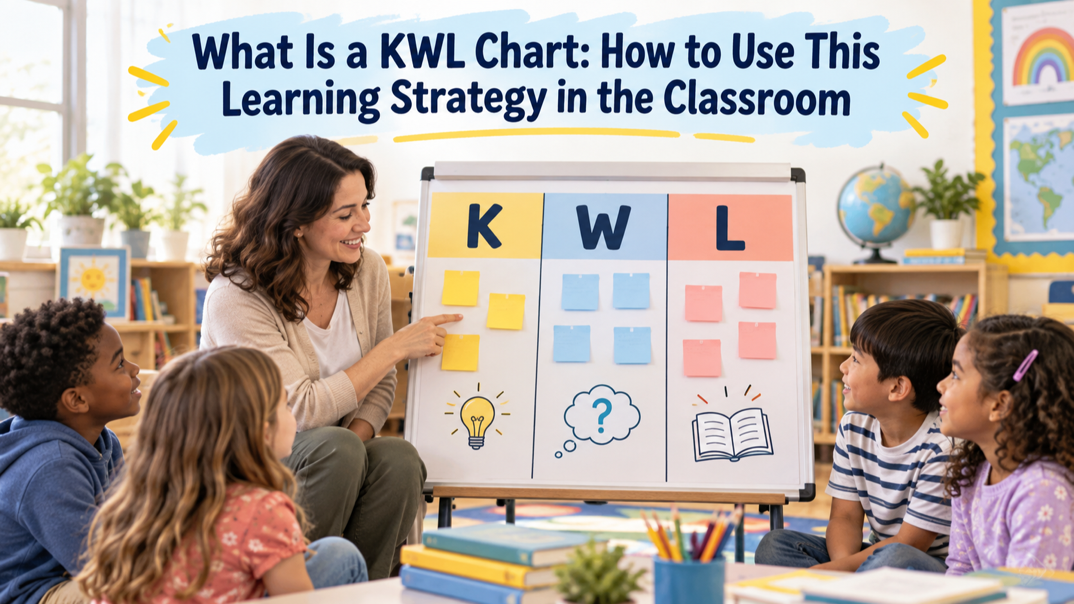
A KWL chart is a simple three-column organizer that helps learners connect what they already know with what they want to find out and what they learned. Teachers can use it before, during, and after a lesson, reading, investigation, or class discussion to make learning visible.
In this guide, you will learn what each part of a KWL chart means, how to introduce it step by step, how to adapt it for young children and multilingual learners, and how to use the finished chart as a formative learning record rather than as a worksheet to grade.
What Is a KWL Chart?
A KWL chart is a simple learning tool that helps students organize what they know, what they want to learn, and what they have learned about a topic. It is usually divided into three columns: K, W, and L.
| Section | Meaning | What Students Do |
|---|---|---|
| K – Know | What I already know | Students share facts, ideas, or experiences they already have about the topic. |
| W – Want to Know | What I want to know | Students ask questions or identify things they want to understand better. |
| L – Learned | What I learned | Students record new information after a lesson, activity, reading, or discussion. |
Because the structure is simple, a KWL chart can be used with many subjects, including science, social studies, reading, and project-based learning. Teachers often use a KWL chart before, during, and after a lesson. The first two columns help activate prior knowledge and identify students’ questions. The final column helps students review what they learned and see whether their original questions were answered.
This purpose is consistent with guidance from Reading Rockets, the University of Delaware, and Facing History & Ourselves: a KWL chart activates background knowledge, gives learners a reason to read or investigate, and supports reflection after learning.

What the K, W, and L Columns Mean?
Each column in a KWL chart represents a different stage of the learning process. Together, they help students connect what they already know with the questions they have and the new information they gain.
K: What I Know
Begin with the learners’ starting knowledge. Invite them to share facts, observations, experiences, vocabulary, predictions, or ideas connected to the topic. “Know” can be interpreted flexibly with young children: “What have you seen?” or “What do you notice?” may produce richer responses than “What facts do you know?”
Teachers should record ideas respectfully and avoid immediately turning the opening conversation into a correction session. Instead, listen for ideas that can be confirmed or revisited later. If a statement may be inaccurate, write it in a neutral way or mark it with a question so the class can check it during the lesson.
W: What I Want to Know
The W column captures curiosity and learning goals. Students may ask direct questions, such as “Why do some seeds grow faster?” They may also identify a process they want to understand, a word they want defined, or evidence they want to find.
Help learners turn broad interests into questions that the lesson, text, experiment, or source can actually address. For example, “Tell me everything about space” is too broad for one short lesson, while “How do astronauts get air to breathe?” gives the class a clear question to investigate.
L: What I Learned
Complete the L column during or after the learning experience. Students should record new information in their own words, draw a labeled picture, explain a change in thinking, or point to evidence that answers a W question.
The L column is stronger when it includes more than copied sentences. Ask prompts such as “What is new for you?”, “Which question can we answer now?”, “What evidence supports that idea?”, and “What do you understand differently?” Unanswered questions can remain visible for a later lesson or be used to plan the next investigation.
How to Use a KWL Chart Step by Step?
Using a KWL chart does not require a complicated lesson plan. You can introduce it at the beginning of a new topic, return to it as students explore the subject, and complete it when the lesson or unit ends.

Step 1: Introduce the Topic and Set Up the Chart
Start by introducing the topic students are about to explore. Display a KWL chart where everyone can see it, or give each student a copy.
Before adding anything to the chart, briefly explain to students that this chart will be used to record what they already know, what they want to know, and what they learn during the exploration.
For younger students, you can complete one large class chart together and help them record the answers.
Step 2: Fill In the K Column
Ask students what they already know about the topic. Encourage them to share facts, experiences, observations, or ideas rather than trying to produce a perfect answer.
You can use prompts such as:
- What do you already know about this topic?
- Where have you seen or heard about it before?
- What do you think about it?
Record the responses in the K column. If students share incorrect information, you do not need to correct it. You can return to those ideas later and compare them with what students discover during the lesson. If students give conflicting statements, record both and explain that the class will investigate them. This makes the chart a record of thinking, not just a display of answers the teacher already expects.
Step 3: Develop Questions for the W Column
Next, ask students what they want to learn about the topic.
Help them turn their curiosity into clear questions. Instead of writing broad statements such as “I want to know more about plants,” encourage more specific questions such as “What do plants need to grow?” or “Why do some plants grow better in sunlight?”
Add these questions to the W column. They can then act as a guide for reading, research, discussion, experiments, or other classroom activities.
(Choose a manageable set of questions to investigate. You do not need to answer every question in one lesson. Keep additional questions visible so students can see that good inquiry can continue beyond a single reading or activity.)
Step 4: Keep the Chart Active During Learning
A KWL chart should not sit untouched until the lesson ends. Return to it while students are learning. When students encounter information that confirms, expands upon, or challenges a point in column K, you can add brief notes next to the chart, or have students stick sticky notes next to the relevant questions.
Students can add new questions, revise earlier ideas, or note information that answers something from the W column. This makes the chart part of the learning process rather than simply an activity completed at the beginning and end of a lesson.
During a science activity, remind learners to distinguish what they observed from what they inferred. During reading, ask them to locate the part of the text that supports a new idea. In social studies, encourage them to compare information from more than one source when the topic requires it.
Step 5: Complete the L Column
Return to the chart while the learning is fresh. Give students time to explain or draw what they learned before the teacher summarizes. Match new learning to the W questions where possible, and note questions that remain open.
Encourage them to record specific ideas rather than simply writing “I learned about plants.” For example, they might write, “Plants need light, water, air, and suitable conditions to grow.”
Students can then compare the L column with the ideas they recorded in the K column and the questions they asked in the W column.
Step 6: Review Unanswered Questions
Finally, return to the W column and check which questions have been answered.
Some questions may still remain. Instead of treating them as unfinished work, you can use them as starting points for further reading, research, discussion, or future lessons.
This final review helps students see that learning does not always end when one lesson is finished. New information often leads to new questions. This step helps children see learning as a change in understanding rather than as the simple collection of unrelated facts.

KWL Chart Example: How Seeds Grow
The example below shows how a class might use a KWL chart during a plant investigation. The exact answers will depend on the materials, text, and conditions being studied, so treat the example as a model rather than a script.
| K: What I Know | W: What I Want to Know | L: What I Learned |
|---|---|---|
| Seeds can grow into plants. | What does a seed need to start growing? | In our investigation, the seeds needed moisture, air, and a suitable temperature to germinate. |
| Plants have roots. | What do roots do? | Roots anchor the plant and absorb water and minerals from the growing medium. |
| Plants need light. | Why do plants need light? | Plants use light for photosynthesis, which helps them make food and grow. |
Notice that the L column refers to “our investigation.” That wording matters because observations can depend on the species, environment, materials, and time available. A KWL chart should help students connect claims to the evidence and learning experience they actually had.
Benefits of Using KWL Charts
A well-facilitated chart can support several parts of learning at once:
- It activates background knowledge. Students have a starting point for new information instead of approaching a topic with no context.
- It creates a purpose. Questions in the W column give learners a reason to read closely, listen, observe, or investigate.
- It makes thinking visible. Teachers can notice vocabulary gaps, partial understanding, interests, and possible misconceptions.
- It supports oral language. Learners practice explaining experiences, asking questions, and summarizing ideas.
- It encourages reflection. The L column asks students to identify what changed or became clearer.
- It informs next steps. Unanswered questions and uncertain ideas can guide another mini-lesson, small-group activity, or follow-up text.
These benefits do not happen automatically. The quality of the discussion, the relevance of the learning materials, and the teacher’s follow-up questions matter more than the visual template itself. Think of the KWL chart as a structure for purposeful conversation and formative observation.

How to Adapt a KWL Chart for Different Learners?
A KWL chart can be adjusted to match students’ age, independence, and language ability. The basic structure stays the same, but the way students respond can change.
For Preschool and Younger Learners
Use a large class chart with simple language, pictures, or real objects. Children can respond by speaking, pointing, or drawing while you record their ideas.
Keep the number of questions small and focus on what children notice, know, and want to explore.
For Older or More Independent Students
Older students can write more detailed responses and support their L-column ideas with evidence from texts, observations, or research.
They can also return to the K column to correct or expand ideas as their understanding develops.
For Multilingual Learners
Use pictures, gestures, word banks, sentence frames, and partner discussion to support participation.
Students can first express an idea in a familiar language and then connect it to the classroom language. The focus should remain on understanding the topic, not on language proficiency alone.

How to Make a KWL Chart Work Better
- Keep the topic focused. A clear topic makes it easier for students to connect prior knowledge, questions, and new learning.
- Avoid giving students the answers. Use prompts to guide thinking, but let students decide what they know and what they want to investigate.
- Group similar ideas. When several students raise related ideas or questions, combine them so the chart stays clear and easy to follow.
- Use the chart to guide the next lesson. Look for gaps, misconceptions, or repeated questions that can help you decide what needs more attention.
- Leave room for uncertainty. Not every question needs an immediate answer. An unanswered question can become the starting point for further reading, discussion, or investigation.
Common KWL Chart Mistakes
A KWL chart is simple to use, but a few common mistakes can make it less useful for learning.

Treating the K Column as Facts Only
The K column can include experiences, observations, vocabulary, predictions, and beliefs—not just correct facts. If every imperfect answer is corrected immediately, students may become less willing to share what they think.
Filling In the W Column for Students
You can model how to ask a useful question, but avoid deciding all the questions for the class. Give students time to think, talk with a partner, or respond to a prompt before stepping in.
Forcing the Three Columns to Match
The K, W, and L columns do not need to line up row by row. Students may learn something they did not originally ask about, and some questions may have no connection to their prior knowledge.
Using the Chart as a Graded Test
A KWL chart can show you what students are thinking, but it should not automatically be treated as a measure of mastery. Use other forms of assessment when you need to evaluate a specific learning goal.
Expecting Every Question to Be Answered
Not every question in the W column needs an answer by the end of the lesson. Some may require another source, a longer investigation, or a future lesson. Keep those questions rather than forcing an answer that the learning activity cannot support.
Making the Topic Too Broad
A topic that is too broad can produce scattered ideas and questions that are difficult to explore in one lesson. Narrow the focus so students can build meaningful connections between what they know, what they ask, and what they learn.

Useful KWL Chart Variations
Some classrooms extend the three-column routine when learners need to plan research or explain how they found an answer:
- KWHL: Know, Want to know, How will we find out, Learned.
- KWLH: Know, Want to know, Learned, and How can we learn more or How will we use it?
The added column is useful when the process of finding information matters. For example, students might list whether they will use a book, observation, interview, demonstration, or reliable website. Choose a variation only when it clarifies the learning process; a simple three-column chart is often enough for a short lesson.
Frequently Asked Questions About KWL Charts
What Age Group Is a KWL Chart Best For?
KWL charts can be used from preschool through upper elementary and beyond. Younger children may respond with pictures, spoken ideas, or teacher-recorded answers, while older students can write more detailed questions and evidence-based reflections.
When should a KWL chart be used?
Use it before instruction to surface prior knowledge and questions, during learning to monitor ideas, and after learning to summarize and reflect. You can use all three stages or select the parts that fit the lesson.
What If Students Know Very Little About the Topic?
You can give students a short introduction, image, object, video clip, or brief discussion before starting the chart. The goal is not to provide all the answers, but to give them enough context to begin thinking and asking meaningful questions.
How can I use one with children who cannot write yet?
Use real objects, photos, drawings, gestures, oral responses, picture cards, and teacher scribing. Young learners can contribute valuable thinking without writing a complete sentence independently.
Is a KWL chart an assessment?
It is best used as a formative tool that helps a teacher notice starting points, questions, and changes in understanding. It can contribute to assessment evidence, but it should not be the only basis for grading or deciding whether a learner has mastered a complex goal.
Should Students Complete KWL Charts Individually or as a Class?
Both approaches can work. A whole-class chart encourages discussion and is useful for younger learners, while individual charts give each student more space to record personal ideas and questions. You can also combine both methods.
خاتمة
A KWL chart gives a lesson a visible learning path: start with what learners bring, identify what they want to understand, and return to the topic with evidence and reflection. Its power comes from the conversation around the chart, not from the three letters alone.
Keep the topic focused, welcome different ways of contributing, revisit early ideas, and leave unanswered questions available for future learning. Used this way, a KWL chart can help children become more curious, more aware of their thinking, and more able to explain how their understanding develops.






 Arabic
  English
  French
  Italian
  German
  Spanish
  Thai
Thai  Japanese