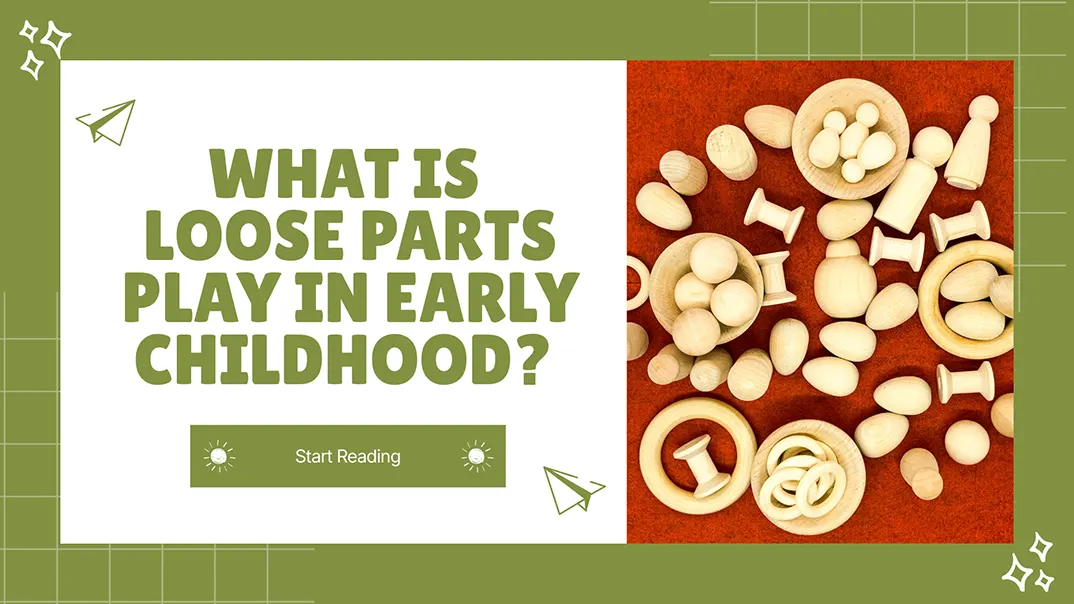
In early childhood education, loose parts play refers to the use of open-ended materials that can be moved, carried, combined, redesigned, lined up, and taken apart in multiple ways. Unlike a puzzle with only one correct solution or a toy car designed only to roll forward, loose parts come with no specific set of directions.
Why does this kind of play matter so much? The answer lies in the fundamental way young children learn. They are not simply looking to be entertained. They are driven to explore, manipulate, compare, transform, and gradually master the world around them. That instinct is at the heart of loose parts play. Whether it is a handful of acorns, a collection of wooden blocks, or objects explored at a sand and water play table, loose parts give children the freedom to become the architects of their own play.
In this article, we will explore what loose parts play really means in early childhood, why it matters for child development, what materials are commonly used, and how schools can create environments that support this kind of open-ended learning more effectively.
The Origins of Loose Parts Play
The concept of “loose parts” is not a modern parenting fad; it is deeply rooted in environmental design and developmental psychology.
The term was first coined in 1971 by British architect Simon Nicholson in his groundbreaking essay, How NOT to Cheat Children: The Theory of Loose Parts. Nicholson challenged the idea that creativity is a rare gift possessed only by a few. Instead, he argued that all children are born creative, but their environments often restrict this potential.
To emphasize this, Nicholson established a core principle that remains a cornerstone of modern early childhood education:
“In any environment, both the degree of inventiveness and creativity, and the possibility of discovery, are directly proportional to the number and kind of variables in it.” — Simon Nicholson
In simpler terms, a static environment dictates how a child plays, while a dynamic environment filled with variables (loose parts) invites a child to invent.
Today, this evidence-based theory is a guiding philosophy in the world’s most respected early childhood frameworks. In the Reggio Emilia approach, loose parts are considered “the hundred languages of children,” offering infinite media for self-expression. Similarly, in Montessori classrooms, carefully curated open-ended materials are deliberately placed on accessible, child-sized shelving to foster deep concentration and self-directed learning.
When early learning spaces are intentionally designed to incorporate these variables, we shift the focus from the toy to the child’s mind.
Benefits of Loose Parts Play
Loose parts play supports multiple areas of early childhood development. Because the materials have no fixed purpose, children must actively think, experiment, and adapt their ideas during play. This process strengthens cognitive skills, physical coordination, social interaction, and emotional confidence. Research in aprendizaje basado en el juego consistently shows that open-ended materials encourage deeper engagement and longer periods of focused play compared with single-purpose toys.

Fosters Divergent Thinking and Cognitive Flexibility
Most commercial toys are designed for convergent thinking, meaning there is only one correct way to use them or one single outcome to achieve. Loose parts, however, are the ultimate tools for divergent thinking.
Because a collection of wooden rings, pinecones, or fabric scraps has no defined purpose, children are forced to generate multiple solutions and ideas. A smooth wooden block can be a phone today, a stepping stone tomorrow, and a piece of pie the next day. This constant reimagining builds cognitive flexibility, allowing them to adapt to new situations and think outside the box as they grow.
Supports “Schema Play” and Early STEM Concepts
If you have ever watched a child obsessively move items from one basket to another, or line up objects in a perfectly straight row, you are witnessing “schema play” (repeated patterns of behavior children use to explore the world). Loose parts are the perfect fuel for these natural developmental urges.
Furthermore, loose parts inherently introduce foundational STEM (Science, Technology, Engineering, and Math) concepts without the need for formal instruction.
- Physics and Engineering: Stacking asymmetrical natural materials or balancing wooden loose parts teaches gravity, weight distribution, and spatial awareness.
- Math and Volume: When interacting with a sand and water play table, measuring, pouring, and transferring materials like gravel or water helps children intuitively grasp concepts of volume, capacity, and conservation.
Enhances Rich Language Development and Peer Collaboration
When a toy dictates the play, the language surrounding it is usually predictable and limited. However, when the materials are ambiguous, the necessity for communication skyrockets.
In a group setting, if a child wants a piece of driftwood to represent a “bridge” in their shared imaginary world, they must articulate this rule to their peers. This leads to complex social negotiations:
- Expressive Language: Describing textures, sizes, and the imaginary functions of the materials.
- Collaboration: Working together to move heavier items or design a shared structure.
- Conflict Resolution: Navigating differing ideas on how a specific loose part should be used within the game.
Encourages Healthy Risk Assessment and Autonomy
Modern early childhood frameworks in Australia, Canada, and the US heavily emphasize the importance of “healthy risk-taking.” Overly sanitized, structured play environments often remove a child’s opportunity to evaluate physical boundaries.
Loose parts, whether they are heavy tree stumps, long cardboard tubes, or varied textured materials, require children to navigate their environment deliberately. They must ask themselves: Is this too heavy for me to lift alone? Will this tower fall if I add one more piece? This continuous feedback loop builds physical self-regulation, spatial awareness, and a deep sense of autonomy and self-confidence.
Types of Loose Parts Materials
One of the most appealing aspects of loose parts play is that these materials are entirely boundless. They can be gathered from a forest walk, rescued from the recycling bin, or carefully sourced from high-quality educational suppliers.
Nature-Based Loose Parts
Nature is the original provider of open-ended materials. These items offer incredible sensory input, connecting children to the natural world through varied textures, weights, and temperatures.
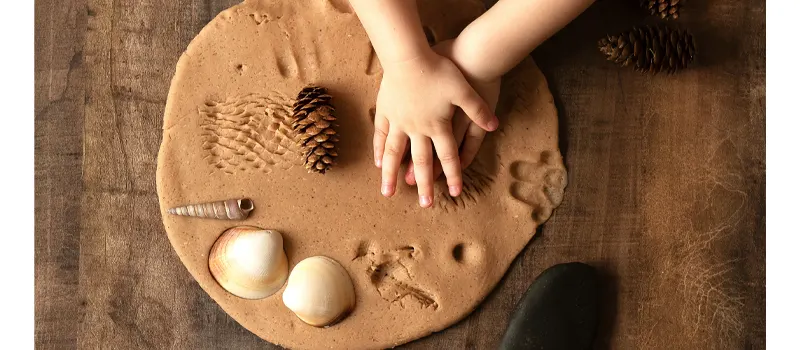
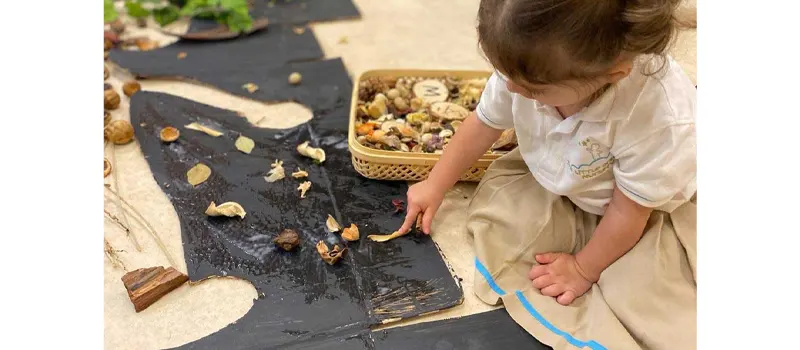
Examples include pinecones, smooth stones, shells, acorns, driftwood, twigs, and dried leaves. These materials are especially valuable for sensory exploration and imaginative play because no two pieces are exactly the same.

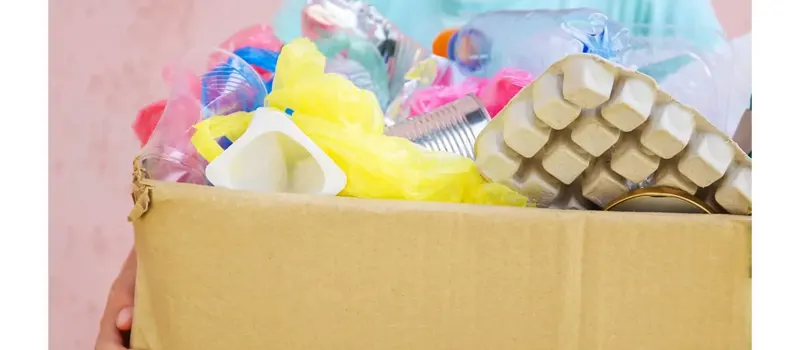
Recycled and Everyday Materials
In North America and Australia, sustainability in early childhood education is a massive focus. Repurposing everyday household or industrial items teaches children resourcefulness and environmental stewardship.
Examples include cardboard tubes, fabric scraps, wooden spools, bottle caps, egg cartons, and small containers. These materials often inspire inventive uses because children can reinterpret them in many different ways.
Classroom Loose Parts Sets
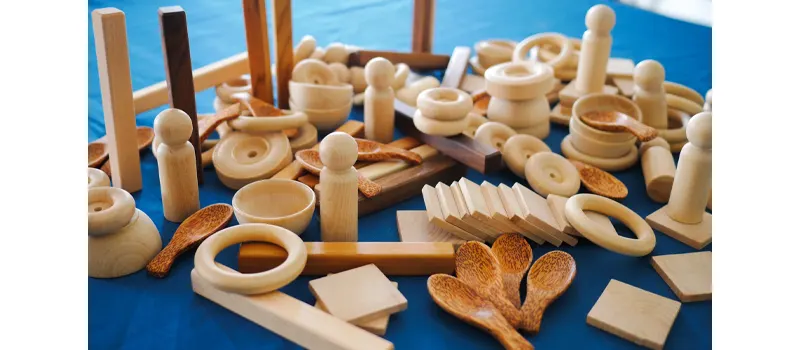
In busy preschool environments, many educators choose professionally designed loose parts sets made specifically for classroom use. These materials are typically crafted from durable, child-safe materials and designed to be handled frequently throughout the day.
Examples include wooden rings, discs, pegs, stacking shapes, small bowls, and sorting trays. These carefully produced materials offer consistent sizes and smooth finishes, making them practical for structured classroom environments while still supporting open-ended exploration.
Sensory and Fluid Materials
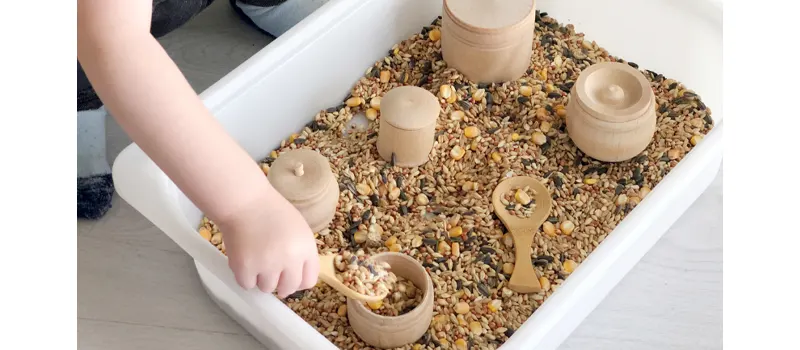
Loose parts are not limited to solid objects. Fluid and granular materials provide some of the most dynamic forms of open-ended play because they can be poured, mixed, measured, and reshaped continuously.
Common examples include sand, water, gravel, mud, kinetic sand, and dry sensory bases such as rice or chickpeas. These materials allow children to experiment with movement, volume, and transformation in ways that solid objects cannot.
Loose Parts Play Examples
Loose parts play can take many forms in early childhood classrooms because the materials themselves do not define the activity. Instead, children shape the experience based on their ideas, interests, and developmental stage. The following examples illustrate how loose parts can support different types of play and learning experiences in early childhood environments.
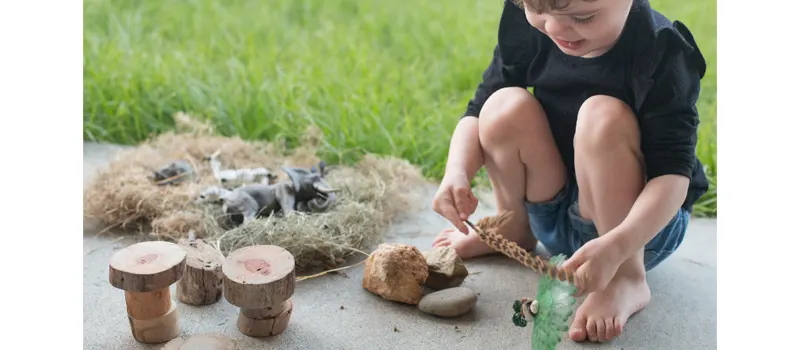
1. Building and Construction Play
Children can use wooden blocks, stones, corks, tubes, shells, or small planks to create towers, bridges, roads, houses, or imaginary cities. This type of loose parts play encourages children to test balance, structure, and design while developing problem-solving skills through hands-on experimentation.
2. Sorting and Pattern-Making Activities
Loose parts such as buttons, wooden discs, acorns, leaves, beads, or bottle caps can be sorted by size, color, shape, or texture. Children may also line them up to create repeating patterns, sequences, or simple designs, which supports early math thinking and careful observation.
3. Small World and Storytelling Play
Children often use loose parts to create story scenes, pretend landscapes, or miniature worlds. A few wooden rings may become stepping stones, fabric pieces may turn into rivers or blankets, and natural materials may represent forests, mountains, or animal homes, helping children expand imaginative thinking and narrative skills.
4. Sensory Play with Natural Materials
Loose parts play works especially well in sensory activities using sand, water, pebbles, scoops, pinecones, shells, or wooden tools. At a sand and water play table, children can pour, mix, transfer, bury, collect, and compare materials, turning sensory exploration into a richer and more open-ended learning experience.
5. Loose Parts Art and Design
Children can arrange loose parts into pictures, shapes, mandalas, or temporary designs on trays, tables, or the floor. Instead of focusing on a finished craft with one expected result, this type of activity allows children to experiment with composition, symmetry, texture, and visual expression in a more flexible way.
6. Counting and Early Math Exploration
Loose parts can be used for counting, matching, comparing quantities, measuring length, and exploring simple number concepts. For example, children may count stones into groups, use wooden pieces to represent numbers, or compare which collection is larger or smaller, making abstract math ideas easier to understand.
7. Outdoor Loose Parts Play
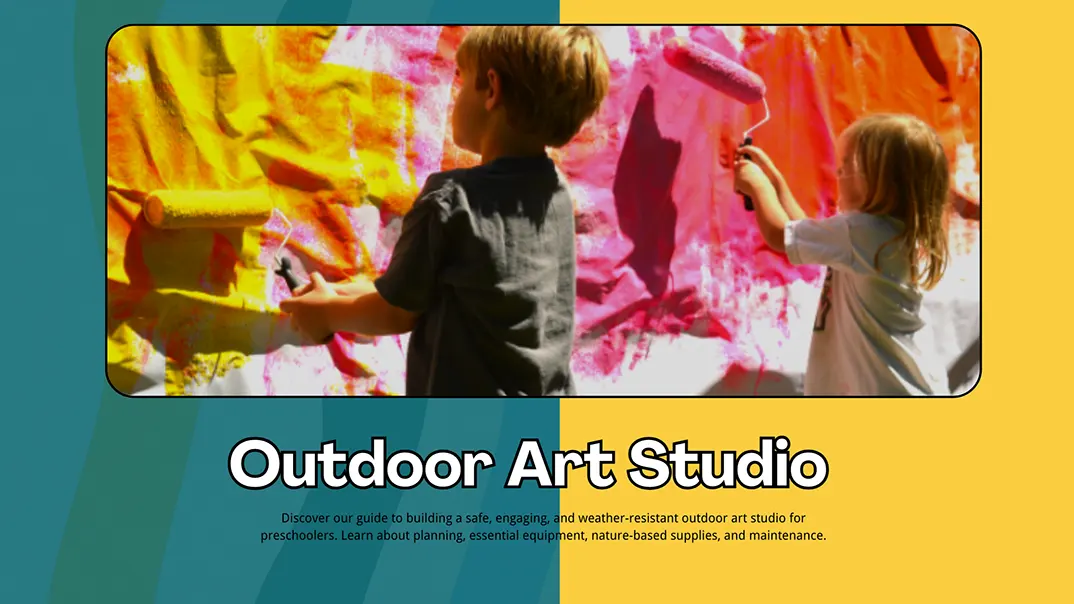
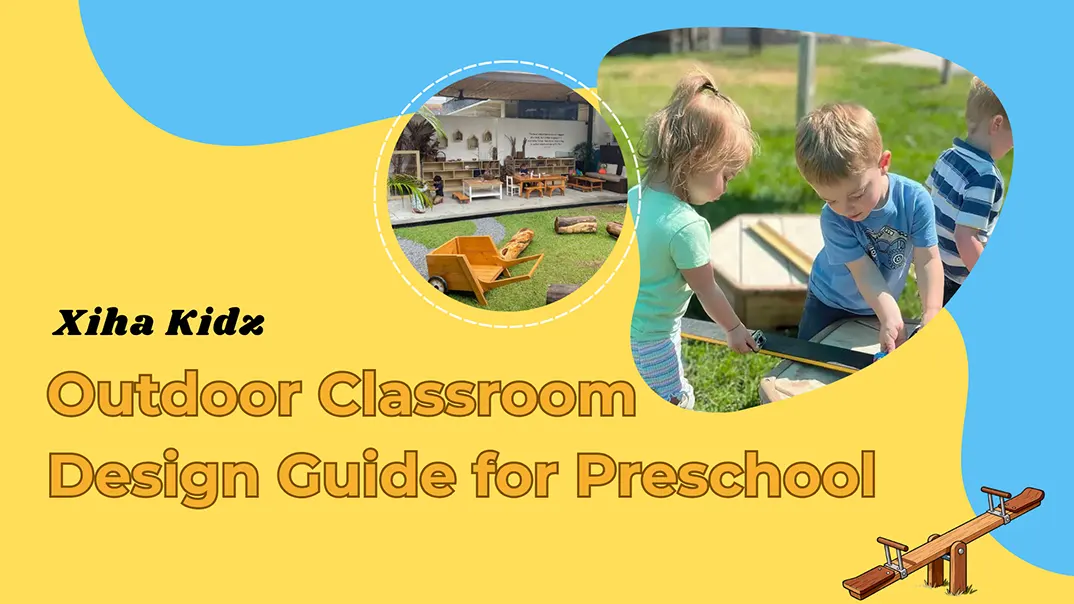
In outdoor settings, children may use crates, logs, buckets, fabric, sticks, tires, or large natural objects to build obstacle paths, pretend shelters, or collaborative play structures. Outdoor loose parts play often encourages larger movements, teamwork, and more physical exploration than indoor activities.
8. Role Play and Everyday Life Scenarios
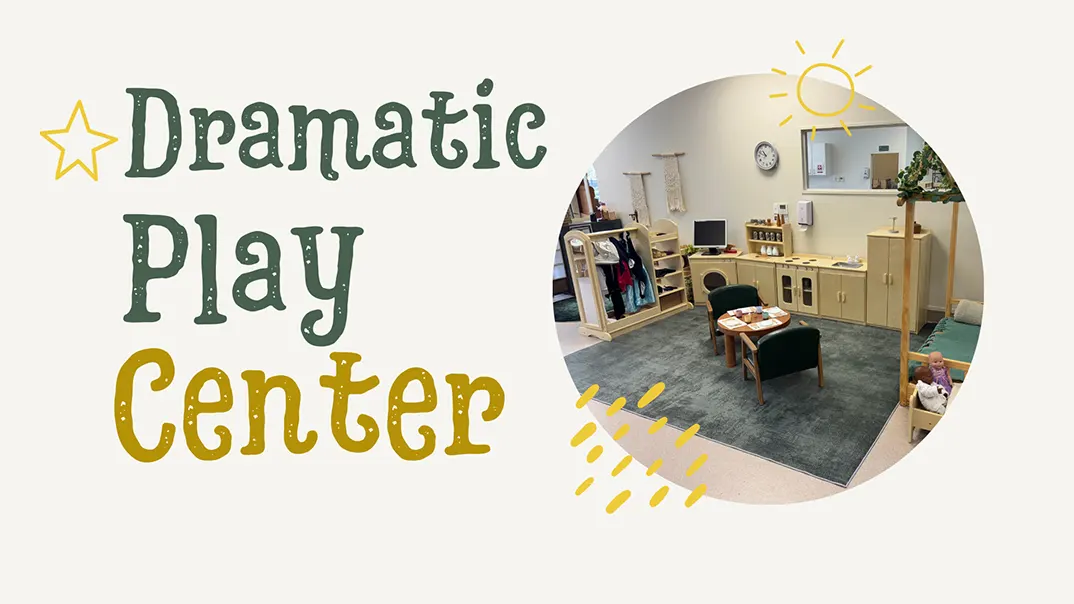
Loose parts can easily become pretend food, money, tools, furniture, or shop items during dramatic play. Children may use bowls, wooden tokens, spoons, fabric pieces, and baskets to set up a market, kitchen, café, or home scene, which helps connect imaginative play with everyday experiences.
How to Choose the Best Loose Parts for Your Classroom?
Curating a loose parts collection for an early learning centre requires a delicate balance. Educators must weigh open-ended freedom against rigorous safety standards and classroom durability. The right loose parts should encourage exploration without overwhelming the space, and they should work well with the age group, classroom layout, and daily teaching routines.
1. Start with the Age and Developmental Stage of the Children
The first step is to choose loose parts that match the children’s age, abilities, and developmental needs. Younger children usually benefit from larger, simpler materials that are easy to grasp, move, and combine safely, while older preschoolers can handle smaller pieces, more detailed sorting tasks, and more complex building or design activities.
2. Prioritize Safety and Durability
Loose parts should always be safe for regular classroom use. That means checking for choking hazards, sharp edges, splinters, breakable pieces, rust, or unsafe finishes. It is also important to choose materials that can withstand repeated handling, dropping, sorting, and storage, especially in busy early childhood environments where materials are used every day.
3. Select Loose Parts That Support Different Types of Play
A balanced classroom collection should support more than one kind of activity. Some loose parts are ideal for building and construction, while others work better for sensory play, art, dramatic play, storytelling, or early math exploration. Choosing materials with a range of possible uses helps create a more flexible classroom environment where children can learn through different forms of play.
4. Include a Mix of Textures, Shapes, and Sizes
A strong loose parts collection usually includes a variety. Materials with different textures, weights, shapes, and sizes make play more interesting and support a wider range of learning experiences. Natural objects, wooden pieces, fabric items, recycled materials, and simple classroom-safe manipulatives can all work together to create a richer and more engaging play environment.
5. Choose Materials That Fit Your Classroom Space
Loose parts should match the size and layout of the classroom. Large items may work well in spacious activity areas or outdoor settings, while smaller materials are often better for table work, trays, or defined learning centers. Teachers should also think about how children will access the materials and whether the space allows for building, sorting, dramatic play, or sensory exploration without creating unnecessary clutter.
6. Think About Storage and Accessibility
Even good loose parts can become less effective if they are poorly stored or hard for children to reach. The best classroom setups use open shelves, baskets, trays, or clearly organized storage so children can independently choose, return, and revisit materials. In many cases, the success of loose parts play depends as much on presentation and accessibility as it does on the materials themselves.
7. Rotate Materials Instead of Displaying Everything at Once
It is not necessary to put out every loose part at the same time. Too many materials can make the classroom feel chaotic and reduce the quality of play. Rotating materials regularly helps keep children interested, supports more intentional use, and allows teachers to adjust the environment based on current themes, skill levels, or classroom interests.
Preguntas frecuentes
Is loose parts play messy?
Loose parts play can sometimes look messy because children are actively moving, combining, and exploring materials in flexible ways. However, with thoughtful storage, clear routines, and well-organized classroom spaces, it can remain purposeful, manageable, and highly valuable for learning.
What age is appropriate for loose parts play?
Loose parts play can be introduced at different ages, as long as the materials match the children’s developmental stage. Toddlers usually need larger and simpler items that are safe to handle, while preschoolers can use a wider variety of smaller materials for more detailed building, sorting, and imaginative play.
Are loose parts safe for commercial daycare settings?
Safety is the primary concern for any commercial childcare provider. While “found” objects (like stones or recycled lids) are cost-effective, they must be rigorously vetted for hygiene and structural integrity. For high-traffic classrooms, many directors prefer commercially-graded, manufactured loose parts.
What is the difference between loose parts play and traditional toys?
The main difference is that traditional toys usually have a fixed purpose, while loose parts can be used in many different ways. A traditional toy often suggests one type of action, but loose parts encourage children to invent their own ideas, uses, and play scenarios.
What is the difference between open-ended toys and loose parts?
While the terms are often used interchangeably, there is a subtle distinction. All loose parts are open-ended, but not all open-ended toys are considered “loose parts.” Open-ended toys are designed products that can be used in more than one way. “Loose parts,” however, typically refers to a collection of multiple, often unstructured items.
Conclusión
Loose parts play is powerful not because the materials are complicated, but because the possibilities are endless. In early childhood classrooms, some of the most meaningful learning often begins with simple objects that children can move, combine, sort, redesign, and imagine in their own way. What may seem ordinary to adults can become a structure, a story, a problem to solve, or a new idea waiting to take shape in a child’s hands.
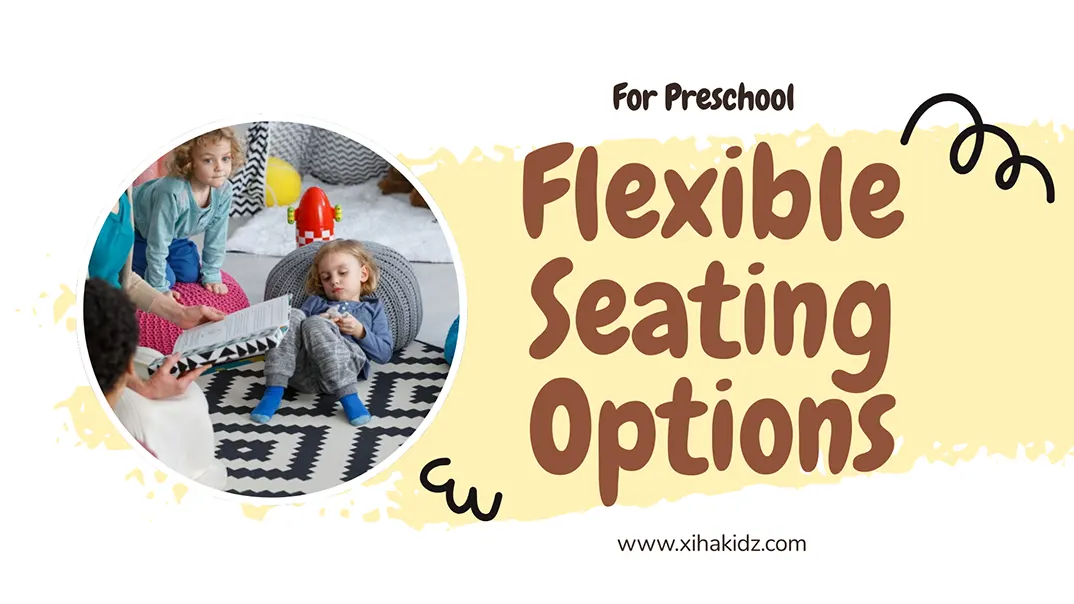
This is also why loose parts play should not be treated as a passing classroom trend. At its best, it reflects a deeper belief about children: that they are capable thinkers, natural investigators, and active participants in their own learning. When early childhood environments make room for that kind of exploration—through thoughtful materials, accessible storage, flexible furniture, and intentional presentation—they do more than support play. They support the habits of mind that children carry into future learning: creativity, resilience, focus, and the confidence to ask, “What else could this become?”
 Spanish
  English
  Arabic
  French
  Italian
  German
  Thai
Thai  Japanese