
Have you ever wondered how Montessori math materials can help children develop a strong understanding of mathematical concepts? Can a hands-on approach build the mathematical foundations necessary for future success? Is it possible to make math fun and engaging for young learners while ensuring they grasp essential skills?
The answer is yes. Montessori math materials are carefully designed tools that guide children in discovering mathematical principles through tactile and visual experiences. By focusing on hands-on learning, these materials help children build confidence in math while developing a deeper understanding of abstract concepts.
This article explores the significance of Montessori math materials in early childhood education and why they are so effective in fostering a love for math. We will uncover how these tools can help children build a solid foundation for future mathematical learning by examining key materials and their benefits.
What Are Montessori Math Materials?
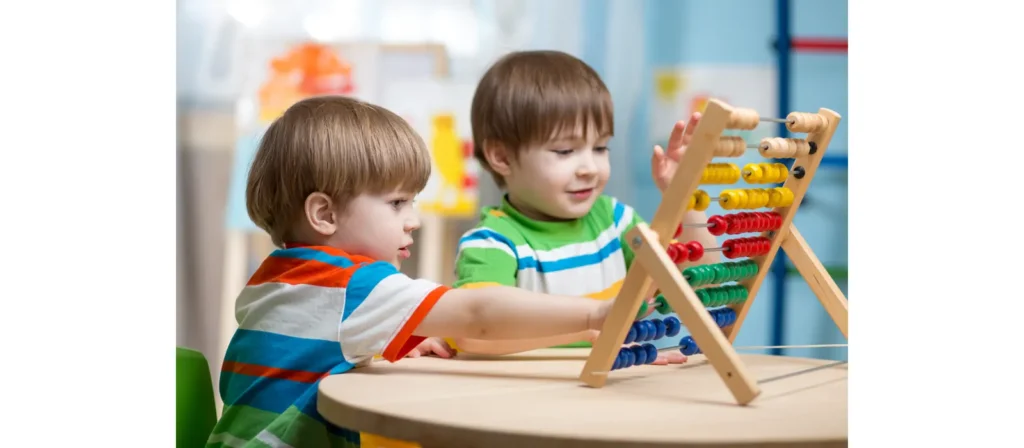
Montessori math materials are hands-on teaching tools that help children understand numbers, quantities, operations, and mathematical patterns through physical experience. Instead of asking children to memorize symbols first, the materials allow them to touch, move, count, compare, and arrange objects before moving toward written numbers and abstract calculations.
Each material is designed to teach one main concept at a time. Its size, color, quantity, and layout are carefully controlled so children can focus on a specific mathematical relationship without unnecessary distractions. Many materials also include a built-in control of error, allowing children to notice and correct mistakes with less adult intervention.
Montessori math materials are not a collection of separate toys. They form a progressive learning system. Children usually begin with concrete ideas such as quantity and number recognition, then move toward the decimal system, counting sequences, arithmetic operations, fractions, and increasingly abstract work. In your classroom, the value of each material depends not only on the product itself, but also on when and how it is introduced.
Key Montessori Math Materials
Montessori math materials are carefully designed to correspond to specific stages of a child’s mathematical development. Each material focuses on a different concept and is introduced when the child is ready to grasp that concept. Below are some of the key Montessori math materials and their uses:
1. Golden Beads
The Golden Beads are one of the cornerstone materials in Montessori math. This set consists of beads representing ones, tens, hundreds, and thousands, allowing children to visually and physically manipulate numbers tangibly.
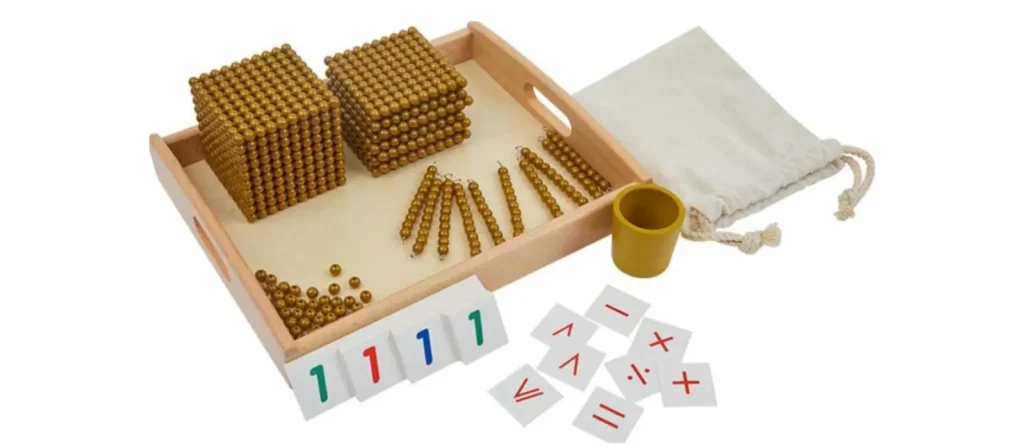
- But: The Golden Beads help children understand place value—the concept that the position of a digit in a number determines its value.
- Math Activities: Children can build numbers by grouping beads in bundles of ten and learn to represent larger numbers by adding more beads. They can practice simple arithmetic like addition, subtraction, multiplication, and division by using the beads, and they can easily observe how numbers change as operations are performed.
These beads also provide an opportunity for apprentissage pratique—children can group, exchange, and perform arithmetic operations, helping them to understand mathematical principles concretely. The physical manipulation of beads also aids in memory retention and fosters an early sense of independence in learning.
2. Number Rods
The Number Rods are another essential Montessori math material, consisting of 10 rods of varying lengths, each corresponding to a specific number from 1 to 10. The rods are typically made of colored wood, each representing a particular number’s length.

- But: Number rods introduce concepts such as number order, quantity, and basic operations (addition and subtraction).
- Math Activities: Children begin by counting the rods and matching them with the corresponding number labels. By physically laying out the rods, they can visually see the relationship between the numbers. The rods also help children develop a visual sense of proportionality as the length of each rod increases incrementally.
Children can better understand how numbers relate to each other by using these rods to explore addition and subtraction. The tactile experience of handling these rods makes abstract math concepts more accessible and engaging.
3. Bead Chains
Bead Chains are a series of chains made up of beads arranged in a sequence, with each chain representing a specific number. These chains are available in various lengths, from a single bead to chains that represent larger numbers.
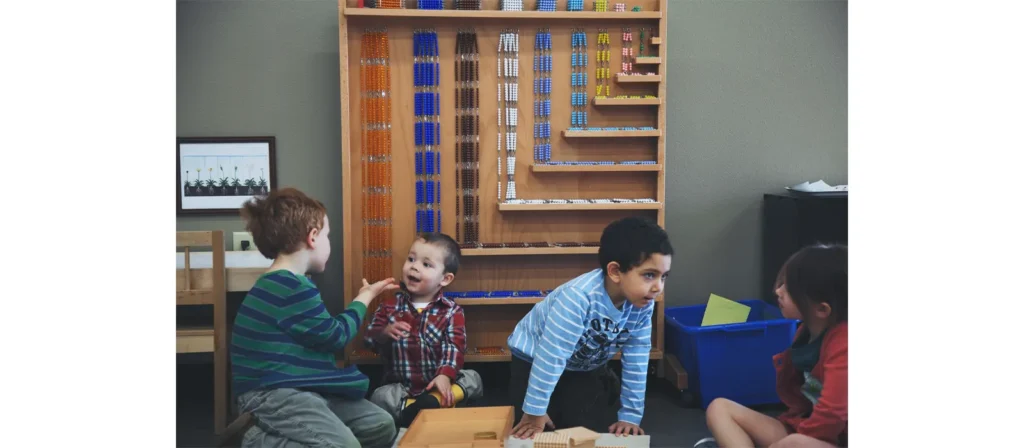
- But: Bead Chains introduce children to multiplication and skip counting. These tools help children understand how multiplication works by grouping and organizing numbers.
- Math Activities: Children can count the beads in a chain, perform skip counting (counting by 2s, 5s, 10s), and practice multiplication by counting beads in groups. This visual and tactile approach makes abstract concepts like multiplication far more concrete and easier to grasp.
Bead chains also help visualize patterns, as children can see how numbers increase in consistent, repeating sequences. The material provides a deep understanding of mathematical progression through repetition and tactile engagement.
4. Stamp Game
The Stamp Game introduces and practices addition, subtraction, multiplication, and division. The game consists of stamped tiles representing units (ones), tens, hundreds, and thousands. Children can physically manipulate these tiles to represent numbers and solve arithmetic problems.

- But: The Stamp Game is designed to help children understand regrouping (carrying or borrowing) and subtraction and solidify their understanding of multi-digit numbers.
- Math Activities: Children are asked to break down numbers using the stamps and solve problems by organizing and regrouping tiles. For example, when performing addition or subtraction, children might need to exchange one tile for a higher value or borrow tiles from another column. This hands-on experience helps children fully understand the mechanics behind carrying and borrowing, as they can physically see the regrouping process.
The Stamp Game also supports the transition from concrete to abstract learning, as children eventually move from using physical stamps to solving similar problems using pencil and paper. It’s a great bridge for children to confidently perform multi-digit operations.
5. Fraction Circles
The Fraction Circles are circular pieces cut into segments that represent fractions of a whole. These materials introduce children to fractional concepts in a very hands-on way, allowing them to manipulate and compare different fractions.
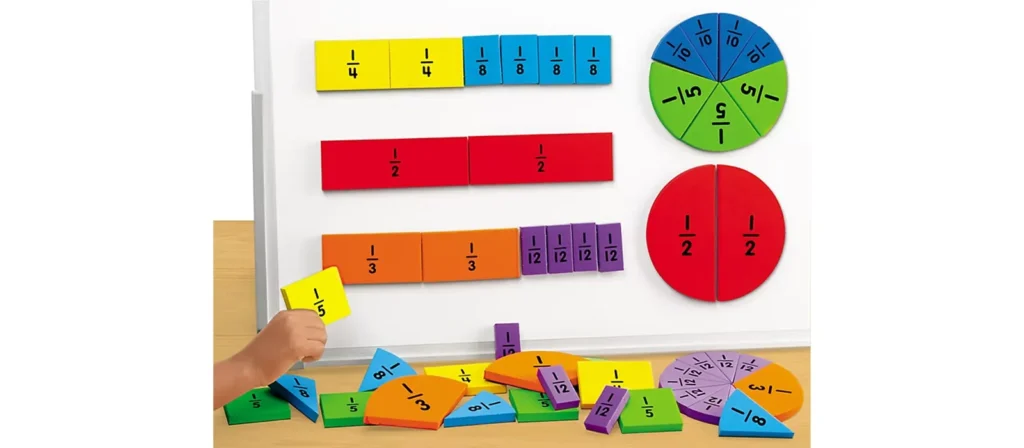
- But: Fraction Circles help children understand fractions, parts of a whole, and equivalence between different fractions. They are crucial in helping children build a strong foundation for later work with more complex fraction concepts.
- Math Activities: Children use the Fraction Circles to explore various fraction relationships, such as 1/2, 1/3, 1/4, and so on. By arranging and combining the pieces, children learn to compare fractions, understand equivalence (e.g., 1/2 = 2/4), and grasp basic operations involving fractions.
Fraction Circles help solidify the understanding that fractions break a whole into equal parts and visually represent fraction equivalence. This is essential for later mathematical concepts like ratio, proportion, and algebra.
6. Geometric Solids
Geometric Solids are a set of 3D shapes used in Montessori classrooms to introduce geometry and spatial relationships. The set typically includes cubes, spheres, cones, and pyramids.
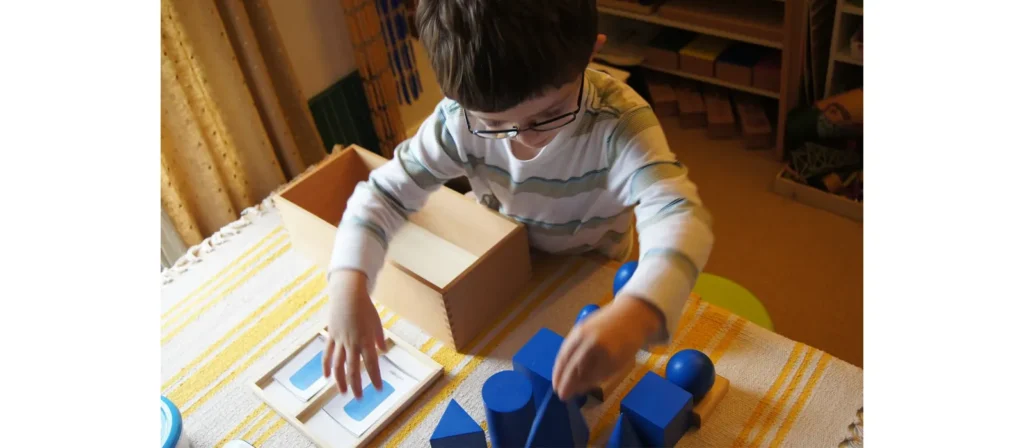
- But: Geometric Solids introduce children to basic geometric shapes and help them explore volume, surface area, and symmetry concepts. These materials also promote spatial awareness and help children understand how shapes fit together in the physical world.
- Math Activities: Children engage with these solids by observing and handling them, exploring their characteristics, and matching them to their corresponding 2D representations (e.g., identifying a square face on a cube). They may also use the solids to explore properties like symmetry and congruency, which later become foundational in more advanced geometric study.
The Geometric Solids offer a rich, hands-on way for children to explore geometry in a way that encourages both visual and tactile learning. These materials also help lay the groundwork for the study of 3D objects and prepare children for more advanced concepts in geometry.
7. Multiplication Boards
The Multiplication Boards introduce and practice multiplication through a grid system. Each board is divided into squares, with each square representing the product of two numbers.
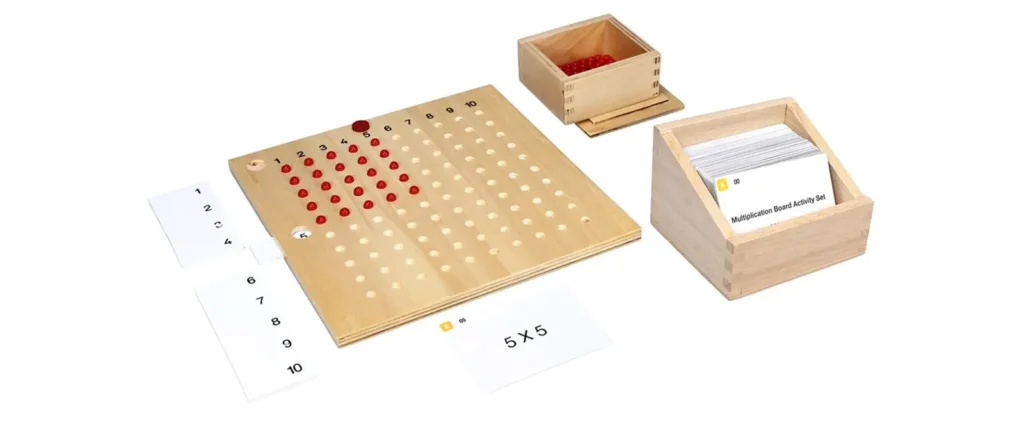
- But: The Multiplication Boards help children visually understand the concept of multiplication as repeated addition and provide a structured way for them to learn multiplication tables.
- Math Activities: Children use the board to complete multiplication problems by placing counters or stamps in the corresponding squares. This visual arrangement reinforces the idea that multiplication is the repeated addition of a number and strengthens children’s understanding of multiplication tables.
What Are the Benefits of Montessori Math Materials?
Montessori math materials are more than just tools; they are integral parts of a child’s learning journey that open doors to deeper understanding and long-lasting cognitive development. These materials, designed with care and purpose, allow children to engage with mathematical concepts in a tactile, meaningful way. The benefits of Montessori math materials go beyond just teaching children arithmetic—they help foster a love for learning, enhance problem-solving skills, and build confidence in their abilities.
1. Promoting Hands-On Learning for Better Retention
One of the most significant benefits of Montessori math materials is their ability to turn abstract concepts into concrete learning experiences. Children don’t just learn through theory or memorization; they physically interact with the materials, allowing them to internalize concepts more deeply.
Children who use materials like the Golden Beads or Number Rods see and feel how numbers are organized, manipulated, and combined. This hands-on learning approach helps children develop a solid understanding of concepts like place value, addition, and subtraction. Children can connect mathematical theory with real-world applications through tactile engagement, reinforcing their learning and improving retention.
2. Building Strong Number Sense
Number sense is understanding, using, and interpreting numbers meaningfully. It is an essential building block for later mathematical learning, providing children with the foundation to confidently approach more complex problems.
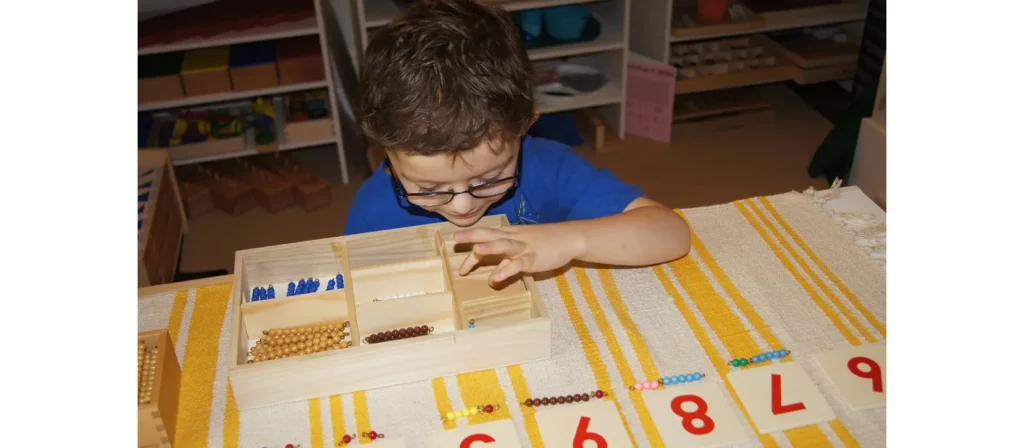
Montessori math materials help develop number sense by introducing concepts such as quantity, order, and comparison early on. For instance, children learn to visualize and compare numbers with materials like the Number Rods by seeing how the rods vary in length. This helps them understand the concept of size comparison and sequence, which is foundational to understanding mathematical operations like addition, subtraction, and multiplication.
Additionally, the Golden Beads support number sense by tangibly teaching place value. Children who work with beads representing ones, tens, hundreds, and thousands grasp how numbers are structured and learn to count by grouping. This hands-on experience reinforces their understanding of number relationships, which is critical for mastering more advanced math concepts later.
3. Fostering Independent Problem-Solving Skills
Montessori math materials are designed to be self-correcting, meaning children can easily identify and correct mistakes independently. This feature encourages children to take responsibility for their learning and fosters critical problem-solving skills.
For example, when children work with the Stamp Game or the Golden Beads, they can often see when they’ve made a mistake, either through an imbalance in the beads or an inconsistency in their calculations. By solving the problem independently, children learn to approach challenges confidently and persistently.
When children are empowered to work through mistakes and figure out solutions independently, they develop a sense of ownership over their learning, encouraging a lifelong love of problem-solving.
4. Encouraging Mathematical Exploration and Discovery
Montessori math materials are not just static objects but tools that encourage exploration and discovery. Children are encouraged to experiment with the materials, ask questions, and explore various mathematical concepts hands-on. This self-guided approach fosters a sense of curiosity and wonder, motivating children to explore math beyond simple memorization or drills.
For example, children can explore properties like shapes, size, and proportion using the Geometric Solids or the Fraction Circles. They might discover that some shapes can fit together to create a new shape or that fractions can be combined to form a whole. These discoveries help children understand the principles behind geometry and fractions and stimulate their creativity and problem-solving abilities.
By allowing children to explore math materials at their own pace, Éducation Montessori supports a sense of autonomy, where children can follow their interests and curiosity. This freedom to explore and discover helps foster a love for learning that can last a lifetime.
5. Strengthening Fine Motor Skills
While the primary purpose of Montessori math materials is to teach math concepts, they also help develop important fine motor skills. Many materials require children to manipulate small objects, which engage the fine muscles in their hands and fingers.
For example, when children work with the Golden Beads or the Stamp Game, they must use precise hand movements to count and group the objects. These activities reinforce mathematical concepts and improve children’s hand-eye coordination and fine motor control.
The development of fine motor skills also enhances children’s concentration and focus. Working with these materials teaches them to pay attention to detail. This focus is an important precursor to mastering other skills, such as reading and writing.
6. Instilling a Positive Attitude Towards Math
Montessori math materials help young learners develop a positive attitude towards mathematics. Traditionally, many children view math as difficult, abstract, and frustrating. However, using engaging, hands-on materials, Montessori math creates a playful, enjoyable learning experience that changes this perspective.
The tactile and interactive nature of the materials encourages children to view math as a fun challenge rather than a daunting task. This positive attitude develops lifelong confidence in math. Children who enjoy learning math are more likely to approach future math problems with enthusiasm and curiosity, making them more open to tackling complex concepts.
Montessori math education helps children develop a growth mindset by focusing on the learning process rather than just the result. They learn that mistakes are part of the learning process and that perseverance and effort lead to success.

7. Preparing Children for Advanced Math Concepts
Montessori math materials are designed to build a solid foundation for more advanced mathematical learning. As children progress through the Montessori curriculum, the materials become complex, introducing them to increasingly sophisticated mathematical concepts.
For example, after mastering the basic concepts of addition and subtraction with the Golden Beads, children can move on to more complex operations, such as multiplication and division, using the Stamp Game or Bead Chains. Later, they can explore fractions, geometry, and algebraic concepts with materials like the Fraction Circles and Geometric Solids.
This gradual progression ensures that children develop a strong understanding of foundational math principles, which they can apply to more advanced topics in later years. By building this foundation early on, Montessori education prepares children for higher-level math and problem-solving success.
8. Tailoring Learning to Each Child’s Needs
Because Montessori education emphasizes individualized learning, children progress at their own pace with the math materials. This personalized approach allows each child to fully grasp the concepts before moving on to more advanced topics. Children who need more time with certain materials can take that time, while others ready for more challenges can move ahead. This flexibility ensures that every child’s mathematical needs are met.
FAQ
How many copies of each Montessori math material does a classroom need?
Most classrooms only need one complete set of each material. If a material is used frequently or your class is large, keeping an extra set of small consumable pieces can reduce waiting and disruption.
What should teachers do if a Montessori material is missing a piece?
You should remove the incomplete material from the shelf until the piece is replaced. Missing parts prevent the material’s built-in control of error from working correctly.
How should Montessori math materials be cleaned?
For daily cleaning, wipe the wooden toys with a soft, slightly damp cloth and dry them immediately. For stained areas, you can use mild soapy water. Never soak wooden toys or use harsh chemical cleaners, as these will damage them. Also, be careful not to mix small toys from different sets to avoid mistakes.
When should damaged Montessori materials be replaced?
Replace materials when pieces become loose, unreadable, cracked, or difficult to handle safely. Damaged materials may distract children, change the intended activity, or create an inaccurate learning experience.
What is the Montessori method of math?
The Montessori method of math teaches children to understand mathematical ideas through hands-on experience before moving to abstract symbols and written calculations. Children first work with physical materials that represent quantities, numbers, place value, and operations.
Can math activities replace Montessori math materials?
Math activities can provide extra practice, but they do not replace the tactile experience of moving, counting, comparing, and arranging physical objects. Hands-on materials are especially important when children first learn a concept.
Conclusion: The Lasting Impact of Montessori Math Education
Montessori math materials are a powerful tool for building a strong mathematical foundation in early childhood. By providing children with hands-on, tactile experiences that promote exploration and discovery, these materials foster a deep understanding of mathematical concepts that will serve them well throughout their lives. Montessori math materials encourage children to engage with math meaningfully and enjoyably, whether through the Golden Beads, Number Rods, or Fraction Circles. As a result, children develop essential mathematical skills and learn to think critically, solve problems creatively, and approach challenges confidently.
Incorporating Montessori math materials into early childhood education is more than just teaching math—it’s about creating lifelong learners with the skills and mindset needed for success in school and beyond. Montessori education helps children build the skills they need to thrive in the world around them by fostering a love for learning and a strong mathematical foundation.





 French
  English
  Arabic
  Italian
  German
  Spanish
  Thai
Thai  Japanese