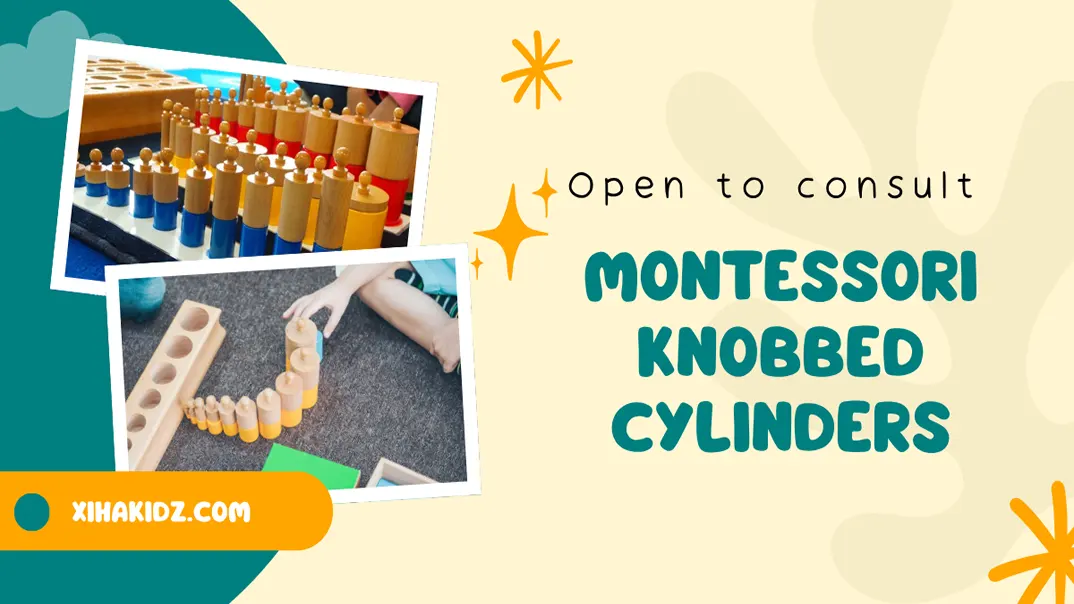
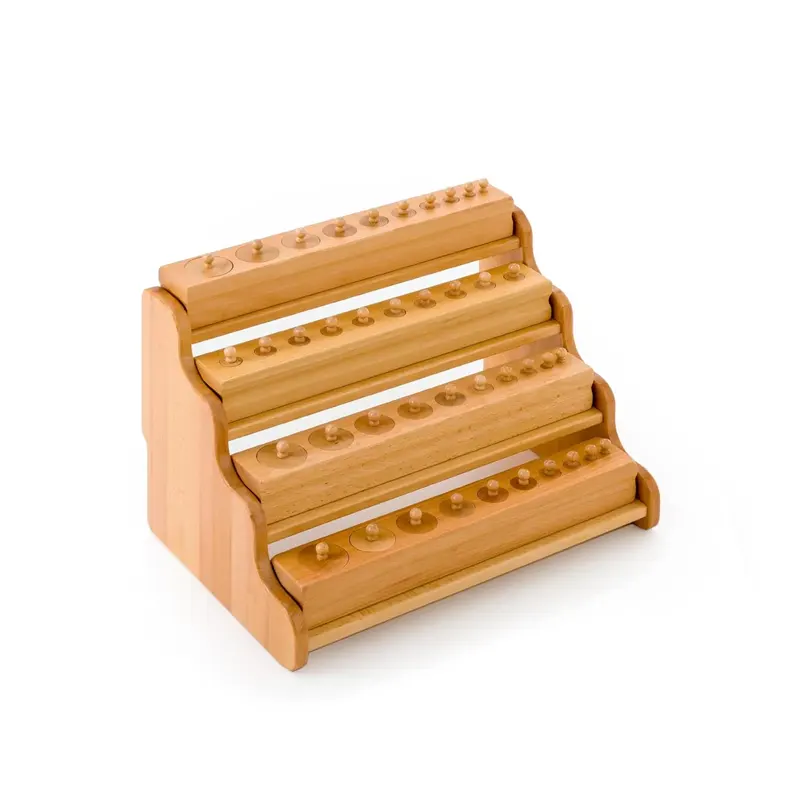
Montessori knobbed cylinders are a Montessori sensorial material consisting of four sets of wooden blocks, each containing a series of cylinders that vary in height, diameter, or both. Children remove the cylinders using the small knobs and return them to the correct sockets, which helps develop visual discrimination, fine motor control, concentration, and an early understanding of size relationships through self-correcting practice.
In real classrooms, these cylinders often reveal how a child works. Some children rush and force pieces into the wrong holes. Others slow down, compare carefully, and adjust their approach. It shows how the material supports not just matching skills, but attention, patience, and self-correction without constant adult instruction. It is also a simple way to observe development without a formal assessment.
What Are Montessori Knobbed Cylinders?
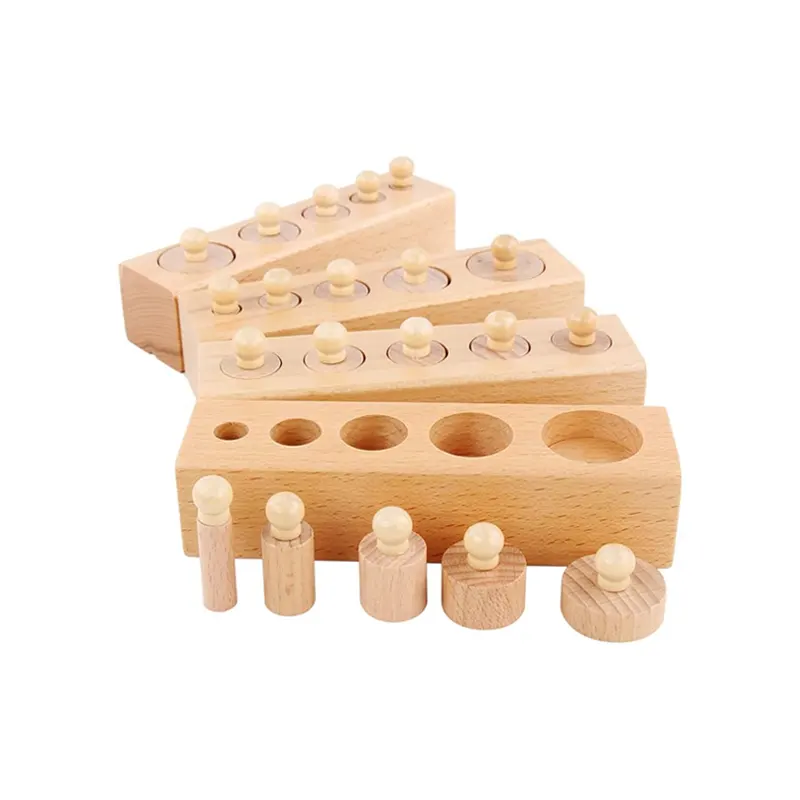
Montessori knobbed cylinders are made up of four sets of wooden blocks, each fitted with ten removable cylinders. Each cylinder has a small knob on top and is designed to fit into a specific socket within the block. The cylinders vary systematically in height, diameter, or both, allowing children to explore size differences through direct handling.
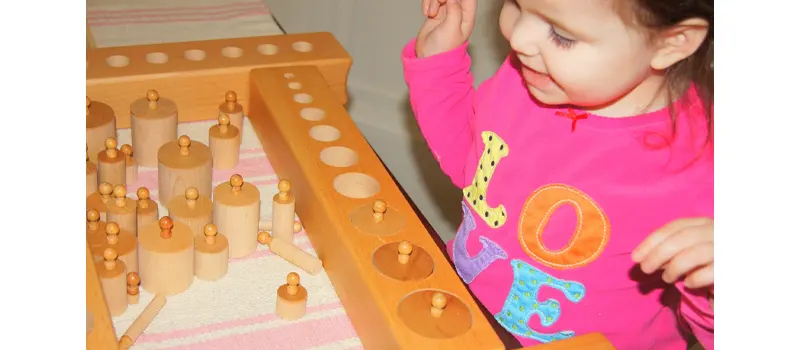
The Four Different Variations of the Montessori Cilindri a pomello
- Block A: Both the diameter and the height decrease simultaneously. The cylinders range from thick and tall to thin and short.
- Block B: The diameter decreases while the height remains constant. The cylinders range from thick to thin.
- Block C: The diameter decreases while the height increases. The cylinders range from thick and short to thin and tall.
- Block D: The height decreases while the diameter remains constant. The cylinders range from tall to short.
What is the Purpose of Montessori Knobbed Cylinders?
Montessori Knobbed Cylinders help children develop visual discrimination, fine motor control, concentration, and independent error correction through hands-on sensorial work. Rather than teaching these skills through explanation, the material allows children to experience differences in size directly by touching, lifting, comparing, and replacing each cylinder.
Develop Visual Discrimination of Size
The primary purpose of Montessori knobbed cylinders is to help children notice small differences in dimension. By working with cylinders that vary slightly in height and diameter, children learn to compare, sort, and make more precise visual judgments. This ability to distinguish detail is essential for later tasks such as recognizing letter shapes, differentiating symbols, and understanding numerical relationships.
Strengthen Fine Motor Control and Pincer Grip
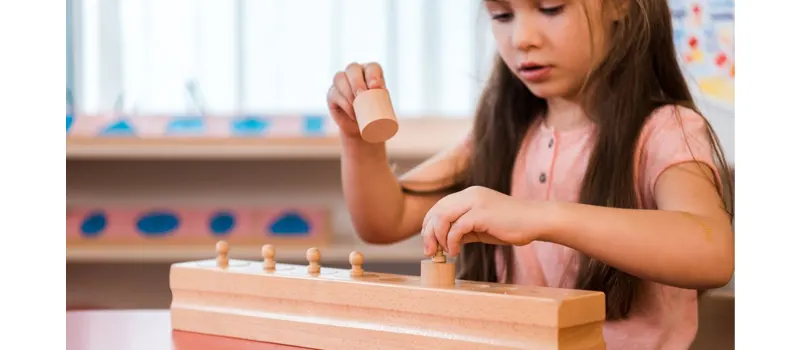
Each cylinder is lifted using a small knob, which naturally encourages the use of a pincer grip. This repeated movement builds hand strength, improves finger coordination, and supports the control needed for writing. Over time, children become more precise in how they grasp, lift, and place objects.
Build Concentration Through Repetition
The structure of the material naturally encourages repetition. Children need to adjust their approach as they go. They require attention to small differences, which helps children stay focused for longer periods. This kind of sustained concentration does not come from instruction alone. It develops through engaging work that has a clear purpose and visible result.
Encourage Independent Problem-solving
The material is designed with a built-in control of error. When a cylinder is placed incorrectly, it will not fit properly or will leave a gap elsewhere. Children can identify and correct these mistakes on their own, which reduces reliance on adult guidance and supports independent thinking.
Supporto Early Logical Thinking and Sequencing
As children work through the cylinders, they begin to recognize patterns such as a gradual increase or decrease in size. This helps them understand order, sequence, and comparison. These early experiences form a practical base for mathematical thinking, even before formal concepts are introduced.
Provide Insight for Observation and Assessment
For teachers, Montessori knobbed cylinders offer a clear way to observe how a child approaches a task. Whether a child works carefully or rushes can reveal important information about their development.
Knobbed Cylinders vs Knobless Cylinders
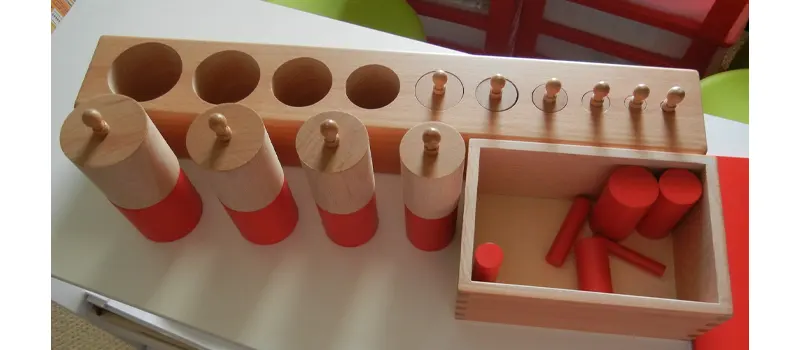
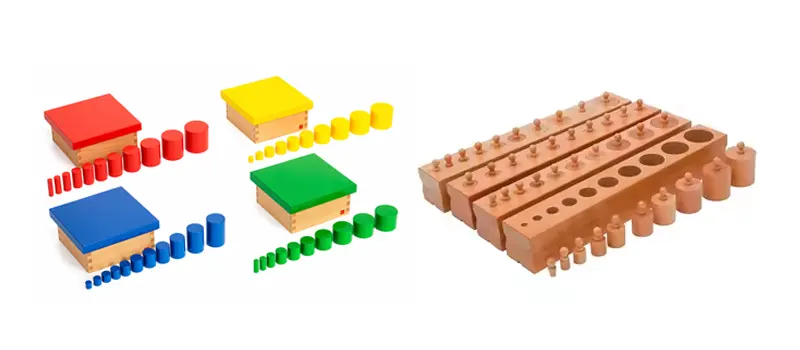
- Knobbed cylinders are wooden cylinders with small knobs, placed in corresponding sockets within a block. Children remove and return each piece, matching it to the correct space.
- Knobless cylinders do not have knobs and are not placed into fixed sockets, usually color-coded, and used for sorting, grading, and comparison activities.
In simple terms, Montessori knobbed cylinders focus on matching and placement, while knobless cylinders focus on ordering and relationships.
Learning Focus and Skill Development
Cilindri con pomello:
- Develop visual discrimination of size, height, and diameter
- Strengthen fine motor control through pincer grip
- Include built-in control of error, allowing self-correction
- Support early-stage sensory learning
Knobless Cylinders:
- Develop logical thinking and sequencing skills
- Encourage comparison, grading, and pattern recognition
- Require more independent problem-solving
- Support the transition toward more abstract thinking
Difficulty and Learning Progression
These materials are designed to be used progressively rather than as alternatives.
- Start with knobbed cylinders
Children learn to recognize differences by fitting each cylinder into a fixed position - Move to knobless cylinders
Children begin to organize and compare without a fixed reference
Introducing knobless cylinders too early can lead to confusion, as children may not yet have a clear understanding of dimensional differences.
How to Use Montessori Knobbed Cylinders?
The introduction of the Montessori Knobbed Cylinders is used through careful presentation, independent practice, and gradual progression from simple to complex sets. In a Montessori classroom, the goal is not to explain the material in words, but to demonstrate how to use it clearly and allow the child to learn through repetition and self-correction. The teacher’s role is to guide the first interaction, then step back and observe how the child engages with the work.
Prepare the Environment Before Presentation
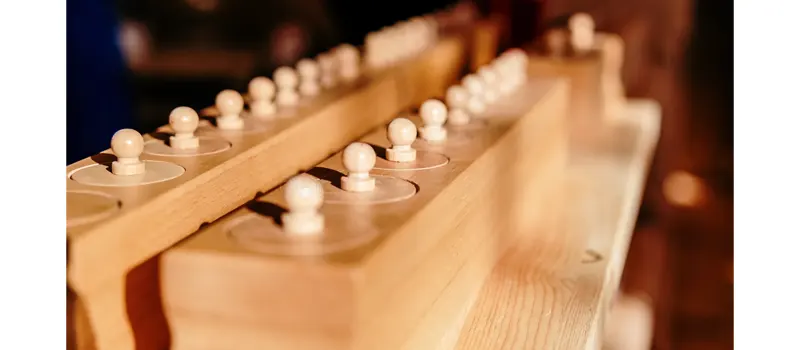
Place the cylinder blocks on a low, accessible shelf where children can clearly see and choose the material. Each block should be complete, clean, and arranged in order. Avoid placing all four blocks out at once for beginners. Start with one block to reduce confusion and help the child focus on a single type of size variation.
Demonstrate Slowly and With Intention
Sit beside the child and present the material with minimal words. Gently remove each cylinder one by one, placing them in front of the block in a controlled manner. Then return each cylinder to its correct socket, moving slowly so the child can follow both the hand movement and the visual comparison. The demonstration should be precise, calm, and consistent, without unnecessary explanation.
Invite the Child to Try Independently
After the demonstration, invite the child to repeat the activity. Allow the child to remove and replace the cylinders at their own pace. Avoid interrupting or correcting immediately. If a mistake happens, let the child notice it through the built-in control of error. This helps build independence and confidence.
Observe Rather Than Intervene
Watch how the child approaches the task. Observation helps you understand the child’s level of development. Only step in if the child becomes frustrated or disengaged, and keep guidance simple and focused.
Introduce Other Blocks Gradually
Once the child is comfortable with one block, you can introduce another with a different size variation. Do not rush to present all four blocks. Each one offers a different challenge, and children benefit from mastering one before moving on. Over time, children may choose to work with multiple blocks together, increasing complexity naturally.
Extend the Activity for Deeper Learning
As children gain confidence, you can introduce variations such as mixing cylinders from one block, working with two blocks at the same time, or arranging cylinders outside the block before replacing them. These extensions encourage deeper comparison and problem-solving without changing the core purpose of the material.
How to Choose Montessori Knobbed Cylinders?
A good set should help children work independently, feel comfortable in their hands, and stay precise after years of repeated use. This means paying attention to the wood quality, dimensional accuracy, surface finish, knob design, and the overall reliability of the product.
Prioritize High Quality Solid Wood
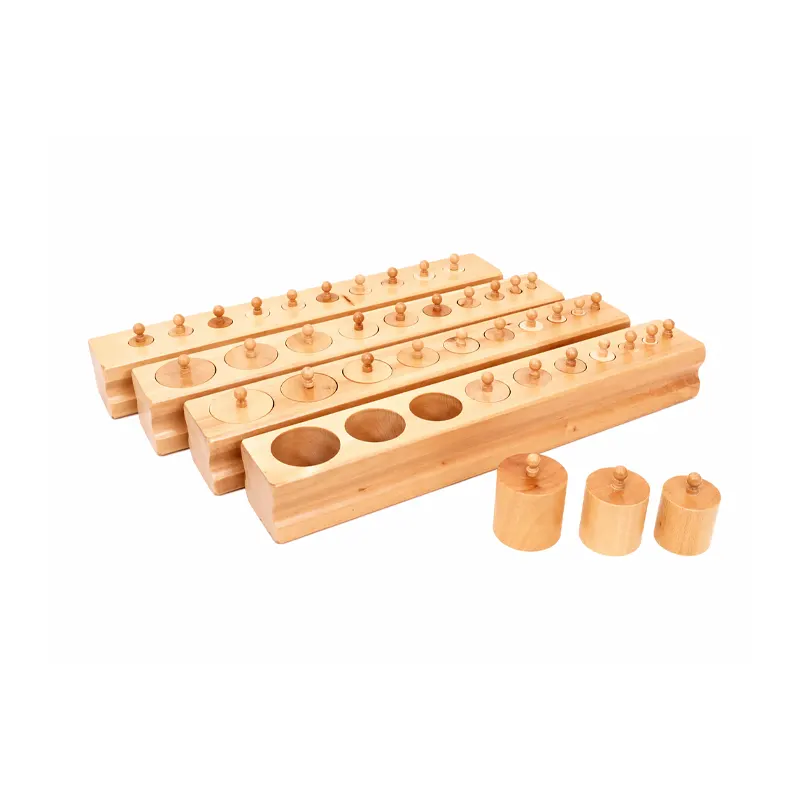
The material itself affects how children experience the work. Well-made Montessori Knobbed Cylinders are usually produced from dense hardwoods such as beech wood because the block needs enough weight to stay stable while children remove the cylinders. A lightweight block shifts too easily on the table and makes the work less controlled. Solid hardwood also performs better over time. It resists chipping, cracking, and warping. Plastic or low-density wood may reduce cost, but they often reduce both durability and the sensorial value of the material.
Check Dimensional Precision Carefully
The most important part of knobbed cylinders is precision. Each cylinder should fit only one socket and should slide in smoothly without being too loose or too tight. The size progression must also be exact. The changes in height and diameter should follow a clear and even sequence across all four blocks. This is what allows children to recognize patterns and compare dimensions naturally.
Look for a Smooth and Safe Surface Finish
The surface should feel smooth, clean, and comfortable in the hand, with no rough edges, splinters, sharp corners, or uneven coating. Many schools also prefer a natural wood finish rather than heavy paint, because it keeps the focus on size and dimension instead of visual decoration. The coating should be child-safe, non-toxic, and durable enough to handle frequent cleaning and daily classroom use. A poor finish affects both safety and the child’s willingness to engage with the material.
Verify the Knob Design
The small knobs are designed to support the pincer grip and help prepare the hand for later writing work. A good knob should be firmly attached, easy for small fingers to grasp, and consistent across the full set. If the knobs are too thick, too thin, loose, or uncomfortable to hold, the material loses part of its fine motor purpose.
Make Sure the Set Includes All Four Blocks
A complete Montessori Knobbed Cylinders set should include four blocks, each designed with a different dimensional relationship. One block changes diameter, one changes height, one changes both together, and one changes them in opposite directions. These are not repeated exercises. Each block trains observation in a different way and increases the level of challenge. An incomplete set limits the learning sequence and reduces the long-term value of the material.
Consider Durability for Real Classroom Use
In a Montessori classroom, core materials are used repeatedly for years, often by many children every day. The blocks need to remain stable, the sockets need to stay accurate, and the knobs must not loosen over time. Buyers should look at whether the construction is strong enough for long-term use.
Pay Attention to Production Consistency
Every set should maintain the same quality, dimensions, finish, and fit across production batches. Inconsistent manufacturing creates classroom problems and replacement costs later. A reliable supplier should have clear quality control standards and experience producing educational materials that require precision.
Choose Long Term Value Instead of the Lowest Price
The lowest price is not always the best buying decision for a classroom material that depends on precision and repeated use. A set that wears out quickly, fits poorly, or needs replacement sooner may cost more in the long run. For most schools and buyers, the better choice is a set that balances accuracy, durability, safe finishing, and dependable classroom performance.
Final Thoughts
When a child picks up, compares, and returns a small wooden cylinder, they are already learning how to concentrate, notice details, and solve problems independently.
This is the real meaning of Montessori education. It does not rush to impose abstract knowledge on children, but helps them build understanding through movement, repetition, and direct experience. Materials like Montessori knobbed cylinders quietly lay this foundation, and their impact reaches far beyond the sensorial materials themselves.
A Xiha Kidz, we work closely with schools and wholesalers around the world to create Montessori environments that truly support classroom learning. From classroom layout planning to high-quality sensorial materials, our goal is to help educators build spaces where children can learn with confidence, consistency, and independence.
Domande frequenti
- What Age Are Knobbed Cylinders For Montessori?
Montessori knobbed cylinders are usually introduced between 2.5 and 4 years old, depending on the child’s readiness rather than age alone. A child should be able to focus for short periods, use basic hand control, and show interest in matching and sensorial activities. Some children begin earlier with teacher guidance, while others start later when they are ready for more independent work. - What Is The Order Of The Knobless Cylinders In Montessori?
Knobless cylinders are usually introduced after a child has mastered knobbed cylinders. The common presentation order starts with one color set at a time, allowing the child to grade the cylinders from largest to smallest or tallest to shortest. After this, two contrasting sets are combined, then three, and finally all four sets together. This gradual progression helps children move from simple comparison to more complex visual discrimination and pattern recognition. - What Is The Control Of Error Of Knobbed Cylinders In Montessori?
Each cylinder is designed to fit only one correct socket. If a child places a cylinder in the wrong hole, it will either not fit properly or leave another space empty. This allows the child to notice mistakes and correct them independently without adult correction, which is a key part of Montessori learning. - Can All Four Blocks Be Used At The Same Time?
No, Montessori knobbed cylinders are usually presented one block at a time, especially for beginners. Each block isolates a specific relationship between height and diameter, helping the child focus on one visual concept without confusion. Once the child is confident with individual blocks, teachers may introduce two blocks together for extension work. Using all four blocks at the same time is generally reserved for advanced practice after the child has fully understood the basic presentations. - Can I Purchase Montessori Knobbed Cylinders Together With Other Montessori Materials?
Yes. Many buyers prefer to source knobbed cylinders together with pink tower, brown stairs, red rods, knobless cylinders, and practical life materials as part of a complete Montessori classroom setup. This saves time, improves consistency, and makes classroom planning much easier.





 Italian
  English
  Arabic
  French
  German
  Spanish
  Thai
Thai  Japanese