
In many communities, weather, air quality, or safety concerns limit outdoor play. This makes indoor playground ideas especially important for early learning centers that want to support healthy development. With a clear plan, an indoor space can offer children the same sense of adventure and challenge they might find on an outdoor playground, with even more control over safety and supervision.
Indoor playground ideas should support movement, creativity, and regulation without overwhelming the space. From climbing areas to sensory zones, well-designed indoor play areas go far beyond entertainment. They are intentional, structured, and grounded in child development theory.
This guide is designed to help you take action. By applying the indoor playground ideas shared here, you can assess your current layout, identify improvement opportunities, and begin creating an indoor play area that works for children.
Why Indoor Playgrounds Matter in Early Learning Centers?
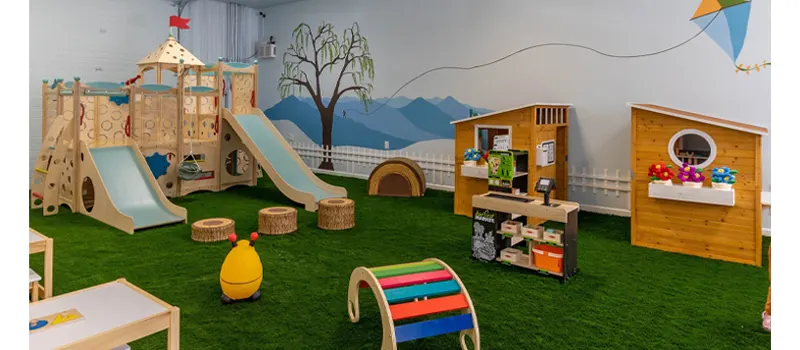
Indoor playgrounds play a critical role in early learning centers because they provide consistent opportunities for active play regardless of weather, space limitations, or safety concerns outdoors. A well-planned indoor playground supports both physical development and daily classroom routines, making movement a natural part of learning rather than a separate activity.
Supporting Consistent Physical Activity Throughout the Year
Indoor playgrounds ensure that children can engage in active play regardless of weather conditions or outdoor space limitations. This consistency is especially important for early learning centers, where daily movement supports healthy routines and prevents long periods of sedentary behavior.
Promoting Gross Motor and Physical Development
Climbing, crawling, balancing, and jumping activities help children strengthen large muscle groups and improve coordination. Indoor playground ideas that include varied movement challenges support balance control, spatial awareness, and overall body strength during critical developmental stages.
Enhancing Cognitive Development Through Movement
Physical play is closely connected to brain development in young children. Movement-based play improves focus, memory, and self-regulation. When children engage their bodies, they are also strengthening neural pathways that support problem-solving and early academic readiness.
Encouraging Social Interaction and Emotional Growth
Shared indoor play environments create natural opportunities for cooperation, turn-taking, and communication. Children learn to navigate shared spaces, manage emotions during play, and build confidence as they overcome physical challenges in a supportive setting.
Providing Practical Benefits for Daily Center Operations
From a management perspective, indoor playgrounds reduce schedule disruptions caused by weather and allow for easier supervision in a controlled environment. Well-designed indoor playground ideas help teachers integrate active play smoothly into the daily routine without sacrificing safety or structure.
Gross Motor Indoor Playground Ideas
In early learning centers, dedicated gross motor play zones allow children to actively engage their bodies even when outdoor play isn’t possible. By integrating climbing, jumping, crawling, and balancing activities into the indoor environment, educators can support the physical milestones that are foundational to a child’s development. These areas also promote confidence, persistence, and social cooperation through shared movement experiences.
1. Climbing Walls
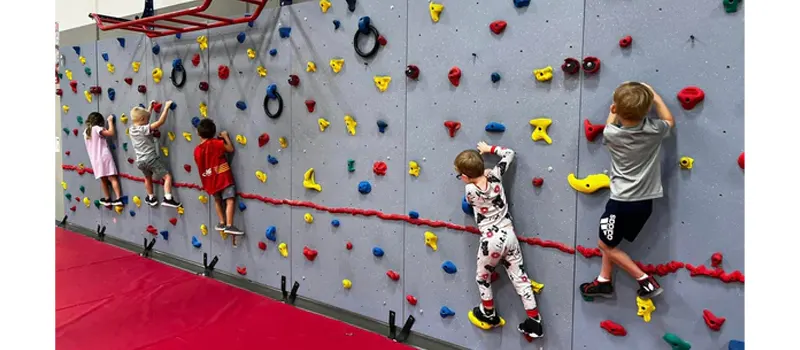
Low-traversing walls are an excellent addition to any learning center. They allow children to move horizontally rather than vertically, which minimizes the risk of falls while still building upper body strength and coordination. Ensure you install adequate safety surfacing at the base to cushion any slips.
2. Soft Play Obstacle Courses
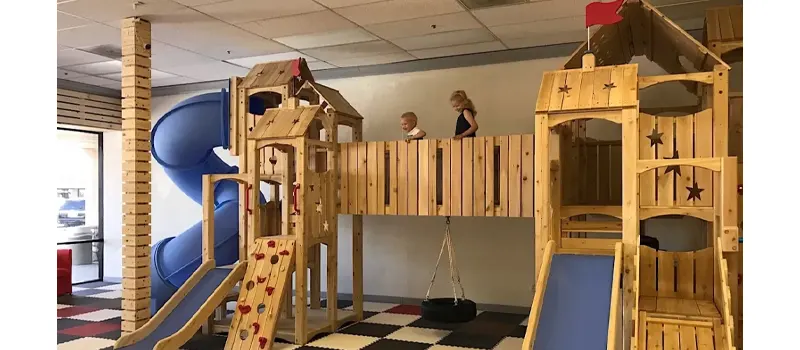
Foam blocks, ramps, and wedges offer endless possibilities for physical activity. These modular pieces allow you to configure new layouts regularly to keep the experience fresh. Children can climb over barriers, roll down wedges, or stack elements to create their own structures. This flexibility makes soft play equipment a staple among indoor playground ideas for versatility.
3. Balance Beams
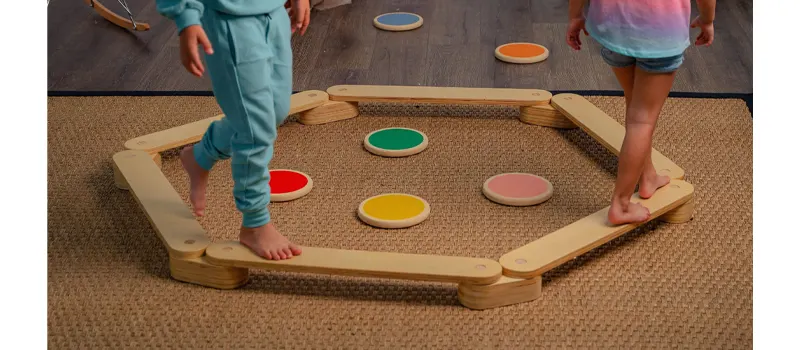
Incorporating balance beams helps children refine their stability and core strength. Low-profile beams with textured surfaces provide tactile feedback and prevent slipping. You can arrange them in straight lines or zigzag patterns to vary the difficulty level based on the age group.
4. Crawling Tunnels
Tunnels are fantastic for developing spatial awareness and coordination. Crawling requires the simultaneous use of arms and legs, which supports cross-lateral movement. Connecting multiple tunnels or pairing them with playhouses creates an engaging pathway that encourages exploration.
5. Mini Trampolines
Mini trampolines offer an excellent outlet for energy release and rhythmic movement. To go beyond basic jumping, turn it into a movement game, such as “jump and freeze” when the music stops or “count your jumps” challenges. These activities support vestibular development and help children regulate their energy in a playful, controlled way.
6. Stepping Stone Paths
Use stepping stones to guide movement through underutilized areas, such as between classroom sections or along hallway edges. By laying them in curves or zigzags, you can subtly shape children’s traffic flow while encouraging gross motor control. Choose materials with varied textures or heights to create sensory interest without taking up additional space.
7. Slides and Spiral Chutes
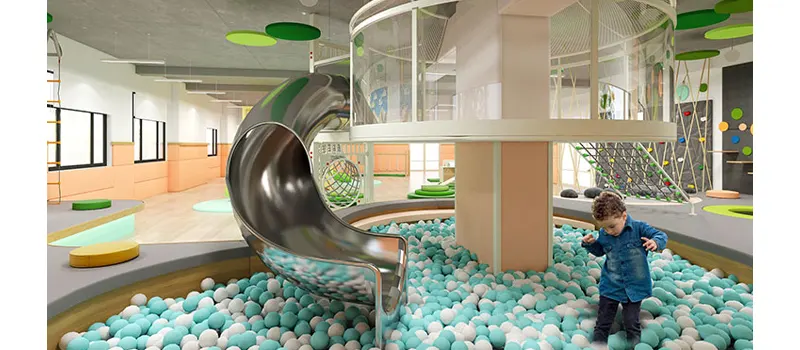
Slides are often the highlight of any multi-level structure. Spiral chutes allow for a thrilling descent while conserving valuable floor space. Tube slides can be connected to jungle gyms to create a seamless transition from high platforms to the ground. Open wave slides are also excellent for younger toddlers as they allow for easy supervision by parents and staff.
8. Multi-Surface Climbers
Multi-surface climbers combine various textures and angles into a single piece of equipment. These units might feature a traditional ladder on one side, a rock-climbing face on another, and a knotted rope net on a third. This variety encourages children to solve problems by determining the best way to navigate different surfaces. Physically, it challenges different muscle groups; gripping a rope requires different hand strength than grasping a wooden rung or a plastic hold.
Sensory-Based Indoor Playground Ideas
Sensory-based indoor playground ideas focus on engaging children’s senses while supporting movement, emotional regulation, and exploration. In early learning centers, these environments help children process sensory input in healthy ways and are especially valuable for supporting diverse learning styles and self-regulation needs.
9. Ball Pits and Ocean Ball Pools
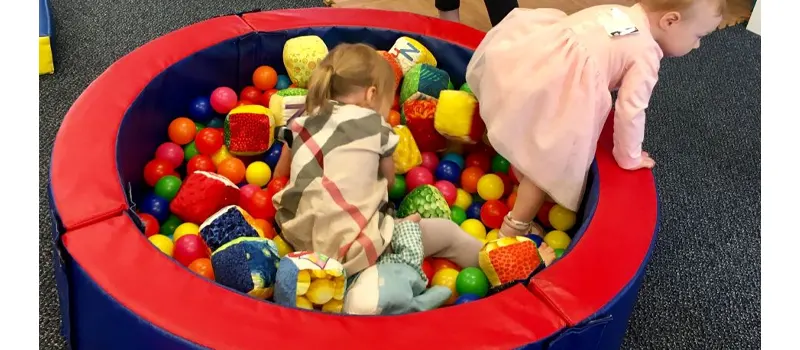
Ball pits are a staple in many play centers because they provide a unique sensory experience and a safe environment for falling or jumping. The resistance provided by the balls helps build muscle tone as children engage in heavy work by moving through them. Utilizing ball washing machines ensures hygiene standards are met while keeping this popular attraction available.
10. Musical Play Components
Incorporating auditory elements introduces children to the concepts of rhythm and sound. Durable xylophones, drums, or chimes can be mounted directly onto play structures. Unlike loud electronic toys, these acoustic instruments allow children to experiment with cause and effect at a reasonable volume.
11. Tactile Wall Panels
Wall panels are perfect for facilities with limited floor space. These boards feature various textures such as artificial grass, sequins, wood, and sandpaper. Children can run their fingers across different surfaces to explore rough, smooth, soft, and hard sensations. This interaction improves tactile discrimination and fine motor control without requiring a large footprint.
12. Light and Color Exploration
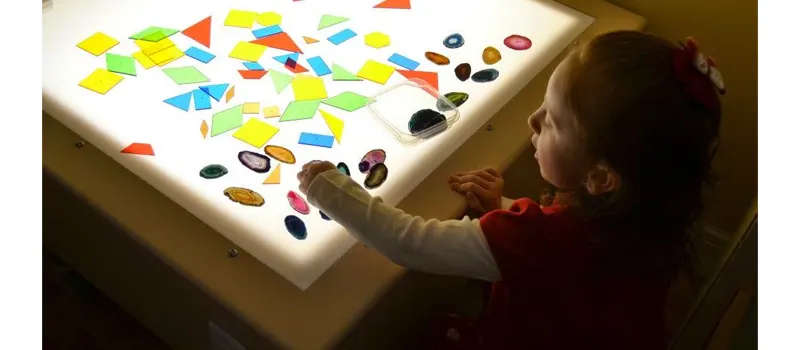
Visual stimulation captures attention and encourages focus. Light tables or colored acrylic windows within a playhouse structure create changing patterns of light. Mirrors are also a valuable addition as they help children develop self-awareness. Placing unbreakable mirrors at eye level allows toddlers to observe their expressions and movements during play.
13. Soft Sensory Nooks
Design quiet sensory corners with soft seating, acoustic padding, and minimal visual clutter. Incorporate beanbags, hanging fabric, or weighted lap pads to create a grounding environment. Placing these nooks near, but slightly apart from, active play zones provides children with an option to retreat and self-regulate when needed.
14. Water and Sand Tables (Indoor-Optimized)
If space and maintenance allow, indoor water or sand play stations offer rich tactile and proprioceptive input. For cleaner setups, opt for enclosed bins with lids and drainage options. Position these tables on washable mats and near easy-to-clean flooring to make them practical. Use dividers or low fencing to define the wet zone without isolating it.
15. Textured Balance Paths
A sensory path consists of floor tiles filled with different materials like gel, liquid, or textured rubber. Walking over these surfaces provides proprioceptive input, which tells the body where it is in space. This type of equipment combines gross motor balance practice with immediate sensory feedback.
16. Indoor Swings and Gliders
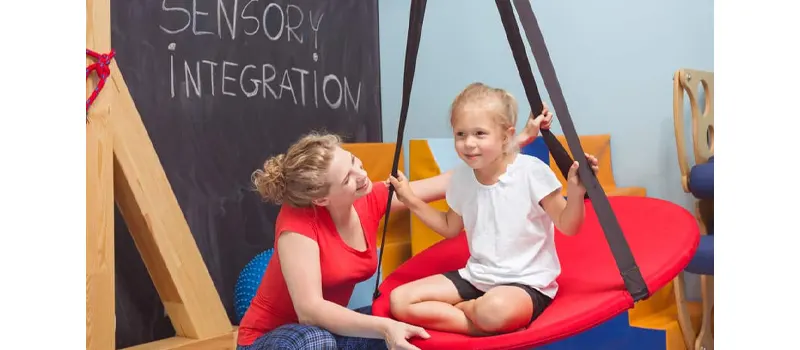
Swings are powerful tools for vestibular input which helps children develop a sense of balance and spatial orientation. For indoor environments, pod swings or cocoon swings are particularly effective as they provide a hugging sensation that creates a calming effect for overstimulated children. Toddler bucket swings with high backs offer necessary support for younger children who are still developing neck and core control.
When incorporating these indoor playground ideas, it is crucial to ensure that the suspension systems are reinforced and that there is ample clearance space to prevent collisions with other equipment or walls.
17. Interactive Projection Games
Modern centers often incorporate technology through interactive floor or wall projections. These systems project games onto a surface where children use their body movements to interact with virtual elements like popping bubbles or playing virtual soccer. This facility combines physical activity with cognitive challenges and keeps the play area modern and competitive.
Social and Emotional Indoor Playground Ideas
Playgrounds are social hubs where children learn to navigate relationships and manage their emotions. A well-designed play area facilitates communication, cooperation, and empathy among peers. Integrating these specific indoor playground ideas will support the social and emotional milestones of early childhood.
18. Themed Role-Play Areas
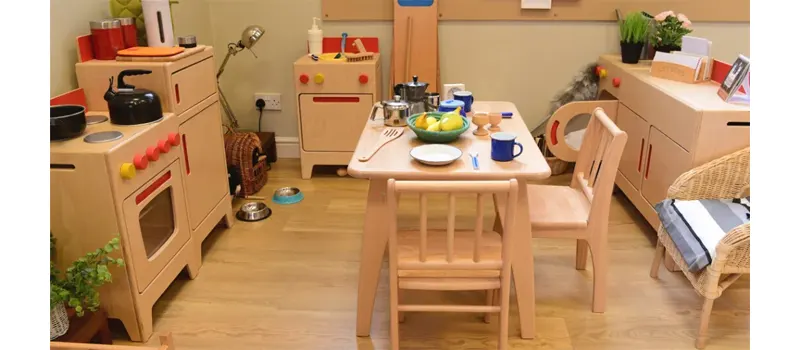
Imaginative play is a powerful tool for social development. Designing specific zones such as a mini kitchen, a grocery store, or a doctor’s office encourages children to act out different scenarios. This type of play requires them to negotiate roles, share resources, and practice verbal communication. It also fosters empathy as they pretend to be someone else and understand different perspectives.
19. Multi-User Equipment
Include equipment that requires teamwork to operate effectively. A dual-seat rocker or a merry-go-round needs coordination between two or more children to generate movement. These structures naturally encourage interaction because children must communicate to start, stop, or change speed. This shared experience builds a sense of community and teaches the value of cooperation.
20. Quiet Retreat Spaces
Emotional regulation is just as important as active play. Some children can become overstimulated in a busy environment and need a place to decompress. Incorporating cozy nooks, reading corners with soft seating, or small sensory tents provides a safe haven for solitude. These quiet zones allow children to calm down and process their emotions before rejoining the group.
21. Collaborative Building Stations
Large foam blocks or magnetic building tiles are excellent for group projects. Unlike small table toys, large construction materials often require two children to lift or stack them efficiently. This physical necessity leads to collaborative problem solving where children plan structures together and celebrate their shared success.

22. Puppet Theaters and Storytelling Zones
Set up a small puppet theater or storytelling platform where children can act out social situations or stories. Position soft seating in front of the stage to encourage group listening and interaction. The goal is to foster expressive language and social imagination in a non-pressured, creative space.
How to Apply Indoor Playground Ideas in Real Early Learning Centers?
Applying indoor playground ideas in real early learning centers requires more than selecting attractive equipment. Successful implementation depends on thoughtful planning, space awareness, safety considerations, and alignment with daily teaching routines. The following practical approaches help translate ideas into functional, usable play environments.
1. Assess Your Available Space
Begin by measuring and mapping the indoor areas available for play. Identify open zones, underused corners, transition corridors, and multi-purpose rooms that could support playground functions. Consider ceiling height, natural lighting, sound levels, and flooring material when evaluating what types of play each space can accommodate. A clear understanding of your usable space lays the groundwork for intentional zone planning.
2. Define Zones Based on Developmental Objectives
Once the space is mapped, define zones by function: gross motor, sensory, imaginative, social-emotional, etc. Allocate space proportionally based on the needs of your student population. For instance, toddlers may need more crawling and soft play space, while older preschoolers benefit from climbing and balance challenges.
3. Choose Multi-Functional and Modular Equipment
Select equipment that serves multiple purposes and can be reconfigured easily. Opt for climbing structures that include crawl-through tunnels, pretend play elements that double as seating, and soft foam pieces that can build or separate zones. This is particularly useful for centers with limited square footage.
4. Ensure Visual Supervision
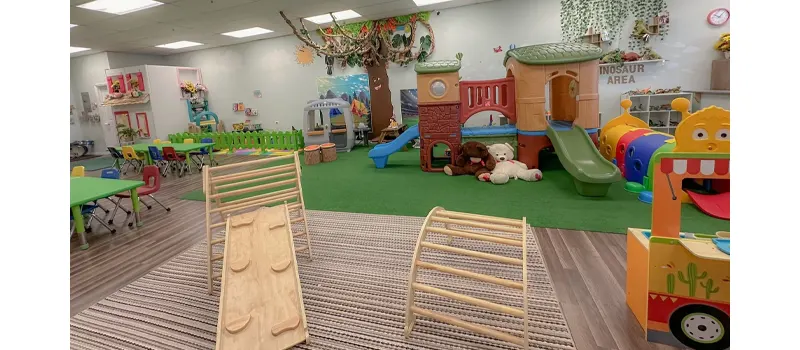
Design layouts that allow clear lines of sight across all areas. Place active zones like jumping and climbing away from calm areas. Use low dividers or shelving units to define space without blocking visibility. Ensure wide circulation paths for children and adults to move freely and safely.
5. Prioritize Safety Standards
Compliance is non-negotiable. Ensure that all equipment meets local and international safety standards, such as ASTM F1918 (USA) or EN 1176 (Europe). This includes checking for non-toxic materials, pinch points, and sharp edges. Impact-absorbing flooring, such as EVA foam mats or rubber tiles, must be installed under all climbing and swinging apparatus to minimize injury risks. Regular audits should be scheduled to inspect wear and tear on high-traffic items.
6. Pilot Small Zones Before Large-Scale Investment
If resources are limited, start with one sensory pod, a small climbing nook, or a modular pretend-play corner. Observe how children interact with the setup, make adjustments, and gather feedback. This pilot-first approach helps avoid costly mistakes and ensures better long-term design decisions.
7. Observe and Adjust Continuously
Post-installation, observe how children interact with the environment over time. Are certain areas overcrowded? Are others ignored? Make layout or equipment adjustments based on usage patterns, noise levels, or behavior incidents. A successful indoor playground is never static—it evolves with the children and staff who use it.
FAQs About Indoor Playground Ideas
How much space is needed for an indoor playground in a preschool?
There is no fixed size requirement. Indoor playground ideas can be adapted for both large and small spaces by using modular equipment, wall-mounted elements, and clearly defined play zones that match the available area.
What are some indoor playground ideas for small spaces?
In small centers, modular play structures, wall-mounted sensory panels, foldable tunnels, and dramatic play carts are ideal. Use vertical space and movable elements to allow flexible use without overcrowding the environment.
How do I ensure safety in an indoor playground layout?
Maintain clear supervision lines, use soft surfaces and rounded edges, separate high-energy and quiet zones, and ensure all equipment meets safety standards. Regular inspections and proper staff-child ratios also play a key role.
What ages can safely use indoor playground ideas in the same space?
Mixed age groups can share an indoor playground if you clearly define zones and difficulty levels. Toddlers can use low, soft equipment and simple tunnels, while preschoolers explore slightly higher climbers and balance paths. Visual signs and adult guidance help children choose the right challenges.
Schlussfolgerung
Well-designed indoor playground ideas help early learning centers create safe, engaging environments where children can move, explore, and connect every day. By thoughtfully combining gross motor play, sensory-based experiences, and social and emotional zones, centers can make better use of their indoor space while supporting healthy development and smooth daily routines.
If you’re planning to build or upgrade your indoor play environment, Xiha Kidz is here to support you. As a professional manufacturer of daycare furniture and educational toys, we provide high-quality products and tailored space planning services. Whether you need help designing a new layout, selecting the right materials, or sourcing durable, child-safe equipment, our team is ready to help you create a safe, engaging, and developmentally appropriate indoor playground that grows with your center.




 German
  English
  Arabic
  French
  Italian
  Spanish
  Thai
Thai  Japanese