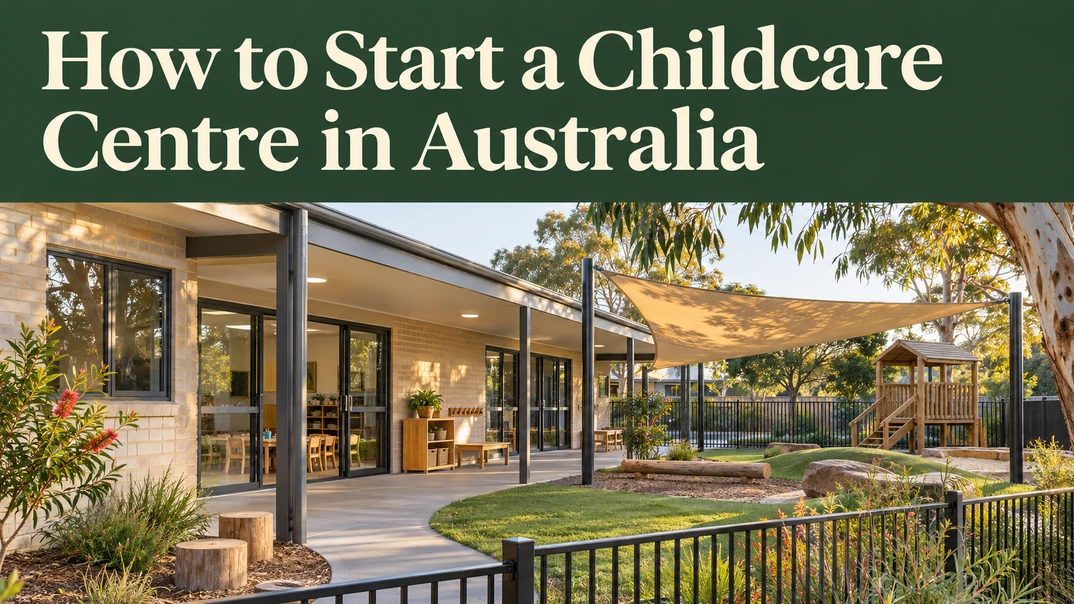
Opening a childcare centre in Australia can be both a meaningful way to support children’s early development and a worthwhile business opportunity. By creating a safe, welcoming environment where children can learn, explore, and grow, you can make a lasting contribution to families and your local community while building a sustainable business.
Turning this vision into reality requires careful planning, from understanding government approval requirements and staffing regulations to choosing the right location and designing suitable learning spaces. This guide walks you through the key steps to help you establish a childcare centre that meets Australian requirements and supports children’s development.
Understand the Childcare Business in Australia
Before opening a childcare centre in Australia, you need to understand how the local early childhood education and care (ECEC) sector works. Australia offers several types of childcare services, each designed for different age groups, family needs, and operating arrangements. Choosing the right service model will help you plan your business, identify your target families, and understand which government approvals and operating requirements apply.
What Types of Childcare Services Can You Open?
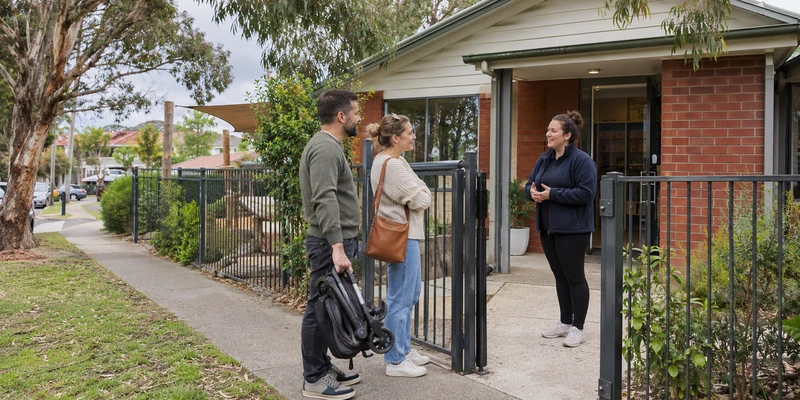
Australia has several childcare and early learning options. The main types recognised under the Australian Government’s Child Care Subsidy (CCS) system are Centre Based Day Care, Family Day Care, Outside School Hours Care (OSHC), and In Home Care. Each serves a different purpose, so you should decide which model best matches your business plans.
| Type of Service | What It Offers | Typical Age Group |
|---|---|---|
| Centre-Based Day Care (Long Day Care) | Centre-based care and early learning, usually offered on a full-day or part-day basis. | Birth to school age |
| Family Day Care | Small-group education and care in an approved educator’s home. | Birth to school age, with some services also caring for older children |
| Outside School Hours Care (OSHC) | Care before and after school, as well as during school holidays. | School-aged children |
| In Home Care | Flexible care provided by an educator in a child’s own home for eligible families. | Children from birth to school age |
For most people planning to establish a dedicated childcare centre, Centre Based Day Care (CBDC), commonly known as Long Day Care, is the most relevant model. These centres generally operate during working hours and provide both care and planned learning experiences. Some also include a preschool or kindergarten program for children preparing to start primary school.
It is important to distinguish between a childcare service and a preschool program. In Australia, preschool generally focuses on children in the year or two before they start school and follows a structured, play-based learning program. Depending on the state or territory, it may operate as a standalone service or as part of a long day care centre. The terminology and funding arrangements also vary between jurisdictions.
If you are planning to open a centre that offers both long day care and a preschool program, consider these differences early. They may affect your staffing arrangements, educational program, operating model, and eligibility for government funding. You can find more details in the Australian Government’s guide to early childhood education and care service types.
Understand the Australian Childcare Market
Once you have chosen a service model, the next step is to understand the families and communities you want to serve. Demand for childcare can vary considerably between suburbs, cities, and regional areas. A location with many young families may look attractive, but you should also consider existing centres, available places, local fees, and the types of care families actually need.
Start by researching the following:
- Local family demographics: Look at the number of families with young children, household growth, and new residential developments in your target area.
- Existing childcare centres: Check how many centres operate nearby, what age groups they accept, their opening hours, and their available places.
- Family needs: Find out whether local parents need full-day care, part-time enrolments, preschool programs, or extended operating hours.
- Local fee levels: Compare daily fees and understand what families pay after any applicable Child Care Subsidy.
- Community expectations: Consider the importance of outdoor play, inclusive learning environments, cultural diversity, and communication with families.
A useful starting point is StartingBlocks.gov.au, an Australian Government-supported resource where you can search for childcare services and compare their fees, vacancies, quality ratings, and other details. This can help you understand the local competition and identify gaps in the services available to families.
Identify Your Target Age Groups and Families
Your target age groups will influence almost every aspect of your childcare centre, from room layouts and staffing requirements to furniture selection and daily activities. Before choosing a property or purchasing equipment, decide which age groups you intend to accommodate.
For example, you may plan to provide care for:
- Infants (0–2 years): Babies need dedicated spaces for sleeping, feeding, nappy changing, crawling, and early sensory exploration. Safety, supervision, and suitable rest facilities are particularly important.
- Toddlers (2–3 years): Children at this stage are developing independence, language, and physical coordination. Their rooms should support movement, imaginative play, accessible storage, and hands-on activities.
- Preschool-aged children (3–5 years): Older children benefit from spaces that encourage creative activities, early literacy, numeracy, problem-solving, group play, and preparation for school.
You do not have to accommodate every age group from the beginning. Some centres focus on younger children, while others primarily serve preschool-aged children. Your decision should reflect local demand, available space, staffing capacity, and the costs of meeting the requirements for each age group.
The age groups you choose will also determine how you design your learning environment. For example, an infant room needs appropriate cots and rest areas, while a preschool room may require child-sized tables, chairs, open shelving, reading corners, and creative activity areas. Planning these needs early will help you avoid unnecessary purchases and make better use of your available space.
Develop a Business Plan and Estimate Startup Costs
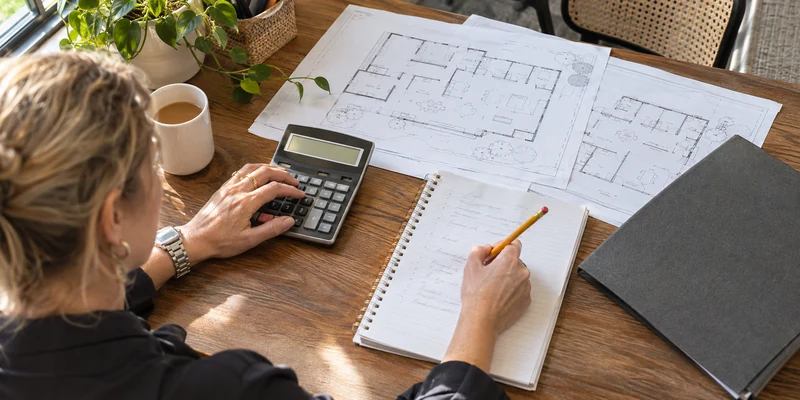
Once you have chosen your childcare service type and identified your target families, the next step is to work out whether your business idea is financially and operationally realistic. Opening a childcare centre in Australia requires a significant initial investment, and your expenses will extend beyond purchasing or leasing a property. You also need to budget for renovations, government approvals, staffing, furniture, educational resources, and ongoing operating costs.
A clear business plan helps you estimate the initial investment, organise your funding, and understand the financial commitments involved in running the centre.
Choose Your Business Structure
Before investing in a property or applying for approvals, decide how you will legally operate your childcare business. Your business structure affects your legal responsibilities, tax obligations, financial arrangements, and the way you manage the organisation.
Common business structures in Australia include:
- Sole Trader: You operate the business as an individual. This is relatively simple to establish, but you are personally responsible for business debts and obligations.
- Partnership: Two or more people operate a business together and share its responsibilities, income, and liabilities according to their partnership arrangements.
- Company: A separate legal entity that can enter contracts, employ staff, and own business assets. A company has additional registration and reporting requirements.
- Trust: A structure in which a trustee manages business assets for the benefit of beneficiaries. It can involve more complex legal and tax arrangements.
The right choice depends on your ownership arrangements, financial circumstances, and long-term plans. It is advisable to consult an Australian accountant or business lawyer before making a decision.
You will also need to consider business registration requirements, including an Australian Business Number (ABN), company registration, and tax registrations. You can use the Australian Government’s Business Registration Service to check which registrations apply to your business.
Calculate Your Initial Investment
The cost of opening a childcare centre depends on its location, size, building condition, planned capacity, and the age groups you intend to serve. A centre that requires major construction or renovation will have a very different budget from one moving into an existing childcare facility.
Before committing to a property, prepare a startup budget covering the main expenses.
| Cost Category | What to Include |
|---|---|
| Property and Lease | Property purchase or rental deposit, legal fees, and initial rent |
| Construction and Renovation | Building alterations, classroom renovations, plumbing, electrical work, and outdoor improvements |
| Planning and Approvals | Planning applications, building approvals, professional consultants, and relevant regulatory fees |
| Mobilier et équipement | Children’s tables and chairs, shelving, lockers, cots, mattresses, and outdoor play equipment |
| Educational Resources | Books, toys, art materials, sensory play equipment, and learning resources |
| Kitchen and Hygiene | Kitchen appliances, food preparation equipment, nappy-changing facilities, and cleaning supplies |
| Recruitment and Training | Staff recruitment, induction, mandatory training, and pre-opening wages |
| Insurance and Administration | Business insurance, legal and accounting services, software, and office equipment |
| Marketing and Enrolment | Website development, local advertising, signage, and enrolment materials |
Do not overlook the cost of preparing the learning environment. Furniture and equipment are not simply finishing touches; they are essential to the daily operation of your centre. You may need different furniture for infant, toddler, and preschool rooms, along with suitable storage, sleep equipment, and outdoor play facilities.
Estimate Operating Costs and Revenue
Your financial plan should cover not only the money needed to open the centre but also the expenses you will face every month. A childcare centre can take time to reach its planned enrolment level, so you should not assume that all available places will be filled immediately.
Common ongoing expenses include:
- Staff wages and superannuation: Salaries for educators, an Early Childhood Teacher where required, the nominated supervisor, administrative staff, and other employees.
- Rent and utilities: Property rent or mortgage payments, electricity, water, internet, and waste collection.
- Food and daily supplies: Meals, snacks, cleaning products, nappies where provided, and other consumables.
- Insurance and compliance: Insurance premiums, equipment maintenance, safety checks, and ongoing training.
- Repairs and replacements: Furniture repairs, replacement toys, playground maintenance, and general building upkeep.
- Administration and marketing: Accounting, enrolment software, advertising, and communication with families.
When estimating revenue, start with your approved service capacity, expected enrolments, average daily fees, and operating days. You should also consider how occupancy may change during the first year.
For example, a centre with 60 approved places will not necessarily generate income as if all 60 places were occupied every day. Some families may enrol part-time, and attendance can fluctuate throughout the year. Your financial forecast should account for these differences.
You should also understand how the Child Care Subsidy (CCS) works. Eligible families can receive government assistance with their childcare fees, with payments generally made directly to approved providers on their behalf. This can make your service more accessible to families, but CCS should not be treated as an additional source of profit on top of the fees charged. It is part of the payment arrangement for eligible families.
Find a Suitable Location and Check Planning Requirements
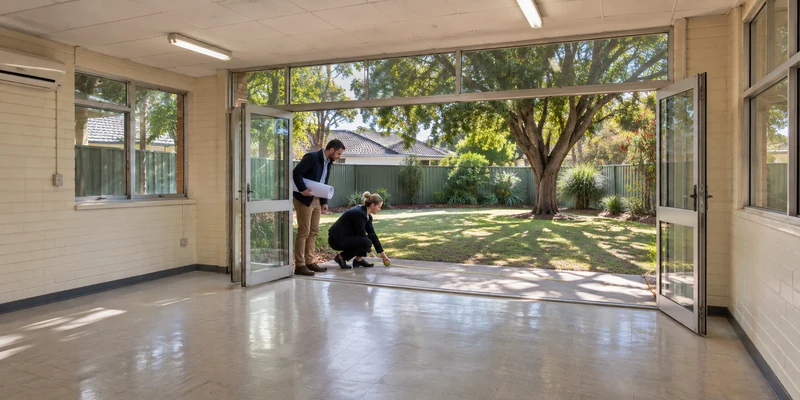
Choosing the right location is one of the most important decisions when opening a childcare centre. In Australia, childcare centre development is subject to both state or territory planning systems and local council requirements. The approval process can vary depending on the property’s location, its existing use, and the proposed number of children. Checking these requirements early can help you avoid costly renovations or delays later.
Check Local Zoning and Planning Approval
Confirm whether childcare is permitted at the address and whether your proposal needs development consent, change-of-use approval or building work. These decisions are separate from permission to operate an education and care service. For example, Brisbane’s planning guidance directs applicants to check zoning and overlays and consult a building certifier where appropriate.
Request the floor and site plans, existing approvals, occupancy information and the landlord’s consent position on alterations. Have your solicitor address approval conditions, due diligence time, rent commencement, fit-out responsibilities and exit rights. You need a workable agreement if approval is delayed or the achievable capacity is lower than expected.
Understand Indoor and Outdoor Space Requirements
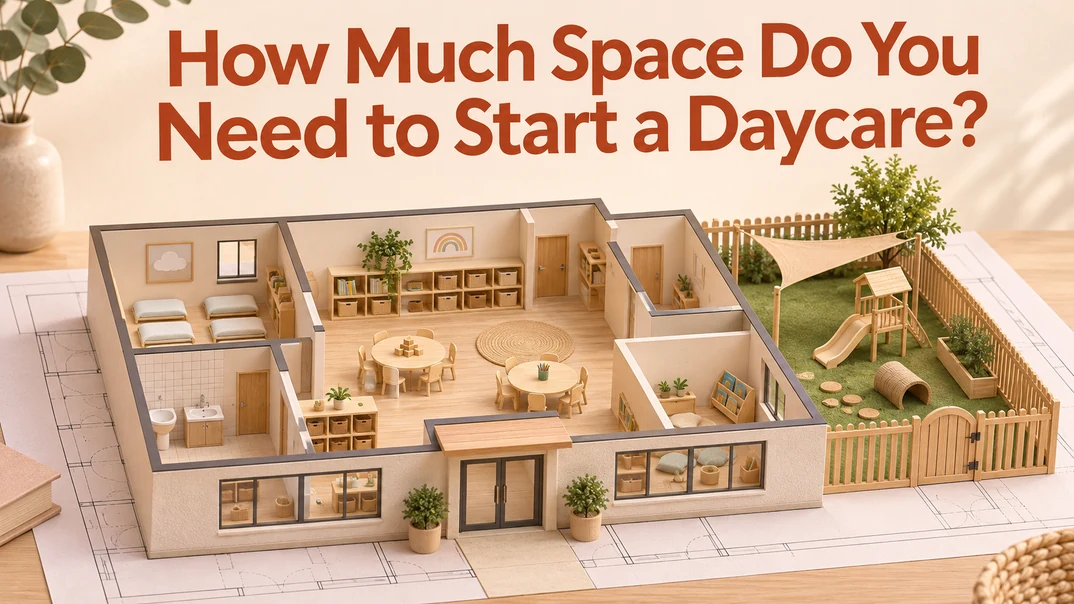
The size and layout of your property will directly affect how many children your centre can accommodate. Under the National Regulations, centre-based care must provide at least 3.25 m² of unencumbered indoor space et 7 m² of unencumbered outdoor space per child. These requirements are based on usable space available to children, not simply the total floor area or land size.
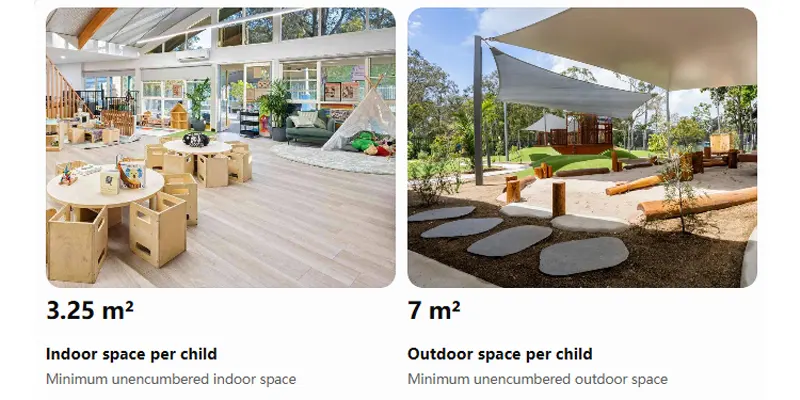
For indoor space, areas such as corridors, bathrooms, nappy-changing facilities, bottle preparation areas, permanent cot storage, staff rooms, and general storage areas are excluded from the calculation. The kitchen is also excluded unless it is primarily used by children as part of the educational program.
For outdoor space, car parks, storage sheds, unsuitable areas, and pathways that are not used by children as part of the educational program cannot be counted.
For example, if you plan to accommodate 40 children, the general minimum calculation would be:
- Indoor space: 40 × 3.25 m² = 130 m²
- Outdoor space: 40 × 7 m² = 280 m²
These figures represent the minimum unencumbered areas, not the total building or property size. You will need additional space for facilities such as toilets, kitchens, staff rooms, storage, and access routes.
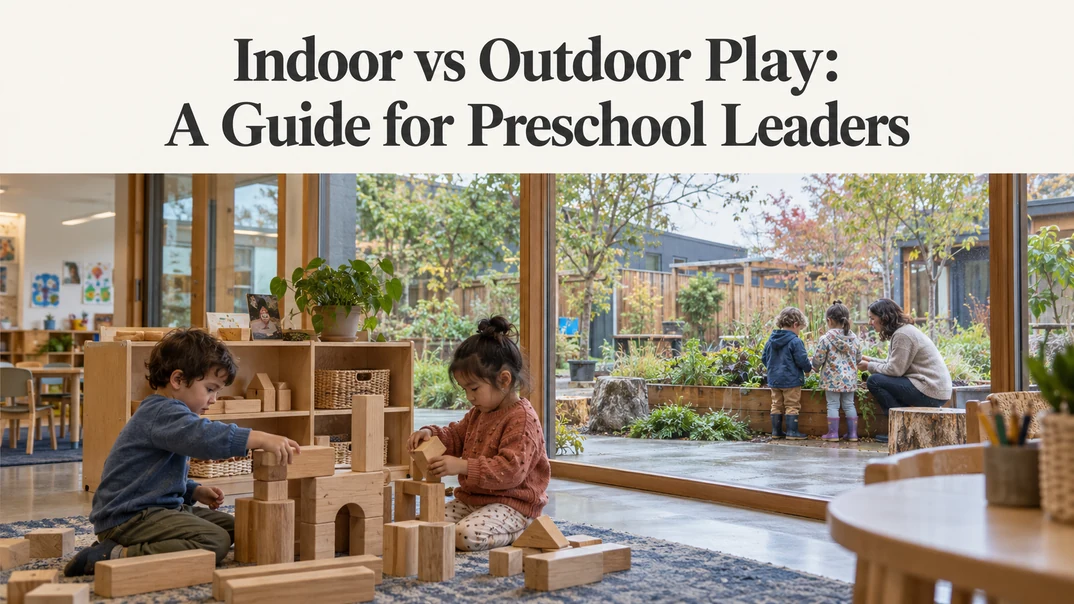
Outdoor space also needs to provide suitable opportunities for active play and contact with nature. Regulations 113 and 114 address natural outdoor environments and shade for centre-based services. When assessing a property, consider whether children can access shaded areas, natural elements, and different types of outdoor activities throughout the day.
You can find the detailed calculation rules in ACECQA’s guidance on physical environment requirements. Areas separately and assess the other restrictions affecting the site.
Consider Accessibility, Parking and Neighbourhood Needs
Meeting the minimum space requirements does not necessarily mean a property is suitable for a childcare centre. You also need to consider how children, families, and staff will use the premises every day.
When assessing a potential location, pay attention to these practical factors:
- Drop-off and pick-up arrangements: Parents need a safe and convenient way to bring children to and collect them from the centre. Consider vehicle access, parking spaces, pedestrian routes, and traffic conditions during busy hours.
- Accessibilité: Entrances, pathways, toilets, and learning areas should support access for children with different abilities and mobility needs. Consider how families using prams and mobility aids will enter and move around the centre.
- Natural light and ventilation: Classrooms should have suitable natural light and ventilation to create a comfortable environment for children throughout the day.
- Outdoor safety and shade: Check the condition of outdoor surfaces, boundary fencing, gates, shade structures, and potential hazards such as swimming pools or water features.
- Room layout and supervision: Classrooms should allow educators to supervise children effectively while providing enough space for different activities, quiet areas, and daily routines.
The National Quality Standard also requires indoor and outdoor environments to be fit for purpose, accessible, and supportive of children’s learning and development. A property with a large floor area may still be unsuitable if its layout makes supervision difficult or limits children’s access to different learning areas.
Obtain the Required Childcare Approvals and Licences
Before opening your childcare centre in Australia, you must obtain the necessary government approvals. These approvals are designed to ensure that childcare providers are suitable to operate, that their premises meet regulatory requirements, and that children receive safe and appropriate care.
Australia has two levels of government approval for childcare services: state or territory approval under the National Quality Framework (NQF), and federal approval under the Child Care Subsidy (CCS) system. Although these approvals are related, they serve different purposes and are assessed separately.
If you plan to operate a Long Day Care centre and allow eligible families to access CCS, you will generally need to complete three approval stages: Provider Approval, Service Approval, and CCS Approval.
Apply for Provider Approval
Provider Approval is the first stage of the National Law approval process. It establishes that your business or organisation is suitable to operate an education and care service in Australia.
You apply to the Regulatory Authority in the state or territory where your childcare centre will operate. Although the application is assessed locally, Provider Approval is recognised nationally, allowing an approved provider to apply for Service Approval in other Australian jurisdictions.
During the assessment, the regulatory authority considers whether the applicant and relevant people involved in managing the organisation are suitable to take responsibility for a childcare service. This includes examining:
- Legal entity and ownership: The organisation’s legal structure, ownership arrangements, and people responsible for its management.
- Management and governance: How the organisation makes decisions, manages responsibilities, and oversees its childcare services.
- Suitability of key personnel: Whether relevant individuals meet the required background and suitability checks.
- Knowledge of regulatory obligations: Whether the applicant understands the responsibilities involved in providing education and care under the National Law and Regulations.
You should prepare your business registration documents, ownership information, relevant background checks, and other supporting evidence before submitting the application.
Keep in mind that Provider Approval does not give you permission to open a particular childcare centre. It confirms that you are an approved provider and allows you to proceed with the next stage.
Apply for Service Approval
Once you have Provider Approval, you need Service Approval for each childcare centre you intend to operate. This approval relates to a specific premises and the type of education and care service you plan to provide.
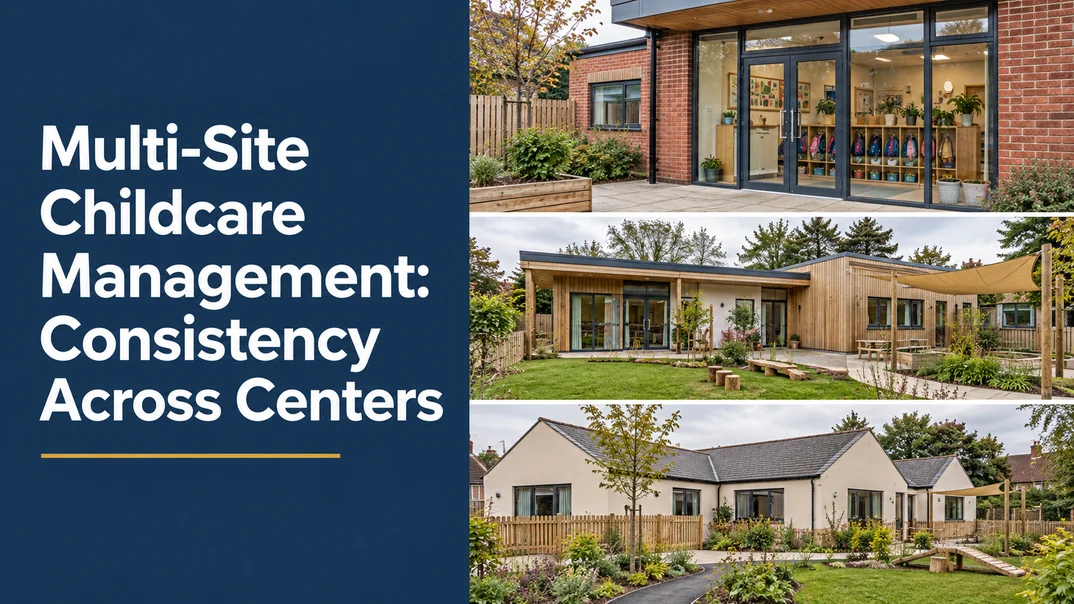
For example, if you establish two Long Day Care centres at different addresses, each location will generally require its own Service Approval, even if both operate under the same approved provider.
When applying, you will need to provide information about the proposed service, including:
- Service details: The centre’s address, operating hours, proposed service type, and intended operating arrangements.
- Nominated Supervisor: Details of the person responsible for the day-to-day management of the service, subject to the applicable requirements.
- Educational program: Information about how the service will support children’s learning and development through an approved educational framework.
- Staffing arrangements: Details of the proposed staffing structure and how you will meet qualification and educator-to-child ratio requirements.
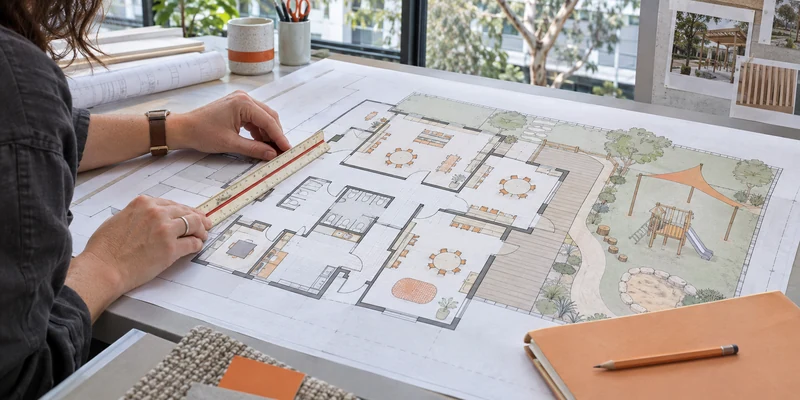
- Premises and facilities: Plans and supporting information demonstrating that the building, indoor and outdoor areas, equipment, and facilities meet the relevant requirements.
- Policies and procedures: Documentation covering children’s safety, supervision, health, emergencies, and daily operations.
The Regulatory Authority assesses whether the proposed service meets the requirements of the National Law and Education and Care Services National Regulations. It may request additional information, inspect the premises, or require changes before granting approval.
An important point: Provider Approval and Service Approval are not interchangeable. You need approval for the organisation as well as approval for the individual centre. Do not assume that securing a property or receiving Provider Approval means you can begin providing childcare.
Apply for Child Care Subsidy (CCS) Approval
In addition to state or territory approval, you need approval from the Australian Government if you want your childcare centre to administer Child Care Subsidy payments.
CCS is a government payment that helps eligible families with the cost of approved childcare. Once your centre receives CCS Approval, it can administer subsidy payments on behalf of eligible families, reducing the fees they pay directly to the service.
The Department of Education assesses CCS applications under the Family Assistance Law. This assessment focuses on whether your organisation is suitable to administer public funds and can meet the requirements associated with CCS payments.
You should be prepared to provide:
- Business and entity information: Your ABN, legal entity details, ownership structure, and relevant business documents.
- People with management or control: Details of individuals who have management or control of the provider, together with the required background checks.
- Governance arrangements: Information explaining how your organisation manages decisions, oversees services, and ensures compliance with Family Assistance Law.
- Financial and tax information: A Statement of Tax Record (STR) issued by the Australian Taxation Office (ATO).
- Service and banking details: Information about your centre’s operating hours, fees, inclusions, and the bank account used for CCS payments.
One requirement worth preparing for is the Statement of Tax Record (STR). Since 1 April 2025, new providers applying for CCS Approval must submit an STR as part of the government’s fit-and-proper-person assessment. The document must be issued no more than 30 days before the application date.
You should also understand that CCS Approval is separate from your National Law approvals. Having Provider Approval and Service Approval does not automatically make your centre eligible to administer CCS.
Understand the Application Process and Timing
Although the three approvals involve different assessments, you do not necessarily need to complete them one after another.
The Australian Government recommends submitting your National Law and CCS approval applications at the same time through the National Quality Agenda IT System (NQA ITS). This allows the relevant authorities to assess their respective applications in parallel and can help avoid unnecessary delays.
A typical application process looks like this:
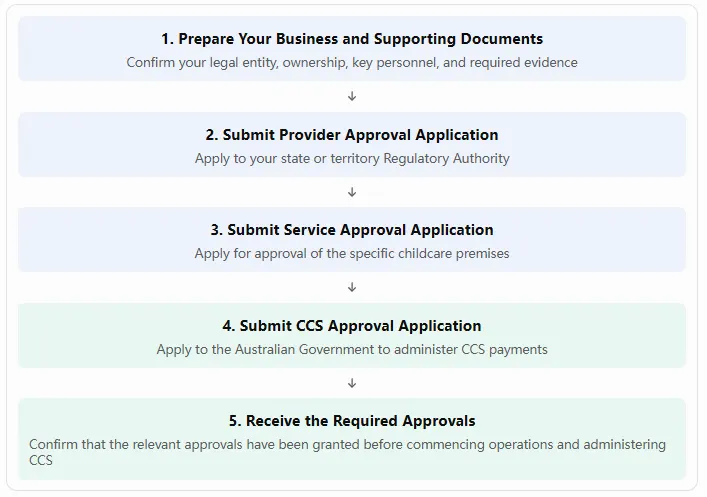
Before applying, you will need to register with PRODA, the Australian Government’s online identity verification system used to access the relevant services. You should also identify all people with management or control of the provider and prepare their required background checks.
There is no guaranteed processing time for CCS applications. The Department of Education assesses applications individually, and incomplete documents or requests for additional information can extend the process. Your state or territory Regulatory Authority can provide guidance on its own approval timeframes.
For this reason, start preparing your applications well before your planned opening date. Do not assume that submitting an application means your centre has been approved. You must also make sure that families understand the CCS status of your service if you are considering opening before CCS Approval is finalised.
Meet Staffing, Qualification and Child Safety Requirements
Your childcare centre needs qualified educators, appropriate staffing levels, and clear child safety procedures before opening. Australian regulations set minimum requirements for staff qualifications, educator-to-child ratios, background checks, and safety training.

Hire Qualified Early Childhood Educators
For a Long Day Care centre, you will generally need a combination of Certificate III-qualified educators, Diploma-qualified educators, and Early Childhood Teachers (ECTs).
Under the National Regulations, at least 50% of educators counted towards the required educator-to-child ratios must hold, or be working towards, an approved Diploma-level or higher qualification. The remaining educators must meet the applicable Certificate III requirements.
You will also need to appoint a Nominated Supervisor and ensure an appropriately authorised Responsible Person is present when the centre operates.
Childcare centre owners do not necessarily need an early childhood education qualification themselves, but the service must meet all staffing and management requirements.
Meet Educator-to-Child Ratio Requirements
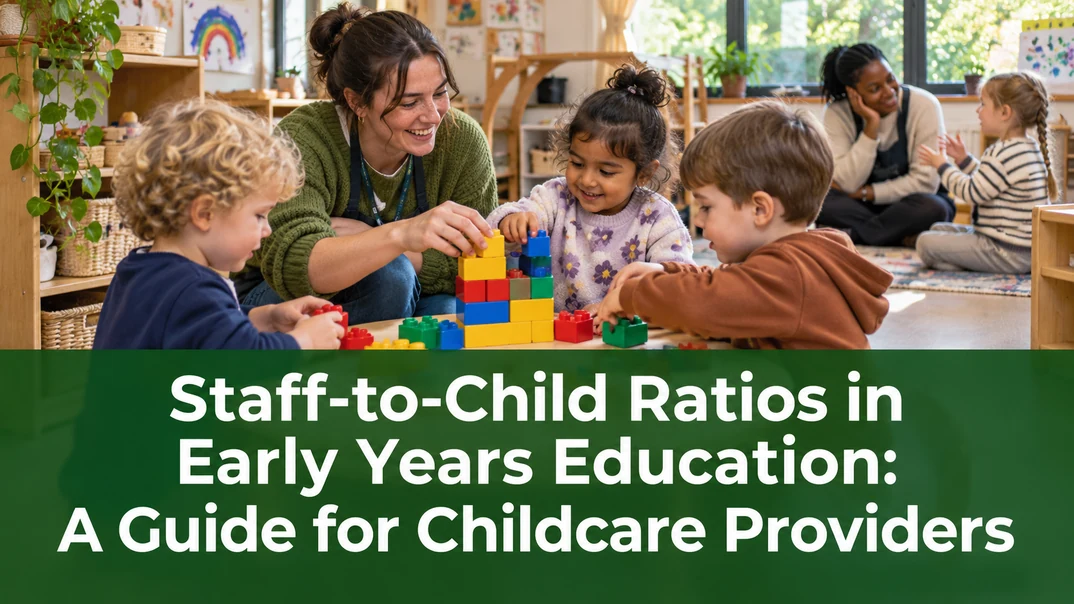
The minimum educator-to-child ratio depends on children’s ages and the state or territory where your centre operates.
For example, the general ratios include:
- Birth to 24 months: 1:4
- Over 24 months to under 36 months: 1:5 (Victoria generally requires 1:4)
- 36 months to preschool age: 1:10 or 1:11, depending on jurisdiction.
Complete Background Checks and Safety Training
All relevant staff must meet the child-related employment screening requirements in the state or territory where your centre operates. These are commonly known as Working with Children Checks (WWCC), although some states use different names and systems.
You must also ensure that the required staff hold current qualifications in:
- First aid
- Anaphylaxis management
- Emergency asthma management
In addition, educators and relevant personnel must complete applicable child safety and child protection training.
Design Your Childcare Centre and Prepare the Learning Environment
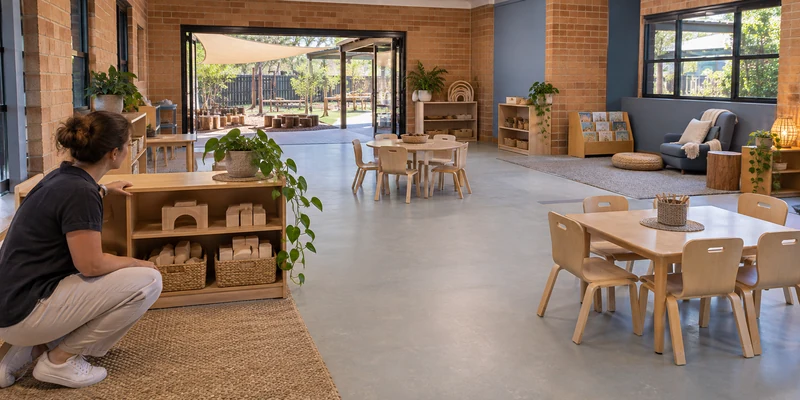
Plan Classrooms Around Children’s Age Groups
Different age groups have different needs, so avoid using the same classroom layout for every room. Plan furniture, activity areas, and storage around the children’s development and daily routines.
- Infant rooms: Include suitable cots, feeding areas, nappy-changing facilities, and safe spaces for crawling and sensory exploration.
- Toddler rooms: Provide low-level shelving, child-sized tables and chairs, role-play areas, and open spaces for movement.
- Preschool rooms: Include reading corners, art areas, construction play, group activity tables, and accessible learning resources.
Keep pathways clear and make sure children can access age-appropriate materials without unnecessary assistance. Educators should also be able to supervise activities across the room.
Choose Safe and Suitable Childcare Furniture
Furniture should fit the children’s age, physical development, and everyday activities. Before purchasing, consider:
- Size and accessibility: Tables, chairs, shelves, and lockers should be suitable for the children using them.
- Sécurité: Look for stable construction, smooth surfaces, secure fittings, and designs that reduce foreseeable injury risks.
- Durabilité: Choose materials and finishes that can withstand frequent use and regular cleaning.
- Practicality: Furniture should be easy to maintain, move when necessary, and organise around different activities.
Check that products are suitable for their intended use and comply with applicable Australian requirements. Do not assume that an overseas certification automatically demonstrates compliance with every Australian standard.
Prepare Your Policies, Procedures and Daily Operations
Before opening your childcare centre, you need clear policies and procedures to guide daily activities and ensure consistent care. Australian childcare services must follow the National Law and Regulations, covering children’s safety, health, supervision, and wellbeing.
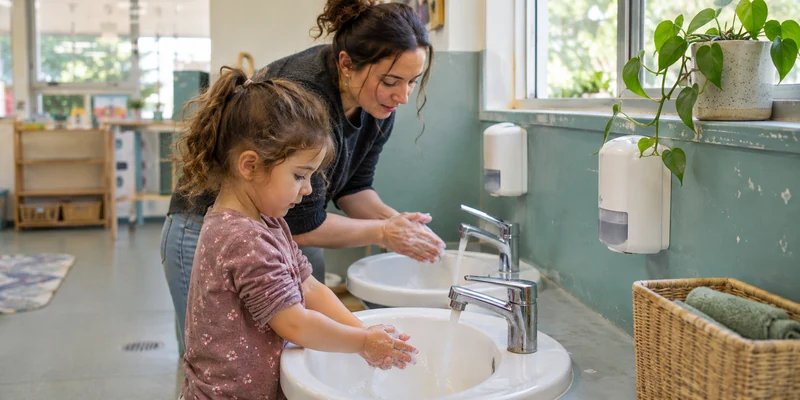
Prepare the following essential policies and operational procedures:
- Child Protection and Supervision: Establish procedures for supervising children, preventing harm, managing access to the premises, and responding to child safety concerns.
- Health and Hygiene: Set rules for handwashing, cleaning, illness management, medication, and infection control.
- Food and Allergy Management: Plan meals, manage dietary requirements, record allergies, and establish procedures for food preparation and handling.
- Sleep and Rest: Develop safe sleep and rest procedures appropriate to children’s ages, including regular checks and supervision.
- Emergency Procedures: Prepare evacuation plans and procedures for fires, medical emergencies, missing children, and other unexpected incidents.
- Enrolment and Family Communication: Establish processes for collecting children’s information, recording attendance, communicating with parents, and sharing updates about children’s daily experiences.
You should also prepare the required documentation, including enrolment records, attendance registers, incident reports, medication records, and staff information.
Your policies should reflect how your centre actually operates rather than simply copying generic templates. For example, sleep procedures should match the equipment and sleeping arrangements in your infant rooms, while supervision policies should consider the layout of your indoor and outdoor spaces.
Complete Your Final Inspections and Prepare to Open
Before welcoming your first families, make sure your childcare centre has received the required approvals and is ready for daily operation. Complete the necessary inspections, prepare your classrooms, organise staff, and confirm that all essential facilities and procedures are in place.
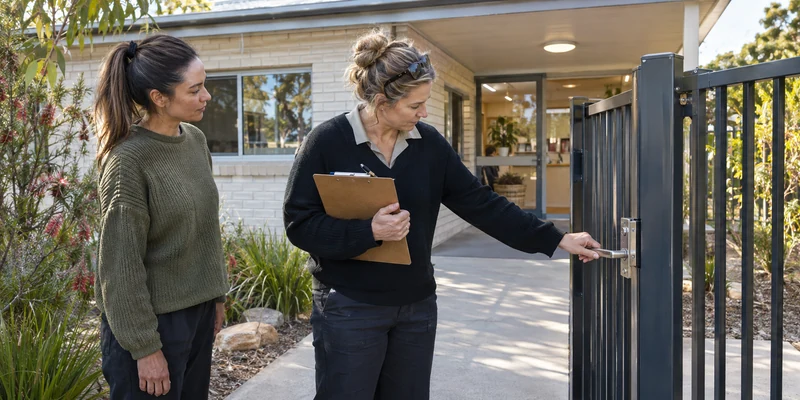
Complete Building and Safety Inspections
Check that the building, fire safety systems, emergency exits, fencing, gates, toilets, and outdoor play areas meet the applicable requirements. Make sure all required building and occupancy approvals are in place and that any inspections requested by the local council or Regulatory Authority have been completed.
Prepare Classrooms and Equipment
Install the furniture, toys, and learning materials needed for each age group. Check that tables, chairs, shelving, cots, and storage units are properly arranged and ready for use. Also inspect outdoor play equipment, rest areas, and hygiene facilities to ensure everything is safe and functional.
Organise Staff and Family Enrolments
Complete staff induction, confirm qualifications and background checks, and assign daily responsibilities. Prepare enrolment forms, attendance records, fee arrangements, and communication procedures, so families understand how the centre operates before their children attend.

How to Run and Grow a Successful Childcare Centre?
Opening your childcare centre is only the beginning. Once operations start, your focus should shift to maintaining service quality, supporting educators, and building trust with families. Regularly review your centre’s performance against the National Quality Standard (NQS), keep staff training up to date, and maintain your facilities and learning resources.
Listen to feedback from parents and educators, monitor enrolment and operating costs, and make improvements as children’s needs change. A well-managed childcare centre should continue to provide a safe, engaging learning environment while building strong relationships with the families and community it serves.
FAQ
Does a Long Day Care centre have to operate all year round?
For a Centre Based Day Care service seeking CCS approval, the general minimum operating period is 48 weeks within a 12-month period. However, there is no nationally prescribed minimum number of operating hours per day or days per week under this particular CCS requirement.
Can I purchase an existing childcare centre instead of starting from scratch?
Yes. Buying an existing centre can save time on property preparation and initial setup. However, you must arrange the necessary transfer of Service Approval and apply for CCS approval under your own legal entity. The previous owner’s approvals do not automatically transfer to you.
Do I Need an Early Childhood Qualification to Own a Centre?
Ownership alone does not automatically require an educator qualification, but you must satisfy the applicable provider suitability and governance requirements. If you also work as an educator, teacher or supervisor, that role’s requirements apply. You remain accountable as the approved provider even when you employ an experienced director.
Can I Buy an Existing Childcare Centre Instead?
Yes, but purchasing the business does not automatically transfer every permission. Review its approval conditions, compliance history, lease, staffing commitments and financial records. Establish the required service transfer and CCS arrangements before settlement, and verify whether your intended changes need further approval.
Will My First Centre’s Approval Cover a Second Location?
An existing provider approval does not automatically authorise another centre. A separate new service needs its own service approval, and you must complete the applicable CCS process if you want to administer subsidy there. Confirm the requirements for the new location before committing to an expansion timetable.
Can I Open Only Some Rooms at First?
You may begin below the approved maximum where all operating requirements and approval conditions are met. Plan staffing and supervision for the rooms and children actually attending. Before opening more rooms, check whether the change affects qualifications, premises arrangements or requires an approval amendment.
What is the difference between a childcare centre and a preschool in Australia?
A Long Day Care centre generally provides extended care for children from birth to school age, while a standalone preschool or kindergarten focuses on early education for children before primary school. A Long Day Care centre can also offer a preschool program, but standalone preschool services are not automatically eligible for CCS.
Conclusion
Starting a childcare centre in Australia requires careful planning, from choosing the right business model and securing government approvals to recruiting qualified educators and creating suitable learning environments. Each decision contributes to the safety, quality, and long-term success of your centre.
With the right preparation, you can build a sustainable childcare business while providing children with a welcoming space to learn, explore, and grow. Xiha Kidz can help you plan and furnish your childcare centre with suitable furniture, educational resources, and customised classroom layouts.

 French
 English
 Arabic
 Italian
 German
 Spanish
 Thai
 Japanese