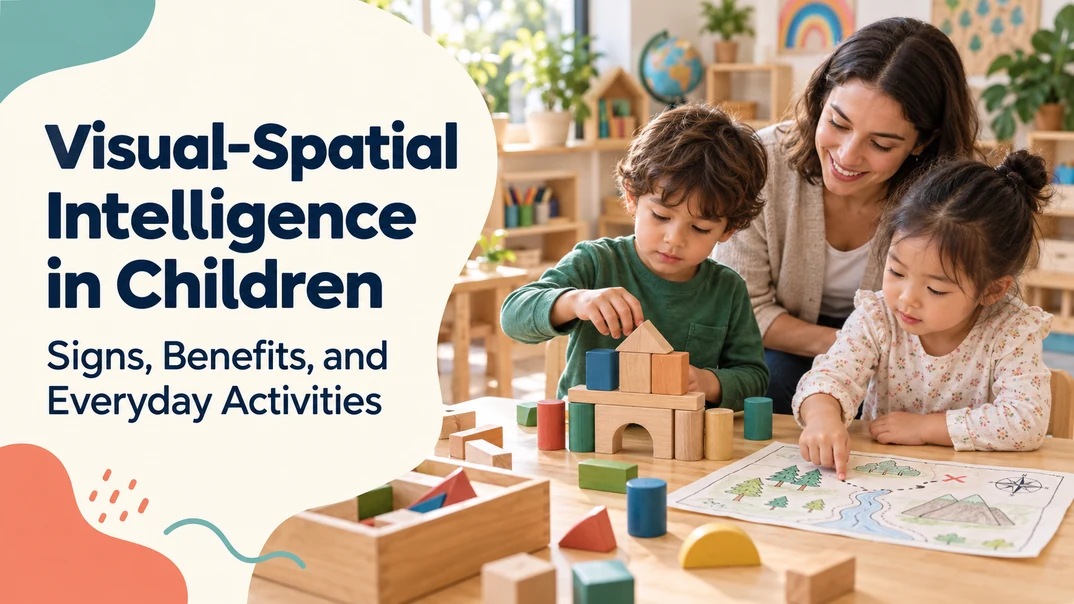
Visual-spatial intelligence is a child’s ability to notice, imagine, and change the relationships between objects, shapes, people, and places. In preschool, it appears when a child builds a stable tower, remembers the route to the playground, or explains that one object is behind another.
This ability is not a fixed label, and it is not the same as being “good at art.” In this guide, you will learn what visual-spatial intelligence means, how it differs from visual learning, what it can look like in young children, and how to build it through everyday classroom routines.
What Is Visual-Spatial Intelligence?
Visual-spatial intelligence is commonly discussed as one part of Howard Gardner’s theory of multiple intelligences. In that framework, spatial intelligence describes the capacity to think about objects and relationships in space, including how things look, fit, move, or appear from another angle. Harvard Project Zero explains that strength in one intelligence does not automatically predict strength in another, so a child who is spatially confident may show a different profile in language, music, or social interaction.
For early childhood practice, it helps to translate the broad theory into skills you can actually observe:
- Spatial perception: noticing where an object is, how far away it is, and how it relates to other objects.
- Visualization: forming a mental picture of something that is not directly in front of the child.
- Mental rotation: imagining how a shape or object would look after it is turned.
- Spatial relationships: understanding words and ideas such as inside, beside, between, above, under, near, and far.
- Visual-motor planning: using what the child sees to guide hands and body movements.
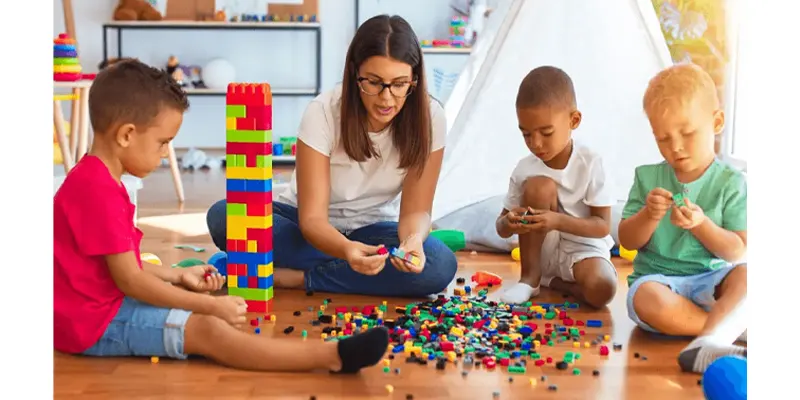
These skills work together. A child building a bridge with blocks is not only looking at colors and shapes; the child is estimating balance, comparing lengths, predicting what will happen, and adjusting the design after it falls.
Visual-spatial Intelligence Is Not the Same as Visual Learning
The two terms are often mixed together, but they describe different ideas. Visual-spatial intelligence refers to how a child understands and reasons about visual information and space. “Visual learner” is usually used as a learning-preference label, suggesting that a child learns best from pictures or demonstrations.
Do not divide children into permanent visual, auditory, or hands-on categories. Instead, offer more than one way to enter an idea: let children see a model, hear spatial language, touch the materials, move through a space, and explain their own choices. This gives every child more opportunities to build the skill without limiting what you expect from them.
Why Does Visual-Spatial Intelligence Matter?
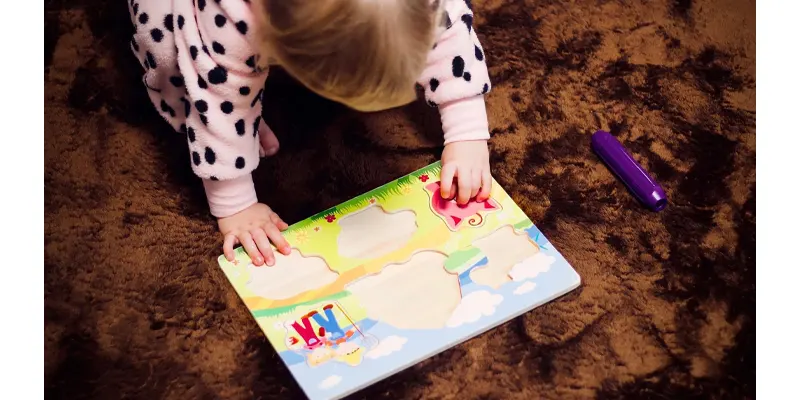
Children use visual-spatial skills in many parts of everyday life. They use it to navigate a room, judge whether they can squeeze through a gap, put on clothing, organize toys, follow a route, and understand how a drawing represents a real object.
It also appears in early mathematics. Children use it to compare size, recognize shapes, understand position and direction, and see how smaller parts form a larger whole. As learning becomes more complex, the same abilities support areas such as geometry, measurement, and other forms of mathematical reasoning.
Visual-spatial thinking also supports problem-solving. When children work out how pieces fit together, how to build a stable structure, or how to reach a destination, they need to observe, predict, and adjust their ideas. This helps them make sense of problems that cannot always be solved by following a fixed sequence.
As children grow, spatial skills continue to appear in drawing, construction, maps, science, engineering, and design. They give children another way to understand information, plan what they want to do, and connect what they imagine with what they see and create.
What Does Visual-Spatial Intelligence Look Like in Preschoolers?
There is no single behavior that proves a child has strong visual-spatial intelligence. Children develop unevenly, and interest is not the same as ability. Look for patterns over time rather than judging one drawing or one puzzle attempt.
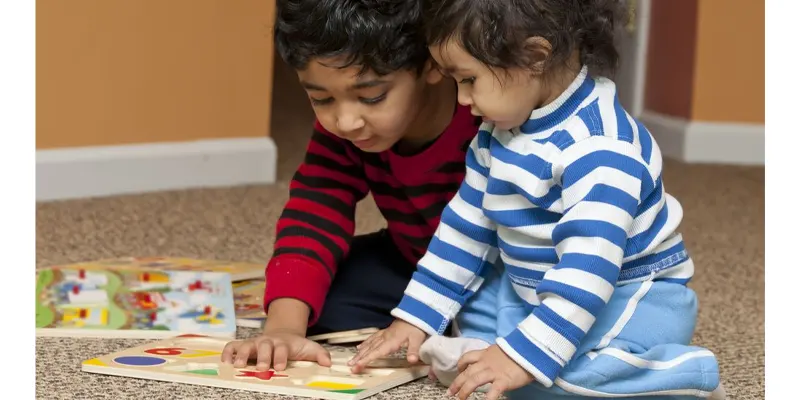
You may notice a child who:
- spends a long time building, arranging, or redesigning structures;
- turns objects in several directions before deciding where they belong;
- remembers routes, landmarks, or the layout of a familiar room;
- notices small differences in shape, pattern, orientation, or position;
- creates detailed drawings, models, collages, or pretend environments;
- understands instructions such as “behind the chair” or “between the baskets” and begins using similar words;
- estimates whether a block, body, or vehicle will fit in a space;
- enjoys mazes, matching games, puzzles, tangrams, building blocks, or construction materials;
- uses gestures, movement, or a quick sketch to explain an idea; or
- keeps testing a design after it does not work the first time.
A child who does not choose puzzles or drawing is not necessarily weak in this area. Some children show spatial thinking through climbing, arranging dramatic-play props, dancing through pathways, or remembering where materials belong. Observe the child across different materials and contexts.
10 Activities That Build Visual-Spatial Intelligence
The strongest activities are open-ended enough for children to make decisions. You do not need expensive equipment or a special “intelligence lesson.” Start with materials that children can move, compare, combine, and represent in more than one way.
1. Build from a Picture, Then Change the Design
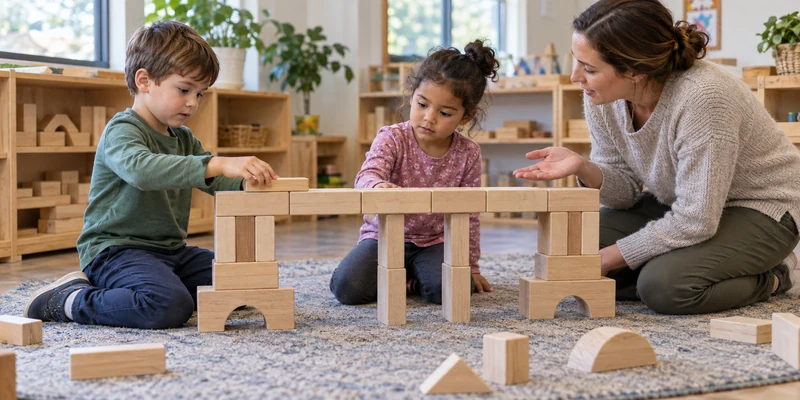
Offer unit blocks, cardboard pieces, or other construction materials and show a simple structure. Ask children to build something similar, then invite them to change one part: make the bridge longer, add another level, or create a second entrance.
Ask, “Which piece could support the top?” and “What changed when you moved that block?” The goal is not an identical copy. The goal is helping children compare a two-dimensional reference with a three-dimensional construction.
2. Rotate Puzzle Pieces Instead of Giving the Answer
Choose puzzles that are challenging but not frustrating. When a piece does not fit, avoid turning it for the child. Try, “What might happen if you turn it?” or “Can you look at the edge and find a matching curve?”
This builds mental rotation and visual discrimination. If a child needs a break, let the child work on a smaller section and return to the whole puzzle later.
3. Make a Map of a Familiar Route
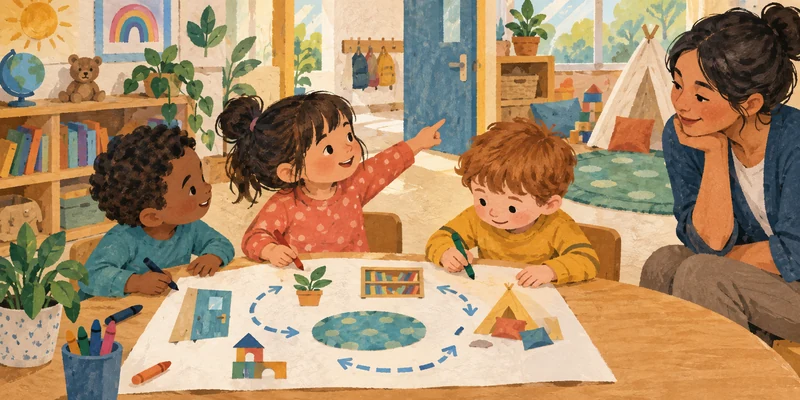
Invite children to draw a simple map from the classroom to the playground, from the front door to the book area, or from one part of the home to another. Use symbols, arrows, landmarks, and a starting point. Then walk the route and compare the map with the real space.
Young children do not need an accurate adult-style map. Their map may show a large tree, a favorite shelf, or a door in an unexpected position. Ask what each mark means and let the child revise the map after walking the route.
4. Play a Spatial-language Treasure Hunt
Hide a safe object and give clues using words such as under, beside, behind, near, and between. Start with one relationship and add a second when children are ready: “Look beside the low shelf, under the blue basket.”
Then let children give the clues. This turns receptive language into expressive language and shows you whether the child understands the relationship well enough to explain it.
5. Explore Pattern Blocks, Tangrams, and Shape Transformations
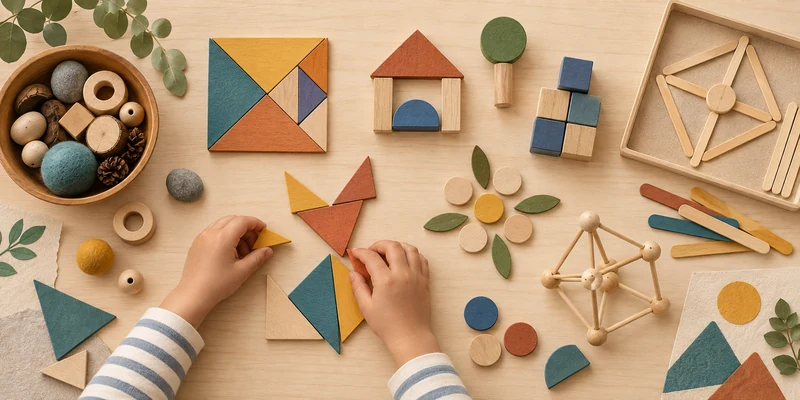
Give children pattern blocks or large tangram pieces and invite them to make a picture, copy a design, or create a shape that covers a marked space. Use precise but age-appropriate language: turn, flip, slide, corner, side, same, and different.
Do not rush to name every shape. First ask children what they notice and how they made the shape. You can introduce a word when it helps them describe or compare their work.
6. Copy a Simple Design and Make One Change
Place a few loose parts—such as craft sticks, buttons, shells, or wooden shapes—into a simple arrangement. Give children time to copy it, then ask them to change one feature while keeping another feature the same.
For example, “Keep the two triangles together, but move the circle to the other side.” This develops attention to position, working memory, and flexible thinking without turning the activity into a speed test.
7. Create a Three-dimensional Picture
Invite children to build a house, garden, road, animal habitat, or imaginary city with blocks and loose parts. Add paper, fabric, tubes, or recycled boxes so children can represent height, depth, entrances, and pathways.
When the model is finished, ask the child to show you around it. Questions such as “Where is the entrance?” “What is behind this part?” or “How do you get from here to there?” can help reveal how the child understands position, direction, distance, and relationships in space.
8. Design a Movement Pathway
Use floor spots, hoops, tape lines, cushions, or low balance materials to create a pathway. Let children follow it, describe it, and then redesign it. Add prompts such as, “Can you go around the hoop and then under the arch?”
Keep the route wide, stable, and easy for adults to supervise. Offer alternatives for children who do not want to climb, and focus on planning and spatial language rather than speed.
9. Draw an Object from More than One View
Place a familiar object on a table and invite children to draw what they see. Then move the object or ask children to look from another side. Compare the drawings without ranking them.
You can say, “The handle was hidden from your first place. What can you see now?” This helps children understand that the same object can look different from different viewpoints.
10. Use Real Routines as Spatial Problems
Everyday jobs offer some of the most useful practice. Ask children to fit lunch items on a tray, organize books by size, place materials back on labeled shelves, or decide how many chairs will fit around a table.
Use questions instead of correcting immediately: “Where could this go so everyone can reach it?” and “What needs to move to make space?” Children learn that spatial thinking is useful beyond a worksheet or a designated center.
How Can Teachers Support Visual-Spatial Intelligence in the Classroom?
Teachers do not have to create a separate “spatial lesson” for children to use these skills. Visual-spatial intelligence can be supported through the way materials are arranged, the questions you ask, and the kinds of problems children encounter during normal classroom activities.
Make Materials Visible and Reachable
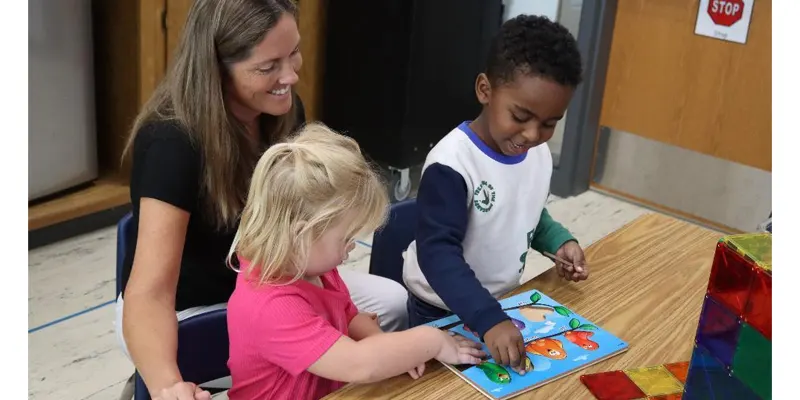
Use low, stable storage so children can see the choices and return materials independently. Keep enough open floor area for building and movement, while maintaining clear adult sightlines and safe pathways. A room can be visually attractive and still be difficult to use if shelves block views or every material is tightly packed away.
When you plan a construction or map activity, think about the complete experience: where children will collect materials, where the work can stay in progress, how finished pieces will be documented, and how the space can be reset without destroying children’s ideas. These practical details are part of good early-learning environment design.
Use Spatial Language During Real Conversations
Pair words with gestures and objects. Say “the truck is under the ramp” while pointing, then invite the child to repeat or demonstrate the relationship. Use a variety of words instead of relying on “over there” or “this one.”
Useful prompts include:
- “What is beside your building?”
- “How could we make this path shorter?”
- “Which part is inside, and which part is outside?”
- “What do you think we will see from the other side?”
- “Can you show me another way to fit these pieces together?”
Plan for Both 2D and 3D Experiences
Children need to move between representations. A flat drawing can stand for a real room; a block model can stand for an idea; a map can guide a real journey. Rotate between pictures, objects, body movement, and spoken explanations so children learn that one idea can be represented in several forms.
Offer More Than One Way to Represent an Idea
A child may understand something spatially before being able to explain it clearly in words. Drawing, building, arranging loose parts, using gestures, or making a simple model gives children different ways to show what they understand.
For example, after talking about a familiar place, you might let children draw a route, build it with blocks, or arrange objects to represent where different things are located.
Let Children Solve Spatial Problems for Themselves
If a structure falls or a piece does not fit, avoid fixing it immediately. If an adult fixes a design too quickly, the child loses the opportunity to plan and revise. Stay close for safety, but give children time to try, notice, and explain. Offer a small prompt rather than a full solution.
Give Children Time to Revisit Their Work
Visual-spatial skills often develop through adjustment rather than through a correct first attempt. A child may rebuild the same structure several times, change a drawing, or return to a model later with a new idea.
When possible, allow some work to remain available long enough for children to look again, make changes, and continue developing the idea.
How Do You Observe Progress?
Do not assess visual-spatial intelligence by counting how attractive a child’s drawing looks. Instead, document the process:
- How the child approaches the task: Do they look carefully before starting, compare pieces, or plan where something should go?
- How they respond when something does not work: Do they rotate an object, change the layout, rebuild part of a structure, or try another route?
- How accurately they understand space: Are they becoming better at judging position, direction, distance, size, or how objects fit together?
- How they explain their thinking: Are they using spatial words more clearly or showing you how different parts connect?
- How much support they need: Can they solve problems that previously required prompts or demonstrations?
For example, instead of writing “Lina is good at blocks,” write: “Lina noticed the bridge leaned, added a wider base, tested it with a toy car, and explained that the bottom needed to be longer.” That record tells the next teacher what the child can do and how to extend the experience.
Häufig zu vermeidende Fehler
The activity itself is only part of the experience. How you present it can either leave room for children to think spatially or turn it into a task with one expected answer. The following mistakes can reduce opportunities for children to explore, test ideas, and make their own spatial decisions.
Treating One Interest as a Permanent Label
A child may love puzzles one week and prefer dramatic play the next. Keep offering varied experiences and do not use a single activity to predict a child’s future abilities.
Choosing Pretty Materials Without a Clear Challenge
A beautifully arranged shelf does not automatically create spatial learning. Children need a reason to compare, plan, rotate, fit, map, or redesign. Ask what thinking the material invites and how you will give children time to use it.
Helping Too Quickly
Try a question, gesture, or partial clue before taking over. The child’s revision is often more valuable than a perfect finished product.
Confusing Difficulty with a Diagnosis
Occasional frustration with drawing, puzzles, or directions is common. If a concern is persistent and affects participation, movement, communication, or daily routines, share specific observations with the child’s family and follow your local process for consulting qualified professionals. Avoid diagnosing a visual, motor, or learning condition from classroom play alone.
Häufig gestellte Fragen
Is visual-spatial intelligence the same as being artistic?
No. Art can involve visual-spatial skills, but the ability also appears in construction, navigation, movement, sorting, map-making, and problem-solving. A child can think spatially without producing realistic drawings.
Can visual-spatial intelligence be developed?
Children can strengthen spatial skills through repeated, meaningful experiences. Evidence from early-childhood research supports hands-on manipulation, visual prompts, movement, gestures, and spatial language. Keep the activities playful and gradually increase the challenge instead of turning them into drills.
Should I call a child a visual-spatial learner?
Use the term carefully. It is more useful to describe what the child did—“she rotated the piece,” “he remembered the route,” or “they changed the structure”—than to assign a fixed learning type. Specific observations lead to better teaching decisions.
What are the best materials for visual-spatial development?
Start with open-ended blocks, puzzles, shape pieces, loose parts, drawing tools, paper, tape, hoops, and everyday objects. Choose materials that let children build, move, compare, represent, and revise. The adult’s questions and the time available matter as much as the material itself.
At What Age Do Visual-Spatial Skills Begin to Develop?
Visual-spatial skills begin developing very early. Babies already respond to movement, distance, faces, and object locations. As children grow, these early abilities become more complex through movement, play, drawing, building, and everyday exploration.
Should a Child Be Tested for Visual-Spatial Intelligence?
Usually, everyday visual-spatial ability does not need a separate test. Observation across different activities often gives teachers and families useful information about how a child approaches spatial problems. Formal assessment is more relevant when there is a specific developmental, learning, or educational concern.
Schlussfolgerung
You don’t need to separate visual-spatial development from the rest of early learning. The more useful question is whether children have enough chances to notice relationships, make choices, test ideas, and represent what they understand in different ways.
Your goal is not to identify which children are “visual-spatial learners.” Your goal is to create enough varied experiences so every child can strengthen these skills and use them with greater confidence in everyday learning.


 German
  English
  Arabic
  French
  Italian
  Spanish
  Thai
Thai  Japanese